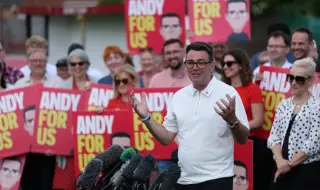
Andy Burnham is an inner-circle politician turned independent who is aiming to become Britain's next prime minister.
Fifty-six-year-old Burnham presents himself as a friendly, everyday guy from the North of England who prefers T-shirts to suits and ties, and in his free time plays football or plays 90s hits at DJ contests.
But he is also a seasoned politician whose career has taken him from high government positions to the mayorship of Greater Manchester and now to the threshold of the prime ministership. cabinet.
Burnham is expected to challenge Prime Minister Keir Starmer after winning a seat in parliament in a snap election he described as a "turning point" for British politics.
Burnham was born and raised in a small town in North West England, between Liverpool and Manchester. His father was an engineer for telecommunications company "British Telecom" and his mother was a receptionist.
Andy joined the Labour Party as a teenager, studied at Cambridge University and was first elected as an MP in 2001. He was an MP for fifteen years, gradually rising through the party hierarchy under Prime Minister Tony Blair and was a member of Prime Minister Gordon Brown's cabinet between 2007 and 2010.
Burnham twice ran for leader of the The Labour Party - in 2010 and 2015 - but both times suffered heavy losses and subsequently left parliament to run for mayor of Manchester.
During his term, he earned the nickname "King in the North" - a reference to the series "Game of Thrones", which reflects both his defense of the interests of his native region and his not-so-disguised political ambitions.
The nickname was imposed during the COVID-19 pandemic, when he sharply criticized Conservative Prime Minister Boris Johnson for what he called a "London-centric" approach to the crisis.
Burnham has led the Greater Manchester administrative region since 2017, and since then has seen rapid regeneration in the city, which was the birthplace of the Industrial Revolution. The city center is experiencing a real boom, and skyscrapers are springing up in place of abandoned industrial sites.
Many residents praise his efforts for the city. He brought the fragmented public transport system under public control, created the “Bee Network“ (a public transport system whose idea is that the regional authority sets routes and fares, rather than this being a decision of private partners – ed.) and improved its services.
His political views are considered more centre-left than Starmer's, something that brings him support from Labour Party members. He is also recognized as one of the best communicators among the party's members. In his previous leadership campaigns, he presented himself as a stiff speaker, while now he has developed a more casual image, dressed in jeans and unbuttoned shirts neck.
His three mayoral victories and his landslide victory in yesterday's by-election in the Makerfield constituency, where he defeated the anti-immigration Reform UK candidate Robert Kenyon, have cemented his reputation as a politician who knows how to win. Many in the party hope he can reverse Labour's sharp decline in popularity since Keir Starmer won the election by a landslide two years ago.
Burnham has promised to implement his trademark "Manchesterism" nationally - a policy that, as he likes to say, puts people and local communities before party interests and focuses on areas that have long been neglected by central government in London.
“What we have built in Greater Manchester must become national model“, Burnham said during his campaign. “I know what it means to transform entire municipalities“, he assured.
According to Tim Bale, a professor of politics at Queen Mary University of London, it remains to be seen whether Burnham can win support nationwide.
“When they call him “King of the North“, it somewhat raises the question, I think, of whether he can also be King of the South, of the East and of the West“, points out Bale. “Nevertheless, he seems to have that elusive “X-factor” that makes people perceive him not as an ordinary politician, but as someone who can communicate with normal people, speaks in understandable language and, to some extent, can overcome the deeply polarized ideological divisions that are currently causing serious problems in British politics“, notes Tim Bale.
Critics say that Burnham's political ideas are too vague and do not answer difficult questions, such as where the funds will come from to fulfill his promises. They also note that governing a country of 70 million people is very different from leading an urban region of 3 million.
However, Burnham is currently gaining momentum that could take him to 10 Downing Street.
“Andy Burnham is probably one of the most popular politicians in the country, although, to be honest, that is not much of an achievement”, notes Bale.
Translation from English: Deyana Hristova, BTA