Comment by Alexander Detev:
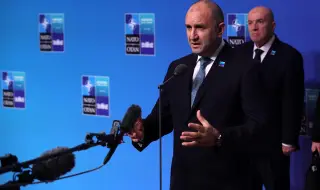
"Bulgaria's place is not there", said Prime Minister Rumen Radev, after announcing that he had rejected Emmanuel Macron's invitation for Bulgaria to participate in the meeting of the coalition of the willing in Paris. Where is it, Mr. Radev?
The leaders of Denmark, France, Germany, Italy, Norway, Spain, Sweden, Ukraine, the Netherlands and the United Kingdom met with representatives of dozens of other countries, including Moldova and North Macedonia, to discuss support for Kiev, joint military exercises and the defense of Europe from Russian threats. According to the Prime Minister of Bulgaria, the country does not belong there.
A symbolic gesture that will cause real damage
The leading European economies announced the creation of a "Missile Defense Coalition", guaranteeing "a missile defense architecture that will deter and counter future missile threats". What does this mean? Security, but also multimillion, possibly billion-dollar investments in the countries that participate. Bulgaria is absent again.
Radev claims that such decisions are made only in the context of the EU and NATO, and officially this is so, but the behavior of the Bulgarian leader in Paris has an important symbolic character. Because Europe's relations with post-war Ukraine and Russia are the elephant in every diplomatic and political room.
On the one hand, the Ukrainian army is considered the strongest and most effective in Europe, as recently confirmed by US Secretary of State Marco Rubio.
We are losing security and billions in investments
In this regard, the partnership with Kiev is of utmost importance for Europeans, who set themselves the main goal of guaranteeing their inviolability, expanding their military capacity in the coming years, and guaranteeing their protection from Russia, which does not stop with hybrid and military provocations towards NATO.
The agreement on cooperation in the field of security, which Andrey Gyurov's official cabinet signed, but Rumen Radev sharply criticized, is a symbolic step precisely in guaranteeing the Bulgarian army's access to Ukrainian capabilities and know-how.
Bilateral and multilateral European defense projects, the foundations of which are laid precisely at forums like the one in Paris, will guarantee billions of investments. Bulgaria, where in recent years the arms industry has generated over 4% of GDP according to data from the Ministry of Economy, can only benefit from its participation.
European investments in Bulgarian arms production have also been called into question. Recently, the Minister of Economy, Alexander Pulev, announced that the large-scale project of the German arms giant "Rheinmetall" in Bulgaria will be revised.
Finally, the post-war reconstruction of Ukraine is expected to be the largest project in Europe since World War II. It requires huge investments in infrastructure, energy and industry. And it will create great opportunities for European companies in construction, engineering, energy and information technology. Do you know who will not have a place there? Bulgaria, which at the moment when the Ukrainian army advances and turns the tide of the war, and European sanctions, together with the Ukrainian offensive, are bringing the Russian economy to collapse, is talking about ending military and financial aid to Kiev.
Where does Bulgaria belong, Mr. Radev? With those who are fighting in lines in front of gas stations?