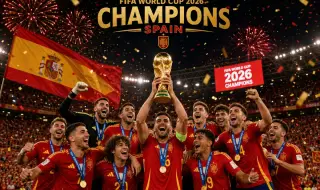
Spain is the new world champion and there can hardly be a serious argument about the merit of this title. Almost all major international media - from British analysts to the Spanish press and American publications - agree that in the final against Argentina it was the Spaniards who imposed their style, controlled the pace and deservedly reached their second world title.
However, this championship will go down in history not only for its football. It showed where the game is going - both in a sporting, political and commercial aspect.
Spain was the most complete team in the championship. Luis de la Fuente built a team that controlled the ball, pressed high, attacked with patience and almost did not allow the rivals to develop their own game. The final against Argentina was the clearest proof. The world champions from Qatar found virtually no way to oppose the Spanish organization and did not even manage to get a shot on goal in regular time.
Spain did not win just one match. They won the philosophical debate about what modern football should look like - aggressive, technical, dynamic and dominant.
Argentina reached the final with enormous character, but this time it was not enough. Lionel Messi had another strong tournament, but against the Spanish press his team seemed to be out of ideas. Enzo Fernandez's red card finally tipped the scales in favor of the Europeans.
Among the big disappointments is undoubtedly Germany. Even in the early stages, the Germans demonstrated a lack of character in crucial moments. The team had quality, but not the psychological resilience that had been their trademark for decades.
The pleasant surprise came from Norway. The team played bravely, without complexes and showed that it already belongs to the serious forces of world football. England and France also confirmed the preliminary expectations, reaching the final stages of the tournament, although they were unable to take the last step towards the title. Brazil, on the other hand, became one of the big disappointments, after once again failing to justify its status as a favorite.
The format with 48 teams and a total of 104 matches, which caused serious concerns before the start, actually did not turn out to be unsuccessful. The tournament offered more diversity and gave a chance to new football nations to show themselves on the world stage.
The ideas of FIFA President Gianni Infantino for an even greater expansion of the World Cup in the future seem far more controversial. More and more analysts are warning that such a move would dilute the quality and turn the World Cup into more of a business product than an elite football forum.
Commercialization is already being felt more and more strongly. Hydration breaks, introduced with the argument of high temperatures, are gradually becoming valuable advertising windows for television stations and sponsors. This is a trend that divides the football community - between the need to care for the health of players and the increasingly visible search for additional revenue.
The political background surrounding the tournament was no less worrying. The most serious scandal arose after the intervention of US President Donald Trump, who publicly asked Gianni Infantino to cancel the punishment of American international Folarin Balogun after his red card. The sanction was later indeed mitigated, raising serious questions about the independence of football institutions.
As for the refereeing, it was generally at a high level. VAR intervened successfully in a number of key situations, although individual decisions in the eliminations and disciplinary cases gave rise to lively discussions. It was the final that showed that even the best referees cannot completely avoid the tension in such matches, but on the whole, referees did not become the main actors - and this is always a good sign.
Ultimately, the 2026 World Cup will be remembered as the championship in which football once again produced a worthy champion. Spain did not just win the cup - it convinced the world that modern, attacking and intelligent football continues to be the surest way to the top.
But the championship also left an important warning. The World Cup is increasingly becoming a global political and commercial product. And the big challenge for FIFA in the coming years will be to find a balance between business, politics and the game itself, because it is football that must remain the real winner.