When FIFA President Gianni Infantino and US President Donald Trump took to the pitch for the awards ceremony, there was booing. Unlike last year's FIFA Club World Cup, this time Trump followed protocol not to intrude on the jubilant Spanish team. However, he did not leave the stage immediately, but remained next to the new world champion, and thus in the celebratory shots.
This final picture tells only part of the story of this World Cup. Beyond the political debates, the tournament in the United States has left its mark on American society, writes the German public broadcaster ARD.
Record TV ratings
Although soccer has long been one of the most popular sports among young Americans, it does not receive such attention among men. This time, however, record ratings were achieved in the United States for broadcasts of the tournament matches.
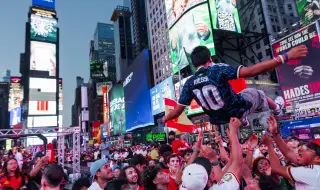
The enthusiasm was also visible off the screens: fan zones were full, restaurants were broadcasting the matches, people from all walks of life celebrated together. Political expert Peter Lodge from "George Washington" University sees this as the tournament's greatest success. "I hope Americans remember that we are at our best when we are together - in restaurants, bars and parks, with friends or strangers in public places", he tells ARD, while also reminding that politics does the exact opposite - it divides people.
High prices, but still full stadiums
The World Cup also showed that the worldview of many Americans and the policies of the US government do not always coincide, the expert believes. People in the host cities welcomed fans from a variety of countries and celebrated their cultures with them. "This further highlighted the gap between the American people and their president", he explains, giving the example of Kansas, where the Algerian team met with overwhelming support from the local people, and American brass bands played the Algerian national anthem.
Ticket prices were among the most controversial issues of this championship. Fans accused FIFA of depriving many people of the opportunity to attend the matches with dynamic pricing. However, FIFA data shows that more than 6.6 million fans attended the 104 matches, a new attendance record.
Inseparable Trump and Infantino
There is hardly another figure who has had as strong a political influence on the World Cup as Donald Trump - even though the final was his only appearance in a stadium, notes ARD. His closeness to FIFA President Infantino has become a symbol of a World Cup where sport and politics cannot be separated.
The case of American striker Folarin Balogun in particular has caused a storm of reactions. After Trump publicly stated that he had called Infantino and suggested a review of the player's red card, FIFA's disciplinary committee overturned the punishment. Whether the call really influenced the decision is unclear.
But even the suspicion of political influence undermines confidence in the world federation and, accordingly, in the tournament. "This call by Trump to Infantino in order to overturn a ban unfortunately confirmed a lot of what the world already thinks about him", Lodge commented on the case.
Historical conflict and war against a World Cup participant
The politically charged moments were not always connected with Trump. The semi-final between England and Argentina was accompanied by the historical conflict over the Falkland Islands. After the match, the Argentine players celebrated with a banner that recalled Argentina's claims to the archipelago.
Even more unusual was the situation around Iran. And during the tournament, the United States was at war with the Islamic Republic, which is an unprecedented case for FIFA. Iran even had to move its camp from the United States to Mexico, and fans waved the historic flag of Iran before the Islamic Revolution from the stands of the stadiums - a message against the regime in Tehran.
US immigration policy also had an impact on the World Cup - Somali referee Omar Artan, who was voted the best referee in Africa, was banned from entering the United States. The explanation was related to alleged links to a terrorist organization, but no evidence was presented.
This is perhaps the biggest contradiction of this year's World Cup - in the stands, fans from all over the world celebrated together, while outside the stadiums, wars, immigration policy and power issues dominated, writes ARD. However, according to Peter Lodge, the balance is positive: "Politics often suggests that we are radically different - in origin, religion or language. This World Cup has shown that we are at our best when we come together, have fun and make noise together."