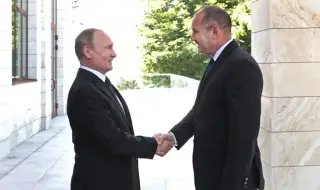
The latest foreign policy statements of the Bulgarian government seem contradictory, inexplicable and even humiliating - not only to the international, but also to the domestic audience. Vesselin Stoynev explains:
Is there a pilot in the government plane flown by Rumen Radev - or is the flight on autopilot? The latest foreign policy statements of the Bulgarian government seem contradictory, inexplicable and even humiliating - not only to the international, but also to the domestic public.
Bulgaria's withdrawal from the Coalition of the Willing and the redeployment of American tanker aircraft led to a serious shake-up of Rumen Radev's government.
A self-incriminating explanatory regime
The rulers entered an explanatory regime, and the explanatory regime is always perceived as evidence of guilt or error. There was no signature of Foreign Minister Petrova under the declaration in Kiev. But since such a document is not signed, what is she doing in Kiev at all, why didn't Radev go alone, along with the other prime ministers, after he was personally invited to Paris by President Zelensky? And why didn't he, like Serbian President Vučić, openly say "no" to the declaration? Are we also giving up on the Ukraine-Southeast Europe format (and North Macedonia, for example, is there), since the declaration provides for deepening cooperation in the Coalition of the Willing? Will there be a formal act of his "no" to leaving the Coalition of the Willing or is this again just a verbal statement, without a signature? And why on earth is North Macedonia there again, not to mention Japan and Australia?
What does not oblige us, can remain on paper
In fact, Radev loves this "legal pragmatism" - something that does not oblige us, we let it remain on paper. That was exactly his explanation on July 3 in parliament why he would not cancel the agreement with Ukraine signed by acting Prime Minister Gyurov - because it had no legal consequences, the document says to help according to our capabilities, but we already had no capabilities. And the fact that it says that they can help us make drones - it doesn't matter. Why on earth do the Americans yearn so much for Ukrainian drone know-how?
The explanation behind the "no" to the Coalition of the Willing, covered by Radeva's unchanging mantra "we are for peace", is also missing. It has not become clear what exactly Bulgaria gains from the Russian Patriarch Kirill, whom it saved from the sanctions list. But it is becoming increasingly clear what our country misses from participating in the new informal initiatives that open up opportunities for strengthening the common European defense and investments in our own defense, as well as for economic benefits from the post-war reconstruction of Ukraine.
The planes will still be here, but visas for the US will remain
Just two months later, the other "pragmatic move" also seems to have failed Radev - to demand the abolition of visas for the US in exchange for an extension of the stay of American tanker planes at Sofia airport. Now he is left with the formal justification again - that they will already be at the "Bezmer" military base, which is designated for joint use, but the decision will be made by parliament, and not, as in previous (regular and official) governments - by the military minister. Against which stands the equivalent formal response that the request was then formulated for NATO exercises, which is authorized by the minister, and now the US directly says that it is for their operations in the Middle East, which the National Assembly must decide on (nothing, because in the previous case the target was still Tehran, but the US never found combat allies in NATO for strikes on Iran).
Now Radev will quite legally hide behind a broad parliamentary majority, which would allow up to eight American planes and 250 military personnel to stay in "Bezmer" from July 24 to October 1. GERB and DPS have already declared that they will give their votes, and it is possible that DB and PP will do the same. But the ruling party remains with the difficult question of how the security of the country, which is now quite openly becoming a target of Iran, will be guaranteed, after the US says what our base is for. Will Radev ask Greece, as the State Security Service insists, to once again deploy the Patriot air defense system to the border to protect Bezmer and the country's territory?
"No" to the Missile Defense Coalition as well?
Which raises the question even more strongly whether Radev will say "no" to the newest European format - the Missile Defense Coalition, which currently includes ten countries, but is open to more willing parties. Its goal is to create an integrated system to protect Europe from ballistic missiles. The leading project here is the Ukrainian "Freya" system, as the basis for a cheaper and mass European-Ukrainian analogue of the American "Patriot". In the most paradoxical way, it may turn out that before the threat from Russia, Bulgaria was more threatened by Iran because of the base it provides to the US. Will Radev say "no" to the US, by making his parliamentary group reject the request for tanker aircraft in "Bezmer"? The American derogation for the "Lukoil" refinery in Burgas, however, it expires on October 29 - will the Americans then not provoke us into an oil Hormuz on the Black Sea coast? And Radev cannot hide behind his group on such an important issue - he will have to come up with a position in advance (if we even assume that it could be "no"), because otherwise he will disgrace himself as a leader.
On July 14 in Paris, when asked about the Missile Defense Coalition, the Bulgarian Prime Minister answered blanketly that all decisions on collective security in which we participate are made in the alliances in which we participate - the EU and NATO. But the EU and NATO are changing significantly and at an accelerated pace, and this transformation is now going through new formats such as the Coalition of the Willing and the Missile Defense Coalition. If Bulgaria passes, it will not be a full-fledged participant, but only a formal member of the old structures, in whose new content it fails to participate. And with that, it misses many opportunities to strengthen its own security and economic development.
When Europe has already been abandoned by the US, Radev spoke on July 20 to our ambassadors abroad that "Bulgarian diplomacy is called upon to find solutions, formulate positions, and defend them in various formats and in the alliances in which we are members". The same template for peace, just when Europe is preparing to secure peace through real actions for defense, and not with the phrases of a leader who preaches "national interest" without even trying to formulate it.
Where is the state plane flying?
The clumsy, proud-shy refusal (finally Bulgaria said "no") to join the new European defense initiatives undermines the trust of Russophile voters in Rumen Radev. They hear from him what he promised them, but they are left with the feeling of helplessness, because when you say "no", you must also be able to offer "yes". Otherwise, you find yourself in the role of a sergeant major who gave the command "On the spot, run!".
At the same time, the prime minister becomes an open target for flank attacks - by the democratic opposition, for being falsely pro-Western, and by the pro-Putin opposition, for being falsely pro-Russian.
In this managerial foreign policy uncertainty, many are left with the impression that the state plane is flying on autopilot in a direction away from Europe. The only question is where the control tower is.
This text expresses the author's opinion and may not coincide with the positions of the Bulgarian editorial office and the State News Agency as a whole.