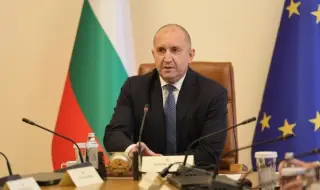
As president, Radev repeatedly said that aid for Ukraine could drag Bulgaria into a war with Russia. As prime minister, he allowed Bulgaria to be included in the logistical support for the US operations in the Middle East.
While talking about the threat of a tactical nuclear strike in Ukraine, Prime Minister Rumen Radev included Bulgaria in the logistical support for the US military operations against Iran.
As president, Radev repeatedly said that aid for Ukraine could drag Bulgaria into a war with Russia. As Prime Minister today, he explains that "the United States is a major security ally", that there has been a bilateral agreement between the two countries since 2006, and that is why American military transport aircraft must be provided with a base in Bulgaria.
The agreement allows for the joint use of four military facilities in Bulgaria, including the "Bezmer" base in the Yambol region, and the residence of up to 2,500 American military personnel.
By a decision of the parliament, eight American tanker aircraft and up to 250 military personnel will be stationed at "Bezmer" to logistically support US military operations in the Middle East. From February to June 30, Bulgaria has already allowed up to 15 American aircraft to use the civilian "Sofia" airport for logistical operations. In exchange for the stay, Sofia also received a 6-month derogation for the work of "Lukoil", which expired on April 29.
The decision also led to a protest note from Iran, in which Bulgaria was warned not to become an "accomplice in aggression".
Spain, unlike Bulgaria, refused to allow American aerial refueling planes to use its bases for the operation against Iran. After Madrid's decision, they were transferred to other American bases in Europe. And also unlike Bulgaria, Spanish Socialist Prime Minister Pedro Sanchez and his government have consistently supported Ukraine in its fight against the Russian aggressor with weapons and financial resources.
Criticisms of the position of "Progressive Bulgaria"
The parliamentary majority of "Progressive Bulgaria" (PB) approved the cabinet's proposal to base American aircraft in "Bezmer". Once again, the MRF group voted together with the PB deputies.
"On the one hand, the war is not ours, but on the other hand, relations with perhaps our most strategic partner are at stake." With these words, Petar Vitanov from "Progressive Bulgaria" explained the position of the ruling party.
The arguments of the government did not go without criticism from the parliamentary opposition. GERB-SDF, "We Continue the Change" and "Democratic Bulgaria" boycotted the vote on the aircraft. All three parties raised the question of how much the executive branch had provided sufficient information about the nature of the mission and the possible consequences for Bulgaria.
Social networks recall what Radev said a month before the April 19 elections, when he was the predicted winner: "Now they are lying to us that there is no direct threat or problem for Bulgaria from the strikes against Iran". In addition, he had stated that "the key to the stability of the Middle East is for Iran to give up its nuclear program", and since it does not want to do it voluntarily, "the solution is for it to be forced".
Rumen Radev does not simply follow Washington's line. He also determines when there is a risk of Bulgaria being drawn into war and when it fulfills its allied obligations. When it comes to Ukraine, the risk is presented as unacceptable. And with regard to the American operation against the Islamic Republic of Iran, the threat is now being explained as an inevitable price of allied relations.
Meanwhile, the risk to shipping through the Strait of Hormuz and the Red Sea has increased again after the latest series of American strikes against Iran and retaliatory attacks against US allies in the Gulf. The European Union has warned of a danger to commercial ships and civil aviation. The renewed military actions come against the backdrop of growing anxiety in oil markets, as transit through the Strait of Hormuz remains blocked and global stocks are at critically low levels, the "Financial Times" writes in its analysis. The price of the reference variety "Brent" reached $95 per barrel - the highest level in a month and a half, and increased fears of a new increase in fuel prices and additional inflationary pressure in Europe.
The fears in Yambol are not new
The decision on the American tanker planes has already caused resistance where the risk is not perceived as abstract geopolitics. A petition against their basing has been launched in the village of Bezmer, and local residents have declared their readiness for protests. The mayors of the five municipalities in the region - Yambol, Tundzha, Elhovo, Straldzha and Bolyarovo - have also opposed it with a declaration. According to them, using the base to support operations in an area of active combat creates risks. The mayors are refusing to make statements until Friday, July 24, when Defense Minister Dimitar Stoyanov will visit the region. Then they will hand him the petition.
Civil discontent against military allies is not the first in the region. Two years ago, locals also protested against the modernization of the "Kabile" military base to accommodate 2,000 soldiers of the NATO Multinational Battle Group. Strengthening the Alliance's eastern flank became a priority after the war in Ukraine.
The "Vazrazhdane" party actively campaigned against the deployment of the NATO brigade, as it would "threaten security in the region if the conflict in Ukraine expanded". Kostadin Kostadinov's party, known for its pro-Kremlin positions, even organized a protest in front of parliament.
What could be the consequences?
The contradictions in the positions of Rumen Radev and his team carry political risks. The strong criticism of military aid to Ukraine and the warnings that Bulgaria could be drawn into the war have turned him over to voters from "Vazrazhdane" and the Bulgarian Socialist Party. The weakening of these positions could cause a new "migration" in view of the presidential elections in the fall.
During the election campaign, Radev criticized the caretaker government of Andrey Gyurov for the 10-year defense agreement with Ukraine. He criticized it for "taking on long-term commitments on behalf of Bulgaria that increase the risks to national security", while Bulgarians do not expect "involvement in war". Only 40 days later, it became clear that Radev's cabinet would not cancel it.
However, the more significant problem is not in the change in political rhetoric. Bulgaria continues to navigate a radically changed security environment with a document from 2018 - when the National Security Strategy was updated. Since then, the world has gone through the COVID pandemic, Russia has started the largest war in Europe since World War II, and the EU has embarked on a course towards accelerated rearmament. And the United States is insisting that European allies take greater responsibility for their own security.
While the world rearranges its security architecture according to new threats, Bulgarian politicians continue to act opportunistically. The lack of a new national security strategy leaves without a convincing answer the question of why Bulgaria refuses to participate in the European initiative to build, together with Ukraine, a protective shield against Russian ballistic missiles, but without hesitation supports an American operation in the Middle East. Thus, some allied initiatives are presented as an unacceptable risk to national security, and others - as an obligation to the allies.
***
This text expresses the opinion of the author and may not coincide with the positions of the Bulgarian editorial office and the DW as a whole.