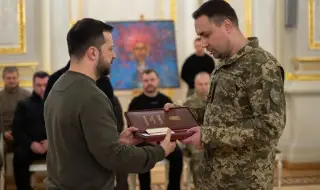
The newly elected Ukrainian commander-in-chief Mykhailo Drapati will cause problems for Russia, says security expert Nico Lange. According to him, Zelensky underestimated the generational battle in the army leadership.
"President Zelensky made what is known in tennis as an unprovoked mistake - he underestimated the large support that the replaced Defense Minister Fedorov has. His dismissal sparked protests, which demanded the resignation of the army commander-in-chief, Syrsky, instead of that of the defense minister. Zelensky reacted by appointing a new army chief. Behind all this is a conflict that has existed since 2014 - that between the different schools in the Ukrainian armed forces, German security expert Nico Lange told ARD.
"On one side are the younger commanders and soldiers who are closely connected to civil society. But on this side are also people from civilian life who before the war were doing something else - they were entrepreneurs or managers. They are used to making decisions decentralized, want to be independent, act very quickly and are open to new technologies - that is one culture. The other is the old school - the post-Soviet military in Ukraine, who value orders and obedience, as well as centralized structures. As a rule, they are not so open to innovation and technology. The protests have exacerbated this conflict. "With the appointment of General Mykhailo Drapati, Zelensky chose a person who is more on the side of modernization," explains Lange.
The expert does not deny that the dismissed General Sirsky achieved successes in the war - if we consider, for example, the Kursk Offensive or the attempts to isolate Crimea. But he is also said to care too little about the soldiers - he is reproached for holding certain cities for too long, as a result of which heavy losses were suffered. "In fact, it is not so easy to evaluate his work", admits Lange and notes that the changes in the leadership of the army are not fundamental - Drapati was previously the deputy chief. And it cannot be assumed that the appearance of Ukraine's army depends only on the personality of the commander-in-chief.
A new phase for Ukraine in the war
As for Zelensky's personnel changes, Lange says that on the one hand his reaction is good, but on the other hand there is the question of to what extent the opinion of civil society or veterans will affect the president's future personal decisions - this will be seen in the coming weeks and months. "However, the decision to replace Syrsky is by no means a manifestation of absolute power or Zelensky's ability to impose himself. Some even say that everything has become too centralized. The president has a strong position in the war and it would probably not be bad to have some opponents."
Security expert Nico Lange explains to ARD what is expected of the new commander-in-chief and what changes he can make. "For several weeks, Ukraine has entered a new phase of the war, as it is able to attack and put pressure on Russia both in the south, near Crimea, and deep inside the country with drones and its own weapons systems. This already applies to ships in the Sea of Azov and around Crimea in the Black Sea. Drapati will certainly expand this approach. Because Ukraine's greatest hope is to use pressure, especially deep strikes, to cut off Russian cash flows from fuel sales, to shake Putin's system and force him to think about at least a partial ceasefire and start talks."
A battle of two different generations
Lange is convinced that the choice of Drapati will have a positive impact on the way Ukraine fights the war. There is also something important: "Drapati is 42 years old, and the Russian commander-in-chief Valery Gerasimov is 70. So it turns out that this is a battle of two different generations. This will reflect the doctrine, the structure, the use of technology and the flexibility."
"I think this is bad news for Russia, as are the comments of the Russian experts on the subject. They are very respected by the new Supreme Commander of Ukraine", Lange concluded to ARD.
The German public media also quoted military analyst Denis Popovich, according to whom Drapati faces major challenges. "One of them is the possible Russian offensive in the Chernihiv region. And there is also the possibility of partial or full mobilization in Russia in the fall. In addition, there are problems with mobilization in the Ukrainian army."
What is expected of the new commander-in-chief?
ARD also describes what hopes for real reforms are associated with Drapati: commanders to take responsibility for mistakes, to communicate honestly and talk about unpleasant truths, resources to be distributed fairly, and so-called micromanagement to be stopped.
For his part, former Ukrainian Defense Minister Fedorov emotionally welcomed the appointment of Drapati, whom he called "new hope": "Now the high expectations of Ukrainians must be justified with a clear vision of ending the war for independence, strong command, and decisive actions aimed at preserving the lives of our soldiers, robotizing the front, delivering asymmetric strikes, and exhausting the Russian economy," Fedorov wrote on Telegram.