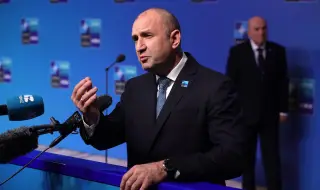
Rumen Radev certainly knows the saying that whoever tries to sit on two chairs at the same time falls to the ground. But he obviously prefers its continuation - that if you put a third one, you can go to bed.
The new government's foreign policy represents a series of mixed signals to both partners and outright opponents of Bulgaria on the world map.
The unsuccessful attempts at maneuvering and the contradictory messages do not stop this week against the backdrop of the re-escalating situation in the Middle East, the relentless exchange of blows between Russia and Ukraine, and the ongoing reformatting of NATO and military alliances, within which regional partnerships are becoming increasingly significant.
In Ukraine, unconditional peace, in the Middle East, war may also occur
Military aid to Ukraine has been a thorn in Rumen Radev's side since his second term as president. After taking office, he and his Defense Minister Dimitar Stoyanov loudly announced an end to aid to Kiev, not bothering to refute the false suggestion that this aid had once been free. A fact that the Defense Ministry itself confirmed to the State Duma.
This was followed by a fierce defense of the Russian Patriarch Kirill and businessman Vagit Alekperov from EU sanctions, with the addition of billionaire Iskander Makhmudov, who was key to the Sofia metro, to their names. And while for Bulgaria's partners these claims can be considered standard arm-twisting, which has been seen before, the ensuing cacophony around the rejection of the invitation to participate in the so-called "Coalition of the Willing" by Radev in Paris and the adoption of a declaration in support of Ukraine in Kiev with the participation of Foreign Minister Velislava Petrova could not have gone unnoticed. Because Radev and Petrova repeatedly entered into a clear contradiction - both with their words and actions.
The first diplomat categorically stated: "Bulgaria clearly shows that it works entirely within the context of the European Union and NATO". However, her pathos means practically nothing - in what other context should Bulgaria, which has been a member of the European Union for nearly 20 years and of NATO - for 22, work? Who is this message addressed to anyway?
The attempt to confuse the pro-Russian voters of "Progressive Bulgaria" so much that they would not be angry that the new government has not reversed the geopolitical direction of the country, has failed. And in none other than eight huge military aircraft.
"Our main ally" and "good relations"
The permission for the Bezmer air base to be used by American aircraft for the US operation in the Middle East provoked sharp reactions from both the opposition and PB voters, who rushed to collect signatures against this decision. Radev immediately argued: "The US is our main security ally". Iran also reacted and sent a note to the Bulgarian Foreign Ministry. The prime minister's response? "We value our good relations with the Islamic Republic of Iran."
Yes, the US continues to be the strongest partner in NATO and yes, Bulgaria maintains trade relations with Iran. But in these statements by Prime Minister Radev, something much more serious is evident - a lack of any vision and understanding of Bulgaria's foreign policy and geopolitical positioning. To say that you value your good relations with an authoritarian regime, which this year also massacred thousands of its citizens in public squares, is, to put it mildly, a manifestation of bad taste. To define the USA from the parliamentary rostrum as your most important ally, while Donald Trump sharply attacks NATO allies, and Europe has placed its main emphasis on armament and emancipation from American dependence, is counterproductive. It is even more losing not to join a number of formats that would guarantee additional investments in Bulgarian defense and would position the country as an important ally on NATO's Eastern flank and in the Black Sea region, as happened during Radev's visit to Paris. Unfortunately, from the Prime Minister's rhetoric, it seems that he himself does not have a clear position in his head on global alliances and conflicts such as the one in the Middle East. This is worrying because it speaks of amateurism, which is unacceptable because Bulgaria is a crossroads, not an island - in a direct and figurative sense.
For the EU, these positions are not a big drama, for Bulgaria they are a huge missed opportunity
For Europe, this uncertain foreign policy of Bulgaria is not a big problem. The latest package of sanctions passed without Alekperov, Patriarch Kirill and Makhmudov. The Greek claims to support the package turned out to be even more serious. And all this is incomparable to the scale to which Viktor Orban reached to twist the arms of Brussels and the allies.
The declaration in Kiev was also adopted with the support of Bulgaria. Serbian President Aleksandar Vučić, for example, refused to have his country included in it. Velislava Petrova has obviously not taken such a step.
The problem of Bulgarian foreign policy is rather internal. Because the lack of a clear and categorical positioning as a full member and ally in NATO and the EU closes doors. The misunderstandings surrounding the statements of Petrova and Radev about Ukraine and of Economy Minister Aleksandar Pulev regarding the key investment of "Rheinmetall" in Bulgaria creates distrust. Because whoever sleeps on three chairs risks missing out on all the opportunities.