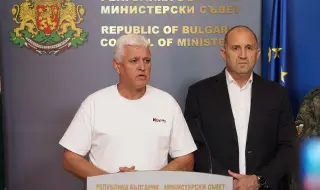
Comment by Emilia Milcheva:
Prime Minister Rumen Radev announced with such a gloomy expression about a drone that had invaded Bulgarian airspace that if it weren't for the white T-shirt of the Minister of Defense, we would have thought there was an air attack. In unusual attire for such a briefing, Defense Minister Dimitar Stoyanov explained that the drone was carrying a significant amount of explosives and, due to its small size and low altitude, was not detected by either Romanian or Bulgarian radars.
Political drama
The device entered from Romania and exploded in a sunflower field just a hundred meters inside Bulgarian territory. There were no injuries or material damage. However, the location is about a kilometer from the Bulgarian compressor station of the Trans-Balkan gas pipeline and about 200 meters from the Romanian one. Gas passes through the pipe from Turkey, through Bulgaria, Romania and Moldova to Ukraine.
According to the initial analysis of the Ministry of Defense, it is most likely a decoy drone "Maya" used by the Ukrainian armed forces. The department explicitly emphasized that there is no evidence that the incident was intentional. The more visible the state's helplessness was before the explosion, the more blatant the demonstration of control became after it. Radev convened the Security Council at the Council of Ministers, and the Foreign Minister expects Ukrainian Ambassador Olesya Ilashchuk today in connection with the incident.
The incident is undoubtedly serious. For the first time, an aerial drone passes unnoticed across the land border and explodes on Bulgarian territory, and near strategic infrastructure.
How many more cases were there
But there were other cases of downed drones or their remains. In the first 7 months of 2026 alone, several aerial and sea drones and parts of them were found on the Bulgarian Black Sea coast - near Burgas, Sinemorets, Elenite, Kranevo and Albena. Some contained explosives and ammunition and were destroyed by the naval forces. According to photos released by the Navy, the device near Kranevo was recognized as a Russian naval drone, reported “Sega“.
For the alleged Ukrainian drone near Kardam, the Ministry of Defense has not published photos of the wreckage. And Kardam is not the first case in which the Bulgarian military has identified a drone that reached the country as Ukrainian. In December 2025, the Navy announced that the fleet had destroyed two Ukrainian naval drones near Bulgaria. At that time, the information was presented as part of the fleet's operational assessment - without the Security Council and the Ukrainian ambassador's invitation.
Now the government has rushed to bring the Ukrainian trail to the forefront, and at the same time it became clear that there is no evidence that Bulgaria was a target. The latter was confirmed in Varna by the Chief of Defense Emil Eftimov, as well as the Ukrainian side.
Preventive measures without result
The threat was not unexpected. It turned out that at the end of July, after the series of Russian “Shahed“ drones entered Romanian airspace, Bulgaria re-based air defense and aviation forces and assets to the northeastern border and strengthened radar surveillance. However, the device near Kardam went unnoticed. Preventive measures did not yield results.
Admiral Eftimov admitted that conventional radars are not effective enough against small drones flying low. Specialized systems can detect them at a distance of only 4-5 kilometers, which leaves minimal time for identification, transmission of information and destruction. Therefore, the defense is not limited to the purchase of the seven new three-coordinate radars, the delay of which was indicated by the Prime Minister.
Bulgaria is working with several companies to build capabilities to counter drones, Eftimov also announced, without naming them. At the end of July, Radev spoke with representatives of the American company Axon about the possibilities of producing drones and anti-drone systems together with Bulgarian companies.
Other countries use allied aid for protection from drones
A project for anti-drone systems is also planned under the European SAFE mechanism, and in October Bulgaria is to host a NATO experiment, also open to Bulgarian companies.
While Bulgaria talks about future projects, Romania is using allied aid as a temporary bridge to its own anti-drone defense. The Ministry of National Defense presented a summary of the incidents on the Romanian border since the beginning of the war in Ukraine. There have been 33 incursions of Russian drones into national airspace, and after a Russian drone crashed into a residential building in Galati in May, injuring two people, Bucharest presented NATO with a detailed list of capabilities it needs.
Italy has deployed four Eurofighter jets and about 180 troops, while Spain is sending seven F-18s, a tanker plane and three helicopters for anti-drone operations. The allies are also discussing expanding radar coverage along the 650-kilometer border with Ukraine.
Romania has changed its law. From May 2025, drones that enter without permission can be taken under control, neutralized or destroyed by national or allied means after assessing the threat and risk to people. In late July 2026, Romanian F-16s exercised these powers by shooting down three drones on three consecutive days.
Bucharest has ordered 24 mobile "Skyranger" systems and has U.S.-supplied "Merops" autonomous interceptors. Romania has launched a framework program to acquire "Spyder" systems with a maximum value of around 2 billion euros, with the first contract already signed.
Poland is investing approximately 3.5 billion euros in 18 mobile anti-drone batteries. Neither country has found a radar that sees everything. They are building a multi-layered system of sensors, jamming, cheap interceptors, guns and missiles and using allied support until their national capabilities are ready.
Against this background, the Kardam incident raises a question that the Bulgarian government does not raise: if the device had been detected in time, who would have authorized its destruction, with what means and under what rules of engagement?
Attention, geopolitics!
The origin of the drone is important for the investigation. However, for political use, the initial analysis turned out to be sufficient. Sofia pointed out that the device was of a type widely used by the Ukrainian army, and it was this reaction that brought to the forefront the Russian and pro-Russian media. Their headlines reported on a “Ukrainian drone“ that exploded near a gas pipeline, and on the Ukrainian ambassador recalled by Sofia. The Russian state publication “InnoSMI“ even wrote that Kiev denied “having deliberately struck the Balkan country“ - a suggestion of a possible Ukrainian attack, which is not contained in either the Bulgarian assessment or the Ukrainian response.
The Ukrainian media referred to the Bulgarian version, but their emphasis was on the lack of intent and Kiev's willingness to cooperate in clarifying the case. The Ukrainian Foreign Ministry did not officially confirm that the device belonged to Ukrainian forces.
And after the cabinet demonstratively demanded explanations from Kiev, a high-ranking representative of the Russian Foreign Ministry praised Radev's cabinet for its "more restrained" and "more rational" rhetoric towards Russia and the war in Ukraine. According to Yuriy Pilipson, the next step is for Bulgaria to reduce its dependence on the "Brussels bureaucracy."
The Bulgarian government's moves so far do indeed give grounds for Russian praise. The cabinet stopped providing weapons to Ukraine, and the defense minister explained that Kiev needed "more people, not more weapons." Radev declined an invitation from French President Emmanuel Macron to participate in the "Coalition of the Willing" and presented the decision as a contribution to peace. Thus, Bulgaria remained outside the joint work of nine European countries and Ukraine on integrated missile defense. In addition, the government threatened to block the 21st package of sanctions against Russia if the Russian patriarch and two Russian billionaires were not removed from it in the name of “Bulgarian interest”.
The drone that exploded near Kardam showed a breach not only in the Bulgarian sky, but also in the vision of security. The state is not ready for the threat, but it indicates where it comes from.