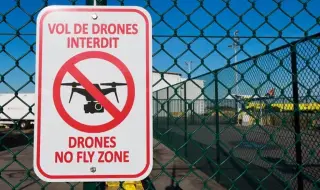
How did a drone loaded with explosives manage to reach Leipzig airport and remain unnoticed for so long? This case made it clear that Germany's drone protection has major weaknesses. What about other European countries?
The dramatic case at Leipzig airport showed that Germany's drone protection is not as effective as it should be. Interior Minister Alexander Dobrint announced that he would pay special attention to the topic, he spoke of a “hybrid scenario“ in which “foreign forces“ are involved. The main suspicions fell on Russia, including because the drone was found near a Ukrainian cargo plane.
Germany: more than 1,000 drone flights in 2025
The fact that the explosive-laden drone managed to reach the airport represents a new level of danger. And it is actually not new at all. The Federal Criminal Police Office registered more than 1,000 suspicious drone flights in 2025 - such as at Munich Airport last October. On this occasion, security expert Nico Lange told DW: “We do not have the necessary sensor networks and sensor beams to detect all types of drones, especially those that fly low and slowly“.
The finding is similar by UAV DACH, a large European organization for unmanned aviation. “The fact that a drone can reach an airport unnoticed and be discovered there by chance reveals the essence of the problem.“ That is why the organization is insisting on real-time monitoring of the lower sector of the airspace, as well as on mandatory electronic marking of all participants in the airspace via a radio system.
Interior Minister Dobrint, for his part, wants to unite efforts and information from the police, secret services and the Bundeswehr so that lethal aircraft can be detected in a timely manner and the reaction is not delayed. It is also planned to increase the protection of airports from drones.
Russia's neighbors have the most experience with combat drones
In terms of protection from larger combat drones, the countries that border Ukraine or Russia have the most experience – such as Poland and Lithuania, notes ARD.
The German public media writes that drones such as the Russian “Geran“ are used in the war against Ukraine as kamikaze-type machines. If they appear over the territory of a NATO country, in the event of an emergency, their trajectory must be calculated as quickly as possible in order to assess how great a threat they pose to people or to important and strategic objects. Then either aircraft, most often of NATO partners, take off and take on the task of destroying the drone, or defense is taken over by ground-based anti-aircraft systems.
NATO central intelligence systems are installed in Poland and Lithuania. Both countries have experience in dealing with constant threats on their borders. In September 2025, for example, several Russian drones entered Polish airspace, many of which were shot down by NATO aircraft, and some crashed to the ground. NATO described the defense against drones as “largely satisfactory”.
However, when it comes to smaller drones, similar to those discovered in Leipzig, there are European countries that are much better prepared than Germany, ARD points out.
France is an expert in early detection, the British in defense
France is a country that has been paying attention to possible terrorist attacks with small drones, respectively – to defense against them, the German public media writes.
In the event of an imminent danger, state authorities have the right to electronically intercept drones or even destroy them. For the 2024 Olympic Games in Paris, France has established its own airspace surveillance system that can distinguish officially registered drones from others. In addition, France has moved from a state monopoly in the field of drone protection to a mixed model - large airports have the right, under certain conditions, to shoot down drones themselves, including with the assistance of private companies, ARD reports.
The United Kingdom has achieved success in practical defense mainly due to the distribution of responsibilities in this area between the criminal police, the army and local authorities. The criminal police are assigned a leading role, and the military is involved only in "particularly dangerous cases". Clearly defined powers ensure adequate reaction time between recognizing the danger and eliminating it.
The largest training center for drone defense is in Austria
The largest training center for anti-drone defense is located in Austria, and it was not created by the state, the military or the police, but by a private company. The center is located in Köttingbrunn in Lower Austria and is at a level that many police departments in Europe would also like to have, the German public media outlet points out. It emphasizes that practical training for personnel is extremely important and that there is room for improvement in this regard.
Germany lacks such facilities, lacks a unified picture of the situation, as well as practical rules for action in cases like the one in Leipzig - it is unclear whether it falls within the competence of the federal police, the local police, the Bundeswehr or other state authorities, and who has the right to shoot down the drones. Germany is not well prepared, ARD notes, but adds that it is not alone. The EU defines the defense capabilities of its members as “in need of improvement”. And NATO is calling on partners to “optimize drone detection and defense capabilities as quickly as possible“.