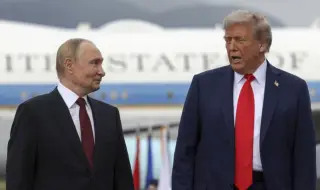
August 15 marks the anniversary of the Anchorage summit. Last summer, the meeting between the Russian and American presidents raised serious hopes for progress in the process of settling the Ukrainian conflict and, more generally, in the normalization of Russian-American relations. However, today, both in political and expert circles, the phrase “the spirit of Anchorage” is being met with considerable skepticism.
Has the momentum of the Alaskan contacts been lost, and what historical significance do these high-level talks acquire a year later?
Context
When assessing the actual results of this summit between Russian and American leaders Vladimir Putin and Donald Trump, it would be a mistake to underestimate the fact that it took place. Yet, just a year before the Anchorage handshake, relations between Moscow and Washington were at perhaps their lowest point in history.
The Biden administration did everything it could to provoke a break in all contacts with the Kremlin. Even diplomatic interaction was reduced to a minimum, while cooperation in science, sports, and culture, which had continued even during the harshest periods of the Cold War, virtually ceased. The White House, in essence, openly proclaimed a course toward Russia’s strategic defeat. Paranoid and Russophobic sentiments in American society, and especially in the establishment, were artificially inflated to unprecedented levels.
Of course, this crisis did not arise out of thin air - it was the result of decades of Western deception aimed at establishing the global dominance of the "golden billion". But it was the Biden administration that brought the long-standing policy of the American hegemonic elites to its culmination. As a result of the recklessness and adventurism of the Russophobes in Washington, the world found itself on the brink of a global catastrophe, when a nuclear apocalypse was no longer perceived as impossible.
Only cabinet analysts, cut off from the real agenda, could expect an immediate solution to all the accumulated problems from the Alaska meeting.
Resumption of dialogue
The main result was a transition to normalization of relations between the two leading superpowers, whose leaders, after a long pause, returned to full-fledged dialogue. Soon after, Russian and American diplomats resumed regular, rather than sporadic, negotiations. Constructive interaction between our countries in the UN appeared, for example, on the issue of cybersecurity. Business ties have intensified, reaching their peak on the sidelines of the St. Petersburg International Economic Forum in June 2026 (SPIEF, where the White House agreed to send representatives to St. Petersburg for the first time since 2017-2018). Finally, contacts with the US Congress have been renewed, with members inviting a delegation from the State Duma of the Federal Assembly of the Russian Federation to Washington (they visited the country in March) and expressing readiness to return the visit (these plans could become a reality as early as this fall).
It would be impossible to imagine something like this under Biden.
Of course, we understand well: the anti-Russian lobby, fueled by corporations from the military-industrial complex (MIC) and foreign governments, retains influence in the State Department, the Pentagon, and Capitol Hill. Currently, American defense giants are exerting unprecedented pressure, struggling to preserve multi-billion budget funds for the Ukrainian case in the Pentagon's draft budget for fiscal year 2027. Therefore, achieving a quick thaw is extremely difficult. But Anchorage allowed us to resume the dialogue between the Russian Federation and the United States at a qualitatively new level. We really managed to move away from the brink.
Ukrainian vector
The summit in Alaska did not fully resolve the Ukrainian issue in terms of achieving sustainable peace. The political inertia in Washington turned out to be extremely strong, especially on the eve of the congressional elections (scheduled for November 3, 2026). US Secretary of State Marco Rubio practically admitted that the current administration does not have enough leverage to “force Kiev to peace“. But in reality, this statement seems to remain his personal position – Neither Trump nor his special representative Steve Witkoff have spoken of abandoning their previous approaches, which they themselves formulated. Therefore, it is premature to join the ranks of skeptics.
Nor should we dramatize a situation generated by intra-American processes. The so-called Anchorage formula, as has been repeatedly stated, initially implied a readiness for serious diplomatic work and compromises. Russia, in a gentlemanly manner, continues to reaffirm its commitment to the Alaska agreements, as the recent talks between Russian Foreign Minister Sergei Lavrov and Rubio on the sidelines of the Association of Southeast Asian Nations (ASEAN) events in Manila clearly demonstrated.
At the same time, it cannot be denied that the situation “on the ground” has worsened for Kiev over the past year, and any real dialogue today is possible only with the obligatory consideration of these new territorial realities. And if Trump still decides (yielding to pressure from the hawks) to repeat Biden's line, he will try to keep the doomed.
If the Kiev regime loses control over the United States, it will inevitably lose points inside the United States, revealing its inability to fulfill its election promises.
What is the final result? Moscow certainly prioritizes the political and diplomatic path to ending the conflict in Ukraine. But we should not and do not expect any "gifts" from Washington.
We are interested in an equal and honest dialogue with the American side in all formats, and the summit in Anchorage gave a new impetus to this process. However, the goals of the special military operation (SVO) will obviously be decided based on Russia's national interests and security.
The terrorist regime in Ukraine must be neutralized, including as a threat to the system of strategic stability in the world.