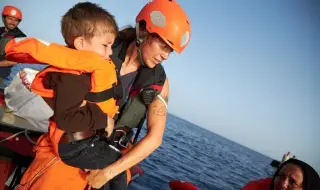
Several thousand underage migrants are still in the Spanish exclave of Ceuta. Many of them suffer from diseases and are subjected to sexual assault, and the authorities have no solution to the problem.
In the industrial zone of Ceuta at eight in the morning, instead of workers and trucks, what you see are mostly dirty blankets and homemade tents. Most of them are sleeping children and young people. It is estimated that between 3,000 and 5,000 underage migrants are still in the city. Many of them have been living on the streets for two weeks now, unable to find shelter in the overcrowded camps in the Spanish exclave.
There is no help for sick children
Amina (her name has been changed - editor's note) is 14 years old. The young Moroccan girl and her brother were among the 80,000 migrants who illegally crossed the Spanish border at the end of July. In the meantime, most have left the city again, but around 9,000 remain - among them many children and young people like Amina. "The worst thing is that we don't even have toilets", says the girl. "We have to go to the bushes, and I don't dare go there alone."
Right next to Amina is Malika, who has spread out several blankets for herself and her four children. The Moroccan says that as a cleaner in Morocco she earns seven euros a day. "This is simply not enough to support us. The school year will start soon, and we have no money for textbooks or decent clothes for the children." That's why the mother decided to join the mass crossing of the border to Spain after learning about it on social media. But now she doesn't know what to do. One of the children is sick. He has a high fever, and I can't get help from anywhere." That's why she tries to ease the child's suffering with water and vinegar.
Rape of minors is increasing
However, Malika is currently worried mostly about her daughters, aged 12 and 14, as she told DW. Over the past week, the number of sexual assaults in Ceuta has increased sharply. Meanwhile, the police are investigating at least 15 cases of alleged rape. And local authorities admit that there are many more.
Susana Asado, who works in the emergency room, has encountered many victims of rape in recent days. "Yesterday a 12-year-old girl came. She said that other migrants harassed her and touched her unpleasantly. She arrived very scared, crying. She was accompanied by a woman who found her on the street. It was she who saved the girl."
The doctor says that for her the current circumstances are difficult to bear. "Girls under 18 are particularly at risk at the moment. Added to this is the fact that there is currently a relatively large imbalance between female and male migrants here - this of course does not help."
Politicians are not united
In an exclusive interview with DW, a number of high-ranking representatives of the local authorities in Ceuta sound the alarm. Regional Minister of Health and Social Affairs Nabila Benzina has spoken of "the worst moment in Ceuta"'s history and is demanding more support from the central government in Madrid. "We need more police - especially for young women, but also for the protection of the population in general."
Her boss, Ceuta's regional president Juan Jesús Vivas, described the situation to DW as "high-risk", in which public services could be very difficult to maintain. "As for minors, we are currently 5,000 percent over our capacity. This means that no one can take proper care of them anymore."
Meanwhile, the central government in Madrid has announced that the minors will be distributed throughout the country in accordance with the law. But there is no concrete plan, and government officials have already warned that the distribution mechanism will take time. Many regions in Spain, governed by the far-right VOX party, refuse to accept migrants.
Is return an option?
The head of government of Ceuta mentioned another option to DW: "The minors must be reunited with their families, otherwise Moroccan social services will have to take custody of them." According to him, this is the only solution to the current crisis and therefore he demands that Madrid take "the appropriate legal steps".
But many of the minors say they do not want to leave Ceuta despite the difficult circumstances. Migrants, mainly from other African countries, have already started building makeshift shelters on the beach. Ibrahim, 17, from Sudan, told DW that he will not give up until he can provide a better life for his parents in his homeland. Amina, 14, is also not thinking about returning to Morocco. "The schools here are very bad. I want a different future for myself - I want to become an architect one day," she says.