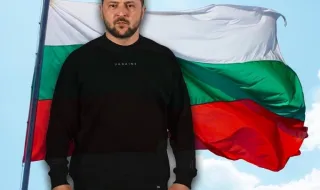
There is no greater risk for Bulgaria than this: Russia destroying the sovereignty of Ukraine. What is Radev's government doing to thwart it? Paradoxically, what the country is doing seems to rather support such a scenario.
From Daniel Smilov:
The war in Ukraine will determine Bulgarian policy in the coming years. If Russia manages to destroy the sovereignty of Ukraine, seize new territories and install a puppet government in the remnants of this country, Bulgaria will be faced with a radically different geopolitical situation. The changes would be twofold: first, there will be Russian troops almost on the Bulgarian border, which after a possible victory against Ukraine will have to be stopped directly by NATO, i.e. by Bulgaria as well. Secondly, a possible Russian success would lead to the strengthening of Putin's military dictatorship and its ability to undermine democratic regimes in Europe, i.e. in our country as well. The appetite of this dictatorship would grow significantly and no one could rule out new attacks against weakly protected countries, including those from NATO.
This is the greatest potential danger that the Bulgarian state has faced in the last nearly four decades of democratic, sovereign and free development. What measures is Rumen Radev's government taking to prevent (as far as it can) such a negative scenario? It is paradoxical, but what the country - governed by his three-month-old government - is doing at the moment seems to be rather helping this highly negative scenario to happen. The symbolic actions are undeniable and unambiguously clear - the Ukrainian ambassador was summoned to provide explanations for a drone that fell on our territory, while the Russian ambassador was not summoned to two similar incidents at the same time. For the 35th anniversary of Ukraine's independence, our government chose not to do anything at a high level. In general, Radev and his party members seem to shy away from even pointing out Russia as a danger to Bulgaria. More importantly, however, our country systematically takes the position that Ukraine should not be provided with military assistance, which for it is a sure path to losing the war. That is, the Bulgarian position in its pure form can be interpreted as follows: the sooner Ukraine loses the war, the better. For us or for the world - it is not entirely clear.
The moment is turning
At the same time, the war in Ukraine is at one of its turning points. On the front line, there is something like a mutual blockade with minimal movements in one direction or the other. But military actions are escalating both in the Donbas region and with missile and drone strikes on major cities and the deep rear of both countries. In these strikes, Russia has a serious advantage because Ukraine lacks resources to intercept missiles (Patriot systems and ammunition), and Kiev still does not have offensive ballistic missiles. However, the new thing in the last year is that with the limited resources at its disposal, Ukraine has managed to "bring" the war back to Russia's territory, including by striking the capital, Moscow. Ukraine even now has some advantage in drone warfare. It cannot compensate for Russia's missile power, but it creates major problems in logistics and fuel supply.
The moment is critical, because everything again depends on the partners' confidence in Ukraine's ability to withstand increased pressure, as well as on the tolerance and rationality of the Russians. Now they are beginning to realize that they are not achieving any visible successes, and the cost of the war is skyrocketing: in terms of casualties, destruction, and economic damage.
The question is who will be the first to lose faith that they will be able to withstand adversity. Putin is clearly willing to give almost anything for something he can call victory. However, Russians are not entirely sure that almost five years of sacrifices, which are gradually becoming comparable to those of World War II, are worth the conquest of Ukraine and the killing of so many people. (Total losses of servicemen in this conflict already amount to about 2 million people, while the USSR's purely military losses in World War II were about 8 million.)
For the fifth year now, the Ukrainians have shown that they can withstand enormous pressure, including indiscriminate bombing of cities and purely civilian targets. But belief in victory (in the sense of preserving territories and, above all, sovereignty) also depends on the belief and help of partners in Ukraine. For this, the so-called "Coalition of the Willing to Help" is of great importance, who promise and act to supply Ukraine with the necessary means. Great Britain seems to be leading at the moment, giving over 100 thousand of the most modern drones to Ukraine, as well as technology for producing its own ballistic missiles and air defense systems. The positions of Germany, France, the Scandinavian and Baltic countries are similar. Bulgaria demonstratively refused to participate and even the statements suggest that this coalition is "warmongers", while we are "fighters for peace".
Protection of Bulgarian interests?
So the question really is why, at this critical point in the war, Bulgaria is speaking and acting in the direction of a quick loss for Ukraine. What could be the reasons and how can this position even be presented as "protection of Bulgarian interests"? There may be many explanations, but none of them is particularly well-founded. And some of the possible explanations are downright frightening:
1. Bulgaria wants to help Ukraine, but does not have the means: First, this is not entirely true and the country has provided assistance over the years, sometimes critically important (especially in 2022). But even if it had nothing much to help with, Bulgaria should be very grateful to the others from the Coalition of the Willing, instead of criticizing them as "warmongers";
2. Bulgaria wants others to bear the cost, and it to benefit from the benefits of a possible Ukrainian success. This is possible, because if Ukraine manages to hold out, it will be both geopolitically advantageous for Bulgaria, and Bulgaria will have "saved money", and Rumen Radev will not offend his Russophile voters. However, this explanation is very offensive to Bulgaria, because it is absolutely unprincipled and petty - and destroys the trust of partners from Europe and the USA. Not to mention the eyes with which we will go to ask Bulgarian companies to participate in the reconstruction of Ukraine, which will be under the auspices of the EU;
3. Bulgaria wants Ukraine to lose quickly, because that way the war will end, and Russia will remain within the new borders, without looking at us or other neighbors. If this is the motivation of the "Radev" government, it is extremely short-sighted and dangerous. No one can guarantee what Putin's plans will be after a possible success. Moldova will probably be the first target, but provocations and actions towards NATO countries are not excluded. Anyone who excludes such a scenario is either incompetent or something else;
4. Bulgaria wants Ukraine to lose quickly, because in this way it can position itself closer to Vladimir Putin and rely on his favor in economic and military-political aspects. This also seems like a miscalculation and there are absolutely no guarantees for such a scenario. From 1941 to 1944, Bulgaria was not formally at war with the USSR, but this does not make Stalin more favorable to the country's ruling elite or itself. It has been conquered and ruled with an iron fist in a manner similar to that of other Eastern European countries;
5. Bulgaria likes Putin's regime and its actions internationally and domestically and therefore supports it. This is not a position worthy of anyone. If this is the possible motivation of the new government, it would betray a large part of its own voters, who are pro-European, democratic and free people.
The moral choices we make
These are the logical options and there seem to be no others. No one can hide behind "strategic uncertainty" for long, especially when it is quite transparent what can shine behind it. And there is another thing: every country is proud of the moral choices it has made throughout its history. The rescue of some 50,000 Jews in 1943 is an episode to which many in Bulgaria look back with pride. Will we be able to return to the present moment in decades with a positive sense of duty fulfilled, that we have done what we can for the benefit of freedom and democracy?
This text expresses the opinion of the author and may not coincide with the positions of the Bulgarian editorial office and the State Gazette as a whole.