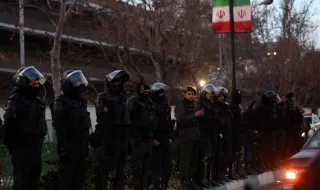
In January 2026, just weeks before the US and Israel attacked Iran, thousands of Iranians risked their lives by participating in nationwide protests against the regime. Growing dissatisfaction with the dire economic situation led people to take to the streets.
The security forces reacted harshly: units of the secret services, the "Basij" militias and the Revolutionary Guards confronted the demonstrators with batons and firearms. The scale of the repression caused international outrage. US President Donald Trump threatened military strikes and promised the demonstrators that "help is on the way".
But this help never came. The subsequent war between the US, Israel and Iran overshadowed the bloody suppression of the protests. Support for the Iranian population in their fight against the regime gradually fell off the political agenda.
There are no exact figures on the number of people killed and injured during the protests. According to Iranian authorities, the number of dead is 3,100. "Amnesty International", however, suggests that the number of victims is much higher.
The imposed internet blockade, repression and pressure by the regime on the families of the victims have lowered an information curtain over the events. The US-based organization "Human Rights Activists in Iran" has registered over 7,000 deaths.
Why did the victims not seek medical attention?
Seven months after the bloody events, many of the victims have permanent physical disabilities. Many of them are unable to work or complete their education.
One of the demonstrators, Masood (his name has been changed by the editors, as have the other names mentioned), was buried only a few days ago. During one of the demonstrations, he was hit by hundreds of bullets - according to his relatives, he was first wounded in the head, after which the security forces continued to shoot at his thighs.
Masood underwent many operations, his wounds constantly became infected and spread more and more. In his last days, he refused further medical attention. According to his brother, he was ashamed of having become such a burden to his family.
Masoud's fate is not an isolated case. Fear of arrest and insecurity in state medical facilities have forced many of the wounded to stay home for treatment, doctor and human rights activist Hamid Hematpour, who lives in Austria, told DW.
He says that due to the shortage of ambulances, some victims were transported in pickup trucks. There were also people who suffocated on the way to medical facilities, crushed by the bodies of other wounded. And the hospitals were overwhelmed, Hematpour points out. “In one Iranian city, in just two days, about 2,000 wounded people sought help at the only central hospital. And it only had 400 beds."
The security forces "shot to kill"
Hematpour believes that the number of injured is very high - their wounds are mainly from shots to the head, neck and chest, in the abdomen or in the limbs. Most of them are gunshots, including from automatic weapons. The targeted shooting to the head and chest is evidence that the security forces did not only aim to stop people, but wanted to kill.
Hematpour also testified that in some cases, after their ammunition ran out, the security forces used knives and machetes. The non-governmental organization “Iran House" has documented cases such as that of the schoolgirl Nagme, who lost one eye, the pianist Mina, who was deprived of the ability to move her fingers, and Milad, a runner who lost one leg.
The repression is not limited to active demonstrators - some of the injured did not participate in the protests at all, human rights activist Mahshid Nazemi told DW. People were shot at while they were in the market, standing in front of their shops or returning home.
Malla, 32, a mother of three, worked in the bazaar in Tehran before the protests. On January 9, when she tried to take one of her sons out of a crowd, the "Basij" militia opened fire on her and wounded her. Initially, she remained at home to recover, but after her wounds became infected, she was forced to seek qualified help from acquaintances.
Seven months later, the injuries to her right leg and wrist still prevent her from returning to work. "They shot to kill. It was better if they had killed me than disfigured me like this," the woman told DW.
Ashkan was 17 years old when he was injured. Before the protests, he worked in the bazaar in Tehran and trained as a goldsmith. When he joined the protests, he told DW, he believed that US President Trump would intervene and end the rule of the Islamic Republic. Ashkan recounts how a friend of his was hit by a sniper, losing one eye and his left leg. Ashkan still suffers from severe complications today, as there are still shrapnel in his head. "I have no future anymore," he told DW.
The regime does not stop the repression
The regime does not stop the pressure on the people of the January protests, and executions are also being carried out. In July and August alone, 12 people were sentenced to death in Isfahan. Authorities accuse them of being responsible for the deaths of four security forces during the demonstrations.
A UN report notes that since March 19, 2026, at least 56 people have been executed on national security charges. Among them are 27 participants in the January protests.
Author: Atefeh Chaharmahalian