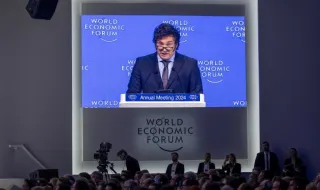
Javier Milley surprisingly made new claims for Argentina to the Falkland Islands. In doing so, he is counting on Donald Trump, but also on growing doubts about the extent to which the US would support its ally Britain.
For his address to the nation, Argentine President Javier Milley had chosen only one topic: Argentina's claims to the Falkland Islands, called the Malvinas by Argentines. This issue is very important for the self-esteem of the country, which in 1982 waged a war for the islands against Great Britain, which ultimately brought it heavy losses and failure.
“The Malvinas are Argentine - based on history and law. There is nothing to discuss”, said Milley. He denies the locals the right to self-determination and intends to impose stricter sanctions in the future on companies involved in oil extraction near the islands. The construction of a long-planned naval base on the southern tip of Argentina must be accelerated in order to strengthen its presence in the South Atlantic. The president also envisages the creation of a National Security Council, as well as the more serious inclusion of the Malvinas issue as part of Argentina's security policy.
Milley seizes his chance
There is nothing unusual in an Argentine president speaking like this. Buenos Aires has been demanding the return of the Falkland Islands since they were seized by Britain in 1833. For the British, this was a restoration of sovereignty, since they have had a military base on the islands since 1765, but for Argentina it was an annexation. However, Millay has so far avoided the traditional Argentine pathos in relation to the Malvinas. And for him, Margaret Thatcher, the British prime minister during the Falklands War in 1982, is one of the greatest political figures in history.
Only last year, Millay said that Argentina should become so successful that the islanders would one day voluntarily decide to become Argentines. Now, however, he defines them as an “implanted population” and denies them the right to self-determination. What happened?
Milley clearly believes in his chance to change something in the long-standing dispute in his favor. And this is mainly due to his most important international ally - Donald Trump, who may have opened the door to Milley in the dispute over the islands.
Is Trump planning a change of course?
When asked by a journalist whether the US intends to reconsider its position on the sovereignty of the Falklands Islands, the US president recently replied: “I always test every position. This is just one of many”. Although Trump does not explicitly support Argentina's claims to the islands, the ambiguity is significant.
On the issue of sovereignty, US governments have for decades not officially taken either London's or Buenos Aires' position, but they have recognized British administration of the islands. In 1982, US President Ronald Reagan ultimately provided Margaret Thatcher with both diplomatic and military support in the Falklands War. Now Trump has left open the question of whether this position will be maintained in the future.
The unity of the country
Javier Milley has gladly seized this opportunity. The conservative Argentine newspaper “La Nacion” described the president's words as a “measured turn”. In a phase in which criticism of his administration is intensifying, Milley has brought to the fore a topic that had not played any role in his political life until now.
The Malvinas offer him something that is rare in the deeply divided Argentine society - the prospect of unity. Milley himself called in his speech for all other political oppositions to be set aside and for the dispute over the islands to be spoken with one voice.
The fight for raw materials
It is extremely unlikely that this dispute will lead to another war like the one in 1982. Milley also speaks of a peaceful path, but from the Argentine perspective, time is running out. Oil deposits have been discovered about 220 km north of the Falkland Islands. The project to extract them has been given the green light by the government of the islands and the first quantities should flow in 2028.
As the former chief of the Argentine general staff, Juan Martin Paleo, wrote on this occasion in “La Nacion”, “infrastructure, capital, logistics and economic activity strengthen representation”. Millay's arguments are similar. The start of oil production gives London an additional incentive in relation to the islands. And the more intensive the production, the more difficult it will be to question the status quo.
Resistance of the population
However, Millay could not count on the inhabitants of the Falkland Islands, who number about 3,500, for his initiative. In a 2013 referendum on the future of the islands, 99.8 percent voted to maintain the status of a British overseas territory. For Britain, their right to self-determination is crucial. While Argentina disputes the fact that a society that it claims was settled by a colonial power can make decisions regarding sovereignty.
Thus, Millay finds himself facing the same dilemma as his predecessors. He may raise the diplomatic price for Britain, but this will not change anything in the position of the islanders. They want to remain British.
Is the pressure on London growing?
Despite everything, the developments of recent days are worrying for the government in London. Trump recently avoided answering the question of whether the United States would support Britain in a possible new conflict with Argentina and recalled that Britain did not support the United States in the war against Iran.
Therefore, the British media evaluate Trump's statements not so much as a new policy towards the Falklands Islands, but as an additional means of pressure on London. According to the “Guardian" this is the strongest signal yet that Washington is demanding that Britain increase its defense spending. However, the example also shows how tense the "special relationship" is in the meantime. Even the issue on which the British government could count on American support for decades suddenly turns out to be the subject of additional negotiations.
Thus the circle from the White House to Buenos Aires closes. Milley can therefore afford to demonstrate such self-confidence because his most important ally, Donald Trump, has deliberately taken a confrontational course with London.