The death of Ratko Mladic - the infamous Bosnian Serb army commander and convicted war criminal - marks the end of one of the darkest chapters in history, writes Ambrin Jusuf for TRT World.
"However, his death does not extinguish the pain and suffering of thousands of Bosnian Muslims - many of them survivors, others - relatives of those killed by the "Butcher of Bosnia".
Most of all, Mladic's death brings into focus the suffering of Palestinians and the war crimes committed by the state of Israel over the past three years. As well as the inaction of a world that refused to see the genocide unfolding before its eyes.
To understand Mladic - who died in The Hague at the age of 84 while serving a life sentence for war crimes - we must go back to July 1995, when he led a group of Bosnian Serb soldiers into the town of Srebrenica with the intention of cleansing it of its non-Serb population.
According to the findings of the International Criminal Tribunal for the former Yugoslavia (ICTY), after entering the town he declared: "We are giving this town as a gift to the Serbian people", by which he meant the forcible expulsion of Bosnian Muslims and Croats from the area.
Later, in the presence of international media, he stressed the need to remove Bosnia's non-Serb population - temporarily or permanently. forever.
Mladic was not just a monstrous general, but the chief architect of ethnic cleansing in Bosnia, convicted of numerous crimes, including genocide, crimes against humanity and war crimes.
As commander of Bosnian Serb forces, he ordered the siege of the UN-designated safe areas with predominantly Bosnian Muslim populations - Bihac, Gorazde, Srebrenica, Zepa and Sarajevo - took UN soldiers hostage and blocked the "Vance-Owen" peace plan.
He was also the main organizer of the systematic torture and executions of Bosnian Muslims and Croats in concentration camps such as Omarska, Manyača, Kereterm and Ternopolje.
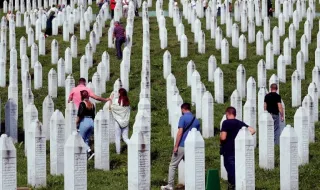
Mladic's role in organizing the Srebrenica genocide, in which at least The fact that 8,372 Bosnian Muslim men and boys were separated from their families, transported and killed by the Bosnian Serb army is well documented and has been confirmed by both the International Criminal Tribunal for the former Yugoslavia and the United Nations.
Despite lengthy court proceedings, ICTY findings and survivor testimony detailing and proving his central role in the genocide, Mladić remained at large for nearly 16 years, moving between locations in Serbia.
He was eventually captured in northern Serbia, indicted by the international tribunal and transferred to The Hague. The court found him guilty on at least 11 counts, including two counts of genocide.
However, he pleaded not guilty to any of them and blatantly denied the genocide in Srebrenica.
Wounds that never healed
The Mladić case was one of the most significant cases before the ICTY.
It raises serious questions about the functioning and capacity of legal systems, especially the ICTY and the International Criminal Court (ICC).
What reveals the weaknesses of the global justice system is the fact that the fate of thousands of people who disappeared during the war is still unknown.
Therefore, the gap between the legal system and the real-life experiences of survivors persists, although the capture and trial of Mladić represents a significant success for the tribunal.
Some Survivors of the Bosnian war and relatives of the Srebrenica victims say they have found solace in Mladic's death, while for others it has had little meaning, as it has reawakened traumatic memories of the war.
Women who experienced the worst atrocities, especially sexual violence, are still struggling with long-term psychological effects that continue to negatively impact their lives today.
Studies show that many survivors continue to suffer from panic attacks, nightmares and constant anxiety due to reliving their traumatic memories.
A study shows that at least 57% of women in Bosnia who experienced sexual violence during the war still meet clinical criteria for post-traumatic stress disorder and have difficulty coming to terms with their experiences even decades later.
Sexual violence is often used as a weapon of war - by perpetrators to revenge, punishment, terrorizing and humiliating the victims.
In the context of Bosnia, this violence was not only directed against women and young girls. Among the worst affected were young boys and older men, subjected to the most severe forms of sexual violence.
Many survivors say that Mladic's death cannot compensate for the scale of the losses and suffering he caused, and therefore brings them no relief.
Lessons for the world
While justice does not require death for every wrongly taken human life, it does require an end to hatred and an apology - something that is not seen in the case of any convicted war criminals, many of whom instead demonstrate a deep animosity towards the victims.
More than 30 years after the end of the Bosnian war, survivors are still waiting for justice and accountability.
Their experiences and trauma are shaped by both past events and the current situation, especially the denial of genocide.
The rhetoric of genocide denial is so widespread in the Balkans that it is often combined with toxic narratives such as denial, revisionism, and triumphalism.
Such narratives are reinforced when convicted war criminals like Ratko Mladic, whose goal was to create an ethnically pure Serbia by exterminating Muslims and Croats, are rewarded and made into heroes.
The horrific atrocities unfolding before our eyes in Gaza bear many similarities to those committed in Srebrenica more than 30 years ago.
From the bombing of civilian infrastructure and the use of rape as a means of warfare to the blocking of humanitarian aid convoys, it is all repeated.
Yet the international community, including the European Union and the United States, remains silent and inaction.
In stark reality, it is precisely the inaction and injustice of those who could prevent such atrocities that allow human lives to be lost.
Therefore, the lessons learned from past tragedies must not be forgotten or confined to history books, commemorative events or memorial sites. They must serve a specific purpose - to prevent genocides from happening anywhere in the world.
The world must act now to uphold international law and human rights and hold perpetrators accountable for their crimes. This will help break the cycle of impunity and revenge.