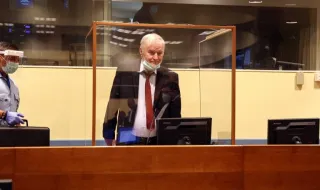
Ratko Mladic, the military leader of the Bosnian Serbs, is one of the three main figures responsible, along with his political counterpart Radovan Karadzic and their "boss" in Belgrade, Slobodan Milosevic, for the war that claimed 100,000 lives in the early 1990s in this small republic that gained independence after the collapse of Tito's communist Yugoslavia.
The portrait of the man nicknamed "The Butcher of the Balkans" is usually dominated by ultranationalism and ideological extremism, placed in the service of Milosevic's project of "Greater Serbia". Like Vladimir Putin in Russia today with his neighbors, Milosevic wanted to forcefully return the former entities of the Yugoslav federation back to the bosom of the "mother", punishing them for having left their homeland in search of freedom after the fall of communism. Some political currents in Europe want to see him, like Vladimir Putin, as a hero defending the West from the "Islamist flood". But like his "cousin" in Moscow, he was actually the exact opposite. This is what political analyst Isabelle Lasser writes in an article for the French newspaper Le Figaro.
Ratko Mladić was above all, to the point of fanaticism, a pure product of Yugoslav communism and the army - its bastion and Praetorian Guard. He was born in 1942 into a communist family of Bosnian Serbs, professing the values of "anti-fascism". His father, a Yugoslav partisan of Tito, was killed during World War II by the Croatian Ustasha, who were close to Nazi Germany.
A member of the Communist Party, he joined the Yugoslav People's Army (JNA), where he became the best officer of his class. In the army, he perceived the communists' distrust of the West and the paranoia that constantly waved the threat of an external enemy. Ratko Mladić owed everything to Tito's party and system, to which he was more attached than to ethnic Serbian nationalism. For officers of his generation, the collapse of the country and the army after the fall of the Berlin Wall was a tragedy. Like Vladimir Putin, who declared in 2005 that the collapse of the USSR was "the greatest geopolitical catastrophe of the 20th century".
Deeply attached to the communist federal Yugoslavia, when the unrest began, Ratko Mladić's first enemy was the Croatian Catholic nationalists. And to a much greater extent than the Bosnian Muslims, whom he would later try to erase from the map, attributing to them a connection with Islam that they did not always have. Their "Muslim" identity was originally a nationality recognized by Tito in 1971. His first crimes, in the very early 1990s, were committed against Croatian villages. He did not hesitate even to order the bombing of a Catholic church.
Mladic only embraced Serbian nationalism in 1992, when he was appointed by Milosevic as chief of staff of the Yugoslav army in Bosnia. "Probably in an attempt to explain himself to a world he no longer understood, he turned to Pan-Slavic and Orthodox myths," analyzes Luka Misetic, a Croatian-American criminal lawyer in X.
"Most of the perpetrators of the atrocities during the Yugoslav wars were professional JNA soldiers, trained in the institutionalized "anti-fascist" "the doctrine of the Yugoslav army," he continues. "The links between their ideological training and the monstrous crimes they committed must be examined."
As well as the very transformation of communism into nationalism.
During the communist era, Yugoslavia and the USSR had a complex but constant relationship. In March 1991, just before the collapse of Yugoslavia, when Ratko Mladić was still serving in Belgrade, the Yugoslav Minister of Defense, Veljko Kadijevic, went to Moscow to ask - in vain - his Soviet counterpart, Dmitry Yazov, the future leader of the coup against Gorbachev, for Soviet military support to fight the separatist leaders. It was in the Russian capital, where he fled in 2001, that he would spend his last days, just like Milošević's wife.
This special bond between the Slavic communist brothers continued after the collapse of the two countries. In his book about the search for war criminals, British author Julian Borger reveals - thanks to the testimony of Serbian democrats who cooperated with the Hague Tribunal - the surveillance and protection that Ratko Mladic received from the Russian security services.
Because in Belgrade, as in Moscow, the same nostalgia for the two former communist empires, weakened by the newly independent states, is still felt. In the West, the Russian and Serbian transitions were perceived as regime change and an opening towards Europe and democracy. But the illusion lasted only until the new teams were swept away by the old system.
Due to the lack of reforms, the ties have not been severed. The Serbian security apparatus, infiltrated by Russia and for a long time partially subsidized by it through a system of bonuses provided to Serbian agents, has never been truly reformed or purged and eliminated.
When Milosevic left office, the transition to the new president took place under the watchful eye of the Kremlin, which had sent its own man to the office of his successor, Vojislav Kostunica. Today, Nikolai Patrushev, a former KGB officer who became an influential advisor to Vladimir Putin, regularly travels to Belgrade.
The closeness between Belgrade and Moscow is also evident in the sending of 200 Serbian mercenaries to fight on the side of the Russians against the Ukrainians. Vladimir Putin, however, is not particularly fond of the current Serbian president, Aleksandar Vučić, whose balancing act between Moscow and Brussels irritates him. Especially when Vučić decides to supply weapons to Ukraine and tries to regain control of the national oil company NIS from the hands of the Russian gas giant "Gazprom". The Russian president prefers Mladić's distant successor - Milorad Dodik, the current leader of the Bosnian Serbs. A regular visitor to the Kremlin, he has become Russia's man in the Balkans.
Putin's Russia, which was accused of helping Ratko Mladic escape from the International Criminal Tribunal, has remained subdued since his death.
But the Kremlin continues to keep one eye wide open on the Western Balkans - that "gray zone" of Europe where frozen conflicts, notably in Kosovo and Bosnia, can easily be rekindled to destabilize Europe and advance Russia's strategic interests.
The region, with its strongholds in Serbia and Republika Srpska, on the lands of Mladic and Karadzic, is also a means for the Kremlin to try to regain the influence it lost in the mid-1990s under Boris Yeltsin. According to European intelligence agencies, Russia is recruiting low-level people there to carry out disinformation and sabotage operations within the European Union.
The latest case: According to information from Der Spiegel, one of the suspects in the failed attack at Leipzig Airport in Germany on August 4 boarded a plane to Belgrade. According to Western security services, Serbia has become a crossroads for Russian sabotage in Europe.
Ratko Mladic is dead, but solidarity between the countries that emerged from the communist bloc remains.