Comment by Konstantin Eggert:
US President Donald Trump intends to sign the "Lindsey Graham Act" by September 27. The document, approved by both houses of Congress, bears the name of the senator who died two months ago, who became known for his tough stance against the regimes in Russia and Iran.
Trump as the "master" of the "Lindsey Graham Act"
The law confirms and expands sanctions against individuals and legal entities, including Russian oligarchs. It also allows the President of the United States to impose a 100 percent tariff on countries that import oil and gas from Russia. Countries that meet 15 percent of their needs with Russian hydrocarbons and at the same time reduce imports from Russia can avoid sanctions.
The bill is the most significant document in support of Ukraine adopted since Trump returned to the White House. But we would be wrong if we expect it to be quickly implemented in practice.
The battle between Congress and the president over the law lasted almost a year. Trump agreed to sign it only because the document gives him extremely broad powers, especially when it comes to introducing or canceling tariffs. This is what outraged 150 Democratic congressmen who voted against the bill. They believe that Trump has usurped too much power, especially in the economic sphere. In addition, the president can freeze the law "in the interests of national security", and the rules for the practical implementation of the sanctions are being developed in the Treasury Department, the State Department and other departments subordinate to the president.
It is very likely that Trump will not immediately activate the law, but instead use the threat of its implementation as a means of pressure to force Russia to conclude "peace". And this poses a problem for Ukraine: the "peace" proposed so far by presidential envoys Witkoff and Kushner is at best a tortured compromise, and at worst - a capitulation of Kiev. For Trump, "peace" is a kind of laurel wreath, which he wants to crown himself with at all costs before his term ends.
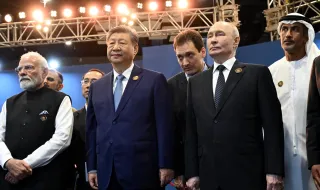
The Kremlin understands this very well. That is why Putin does not say either "yes" or "no" of Witkoff and Kushner. It is important for him to prolong negotiations with the White House as long as possible - while his missiles are killing Ukrainians and destroying the country's infrastructure. Will he be afraid of the implementation of the "Lindsey Graham Act" and especially the withdrawal of buyers, primarily China and India? It depends on how highly the Kremlin assesses Trump's determination to put pressure on Xi Jinping and Narendra Modi. If I were Putin, I would not assess it very highly for now.
Putin's fate is in the hands of Xi and Modi
Everything we have learned about Donald Trump so far gives us reason to believe that he perceives the "Lindsey Graham Act" not only as a tool for putting pressure on Russia and Iran, but also as an element of negotiations with India and China. India, for example, buys Russian oil at a deep discount, and in July Russian supplies accounted for half of all Indian oil imports.
At first glance, it seems that there is nothing easier than putting pressure on India. But the White House cannot help but perceive it as a potential partner in its struggle with Xi Jinping for global supremacy. And this means that Washington will have to somehow come to an agreement with Modi. That is, from the very beginning, the sanctions act becomes part of Trump's big game to contain China and turn the United States into the world's largest supplier of energy resources. Under these conditions, the Russian regime still has some room for maneuver.
If Trump were to impose a 100 percent tariff on India without hesitation or convince Modi to find other suppliers, this would undoubtedly be a blow to the Russian regime. And Modi is interested in a partnership with the United States.
A conversation with Chinese leader Xi Jinping will be much more difficult - if it takes place at all. After all, Russia's defeat in the war against Ukraine is categorically not in the interests of the Chinese regime. In addition, this fall and winter, Putin will try to break Ukraine's resistance with massive missile strikes, drone attacks and, perhaps, a new ground offensive. It is important for Putin to show Xi that it is too early to write off "his" Russia.
I would be happy if I am wrong. But above all, Ukraine and its European allies will have to thwart this intention of the Russian dictator. And as for the current American administration - at best, we can only hope.