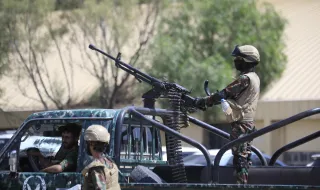
In recent days, men have taken to the streets of Iraq carrying banners with slogans like "Death to America" - similar to those we saw on the streets of Yemen.
The people using them in Iraq are part of the Iraqi Shiite paramilitary structures. They, like the Houthis, Hamas, and Hezbollah, are part of the so-called Axis of Resistance in the Middle East - paramilitary groups supported by Iran that usually work in favor of the Islamic Republic's regime.
After the start of the US-Israeli war with Iran at the end of February this year, the groups from the “Axis of Resistance” began attacks in support of Iran. The Houthis, however, have largely stayed out of the fighting. But that has changed recently. The rebel group in Yemen has launched an offensive and seized more territory along the Red Sea coast to "create conditions for another body of water to be under the control of the "Axis of Resistance" in an attempt to establish control over the region's oil exports," the Institute for the Study of War in Washington summarizes.
The regime media in Iran published laudatory materials about the Houthi offensive in Yemen, and in many cities in the Islamic Republic, regime supporters gathered in support of the Yemeni rebels.
Are the Houthis the "new Hezbollah"?
This treatment was previously given to another group from the "Axis of Resistance" - Hezbollah. But after a long war with Israel and a loss of influence in Syria, the Lebanese Shiite group no longer seems so strong. Now the Houthis are doing things that Hezbollah never managed to do - for example, this week they shot down a Saudi F-15 fighter jet with a missile that the group claims it modified itself.
Is it possible for the Houthis to take Hezbollah's place as the most important and perhaps most dangerous member of the "Axis of Resistance"? The advantage for them is that, for geographical reasons, they have not had to confront Israel so far. "I think they have become more valuable than Hezbollah could ever be," says Fareya al-Muslimi, a Yemen-focused researcher at the Chatham House think tank. "Of course, Hezbollah has decades of experience and has helped build the Houthis' capabilities over the years. But they have now surpassed them."
According to Andreas Krieg, a university lecturer at King's College London, the Houthis now perform a similar strategic function for Iran as Hezbollah, and in some ways are more useful. "Hezbollah provided Tehran with a front against Israel in Lebanon. The Houthis give them an advantage against Saudi Arabia, Israel and in world markets. So their strategic function has increased significantly, and Hezbollah is also under increasing pressure."
Al-Muslimi also draws attention to the fact that the Houthi leader, Abdul Malik al-Houthi, is a follower of the assassinated Hezbollah leader Hassan Nasrallah in 2024. “You can see how he even imitates him in his speeches. And now he has more influence than Nasrallah ever had," the researcher says. Hezbollah’s former leader served as a liaison between the factions. Now, the Houthis seem to be taking on that role, as evidenced by the recent attack by Iraqi militias on a Saudi pipeline.
How dependent are the Houthis on Iran?
Unlike Hezbollah, however, the Houthis are questionable in terms of exactly how much control Iran exerts over them. According to Krieg, the biggest difference between the two groups is autonomy. “The Houthis have their own leaders, ideology, internal support and territorial project,” he notes. “Tehran can support them, arm them and benefit from their actions, but it cannot activate and deactivate them at will.”
Other observers note that the Houthis have carried out operations in the past that Tehran did not agree with. Iran now claims it had nothing to do with the group’s recent actions. Al-Muslimi, however, is not convinced. He says that in the past two years the Houthis have become much closer to Iran, and Tehran is now regularly sending weapons to the Yemeni rebels. "Reuters" reports that in July Iranian authorities discussed with the Houthis the closure of the Bab al-Mandeb Strait.
Who can stop them?
Experts are adamant that the Houthis will be difficult to stop. Previous campaigns against them, led by Saudi Arabia, the US and other countries, have failed. Sanctions and economic pressure clearly have no effect on them - they do not rely on the international financial system. Al-Muslimi explains how the group works - it collects taxes, but does not pay salaries or provide any public services - everything goes to their military operations. The founder of the Houthis preaches that modern Muslim societies have become "soft" and poverty and hardship are a divine test.
This is a huge difference with Hezbollah - the Lebanese group has a political faction and offers social services, and it is very important for them to balance their relations well with other demographic groups in Lebanon. The Houthis have no such inhibitions. "They don't care whether Israel or the US bomb a hospital. On the contrary, it suits them, because their ideology is based on martyrdom and sacrifice," explains Al-Muslimi. According to him, this makes them more dangerous than Hezbollah - both internationally and for Yemeni society.