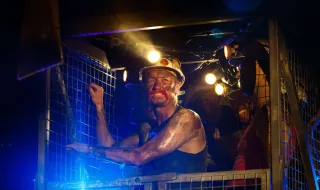
The European energy transition is going so well that this winter the continent will again rely more on… coal.
The reason is annoyingly prosaic – gas is expensive again. The war with Iran has limited supplies of liquefied gas through the Strait of Hormuz, the European gas price in September passed 80 euros/MWh – the highest level in three years – and gas storage facilities are unusually empty. The result according to an analysis by Reuters (first news): Coal-fired electricity production in Europe could jump by about 25% in the next six months. I just wonder why colleagues are using the future tense, because this is already happening in September.
Here comes the fun part. Europe has been closing coal-fired power plants for years.
Germany is even ahead of its own legal targets - the capacity already removed exceeds what was planned for 2029. Now, however, gas is getting more expensive and the electricity system is doing something extremely disrespectful to political strategies - it is obeying physics and economics. The few remaining coal-fired power plants are once again becoming profitable and critically important. Germany is loading them so much that, according to a Reuters analysis, they are approaching their physical production maximum.
A quick check shows the truth of this statement - at 8:30 p.m. on September 22, for example, absolutely all available lignite-fired power plant units in Germany were operating, providing a total capacity of 13 GW (out of 14.8 GW theoretical capacity; second graph). At the same time - despite extreme prices and empty storage facilities - more than 15 GW of gas-fired power plants have to operate, as the German economy needs electricity even when there is no wind or sun.
If Germany had not closed a large number of coal-fired power plants, they would be operating today and prices would not exceed 700 euros/MWh in the dark hours of calm.
However, it turns out that a power plant that you closed based on Excel calculations cannot be included in the program with a click.
Meanwhile, Brussels is worried that expensive energy is fueling public discontent and support for the far right.
However, the problem is more serious than another expensive winter. Europe is gradually giving up not just coal, but the very idea that an industrial civilization should be able to produce a significant part of its own energy. Oil production in the EU is tending to negligible quantities. Our own gas is decreasing. Coal is being shut down. Germany has also closed its last nuclear reactors. Refineries are also disappearing.
Then we import the same “bad“ molecules from elsewhere. In the first eight months of 2026 alone, the European Union has paid about 7.3 billion euros for Russian LNG from the “Yamal“ project.
After the political turn towards the US, American oil and liquefied gas have been making an ever-widening hole in European budgets. Today, the same applies to American diesel.
And since we don't like the current American president, we suddenly start dreaming about Canada's oil, gas and fuels. It's no wonder that until yesterday we were explaining how “dirty” is precisely their extraction of oil sands and shale.
Here I can formulate a curious new definition of clean energy:
Fossil fuel becomes cleaner when it is extracted far enough away from the eyes of the European voter. The same applies to Chinese panels, batteries and electric cars, about whose supply chain we do not want to know unnecessary details.
I don't know how many years I have been saying this. Europe is reducing local extraction and energy-intensive production, but it continues to consume their products.
The emissions, mines and chimneys are simply moved to another longitude and latitude.
And then the finished metals, batteries, photovoltaics, chemicals and electronics arrive back by ship.
China is the world champion in renewable energy. But apparently no one has explained to him that in order to build solar, you must first close your coal plants. In the first half of 2026 alone, China has introduced 30 GW of new coal capacity and has started construction of another 25.4 GW. At the same time, the country is building a lot of nuclear, hydro, solar and wind capacity. China does not choose between industry and electrification, but uses the former to achieve the latter.
In 2000, China produced 1355 TWh of electricity, and in 2025 - already over 10,000 TWh. In a quarter of a century, the country has increased electricity production more than seven times, while in the EU it is decreasing. Data centers, electric cars, railways, metallurgy, chemistry, batteries and photovoltaics do not appear from a climate strategy. They appear when you have a huge amount of reliable energy.
This is not an argument against renewables. Quite the opposite. Renewables and batteries are great technologies and Europe should definitely invest in them.
Electrification is a huge opportunity. But the more we electrify transport, heating, industry and data centres, the more electricity we will need – not just on a sunny May afternoon when the price is negative, but at 7pm on a cold, windless January evening.
A strong Europe and an energy-dependent Europe can hardly be the same thing. The arguments „FOR“ European own extraction and production of fossil fuels and „FOR“ RES and electrification are not alternatives.
The former is the material basis on which the latter can actually develop – as the Chinese model shows.
However, to date, the EU follows a different model: We close mines, wells, power plants and factories, buy all kinds of energy and technology from abroad, pay more and more, pray for a warm winter, tremble at every news about a ship being attacked by natives in the middle of the world's seas and finally find salvation in coal again at the first episode of a September calm.
How long will we last like this?