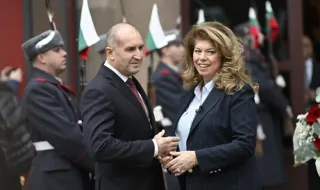
This is no longer a dispute about who loves and who does not love Russia. This is a question of what the future president and supreme commander considers a threat to Bulgaria and how the country will defend its security and its place in Europe.
The residents of Vazovata Byala Church in the 19th century would not have thought of dancing horo while “The Long-Suffering Genoveva” was being performed in the crowded hall of the boys' high school. But citizens of European Sofia in the 21st century do not take into account the performances of the “Ivan Vazov” National Theater and play horo as a demonstration of patriotism, traditional values, and national sovereignty. This is how they understand the “sustainable realization of Bulgarian identity”, as the Sunday event was presented, which interferes with actors and spectators with high decibels.
The speakers are cheap but shrill. The same sovereignist soundtrack can also be heard from “Dondukov” 1, and in the presidential campaign at least five out of a total of 28 presidential candidate pairs play the same strings. The difference is only in the tonality.
Is Russia an aggressor?
The geopolitical division is emerging as one of the most visible lines of this presidential vote. On one side are sovereignty and “national interest”, on the other the EU, NATO and support for Ukraine. The former accuse the latter of serving Brussels, the latter the former of serving Moscow.
Geopolitics was also present in 2021 - then Rumen Radev said in a pre-election television debate that Crimea “is currently Russian“, and Prof. Anastas Gerdzhikov insisted that it is Ukrainian. Shouldn't this question be asked of the presidential candidates again?
The current campaign is dominated by two different ideas about the national interest and Bulgaria's place in Europe, and behind them the older axis - Russia or the West - invariably peeks out. The war in Ukraine has changed the content of the old division “Russophiles-Russophobes“.
It is no longer about historical attitudes towards Russia, MOCHA, Shipka Peak and March 3, but about very specific decisions: is Russia an aggressor, should Ukraine be supported and sanctions continue. And even more important is where Bulgaria fits into the new EU defense policy and how Bulgaria sees its own security as a Black Sea state, when war is on the horizon, Russian drones are entering the airspace, and NATO is strengthening its entire eastern flank.
What is the threat to Bulgaria?
This is no longer a debate about who loves and who doesn't love Russia. It is a question of what the future president and supreme commander considers a threat to Bulgaria and how the country will defend its security. NATO defines Russia as the “most significant and direct threat“ to the allies because of the war against Ukraine and its hybrid actions - sabotage, cyberattacks, disinformation and political interference, which are becoming more frequent.
However, Bulgarian society remains divided. A study by “Open Society“ by 2025 shows 37% preference for an alliance with the EU and NATO in a hypothetical new global division, 11% for Russia and Belarus, and 36% choose “neutrality“.
These 36% are the large gray area of the presidential elections. The current president and candidate Iliana Yotova and the leader of “Vazrazhdane” Kostadin Kostadinov, representatives in the campaign of the moderate and radical option for peace on the Russian model, will compete for part of them. But Andrey Gyurov must also turn to them if he wants to go beyond the electorate of “We continue the change” and “Democratic Bulgaria”.
Gyurov insists that Bulgaria be a predictable partner in the EU and NATO and follow the common European sanctions policy towards Russia. Yotova says that the war has no military solution, insists on negotiations and defends Bulgaria's right to have a different position within the EU. And Kostadinov has already openly stated that, in his opinion, Bulgaria has no place in NATO.
Voter hunting
The majoritarian nature of the presidential vote makes geopolitics particularly important. In the first round, candidates compete with each other for close voters, and in the second round they must attract the voters of those who dropped out. Then the geopolitical preferences "Russia or the West" may turn out to be stronger than party affiliation.
But presidential elections are not won with messages alone. Behind the candidates are party structures that must produce votes. The largest and most organized of them until recently was GERB. Now many from GERB, including mayors, are quickly throwing away their party membership cards, similar to what happened after November 10, 1989, and are reorienting themselves towards the ruling “Progressive Bulgaria” (PB).
However, the PB itself is not a party, structures are still being built. These nearly 1.445 million voters in the parliamentary elections on April 19 largely repeat the vote for Radev for the second presidential term, when he won almost 1.540 million. Despite the PB's declared support for Yotova, the votes for Radev will not automatically flow over.
GERB's decision not to nominate its own candidate does not remove it from the presidential battle. On the contrary, it leaves it the opportunity to become one of the factors that will decide where the vote will go in the second round. For part of the party's active members, participation in GERB was also associated with cheating from the government, and its loss is already loosening loyalty. But for another part, Gyurov is the closest candidate in ideological and geopolitical terms.
The tasks facing Yotova and Gyurov
In a possible runoff between Yotova and Gyurov, the geopolitical division will present the two with different tasks. For Yotova, the reserve is among those who voted for Kostadinov-Volgin, Siderov-Velkov and the other candidates with more radical positions against support for Ukraine and NATO policy. To attract them, she will have to at least rhetorically shorten the distance with them. The question is how far to the right she can go without losing moderate voters.
For Gyurov, the dilemma is different. His reserve is among pro-European voters outside the PP and DB and among the remaining GERB electorate. There is no need for a more solid Euro-Atlantic tone, because belonging to the EU and NATO is largely a common denominator. The more difficult task is to turn it into a vote for a candidate nominated by political opponents of GERB.
The possible second round will not only test which of the two ideas about Bulgaria's place in Europe gathers more support. It will also show what weighs more at the ballot box - the geopolitical choice or the party affiliation.
The National Theater has been in this place for more than a century, the Sunday horo in front of it - for several years. They do not interfere with each other by nature. Someone simply placed them on both sides of an imaginary red line. Just like the national interest and Europe.
This text expresses the author's opinion and may not coincide with the positions of the Bulgarian editorial office and the DG as a whole.