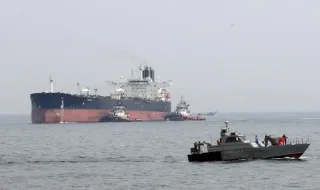
In recent hours, the US and Iran have intensified their exchange of retaliatory strikes, with Washington targeting three Iranian oil tankers, and Tehran attacking tankers and firing a ballistic missile at US warships patrolling near the Strait of Hormuz.
Experts have described Iran's actions targeting the two US aircraft carriers as a "measured escalation", as the months-long conflict increasingly takes place at sea. Both Iran and the US are trying to establish control over the strategic strait - a key global transport artery used by Tehran as leverage in the war, writes "Al Jazeera".
The attacks on tankers coincide with US claims that increasing volumes of oil have begun to pass through the strait, although the exact figures are still disputed. All this is happening against the backdrop of an ongoing naval blockade of Iranian ports.
The latest clashes further reduce hopes for de-escalation through diplomacy, as the US-Israeli war against Iran has disrupted energy supplies and slowed economic growth worldwide.
So what is known about the latest "tanker wars" and where is the conflict headed?
The US Central Command (CENTCOM) said its forces had struck three Iranian vessels, including a tanker off Kharg Island. The island was the main point through which Iran exported 90% of its crude oil before the war.
Another tanker was hit near Jask, and an empty vessel was hit in the Gulf of Oman after the crew was ordered to abandon ship. CENTCOM said the attacks followed Iranian ballistic missile launches at a US aircraft carrier and a destroyer, which the command said successfully evaded the strikes. No American service members were injured.
"If you shoot at two of our ships, we will impose an even heavier economic cost by destroying three of yours, military analyst Wolfgang Pustai.
Iran later said its forces had also targeted three oil tankers sailing a route in the Strait of Hormuz that Tehran has designated as "unauthorized", as well as three US-linked vessels elsewhere.
In a statement carried by Iranian media outlet IRIB, the Islamic Revolutionary Guard Corps (IRGC) Navy warned all vessels in the Persian Gulf or near the Strait of Hormuz not to be "misled." by the US military and to "refrain from any suspicious actions aimed at passing through unauthorized waterways".
"Otherwise you will become a target", the statement said.
Iran also announced that it had shot down an unmanned US vessel trying to enter the Strait of Hormuz, the Associated Press reported.
Washington said that the Iranian tankers it hit were part of a multi-billion dollar "gray sector" network that finances the Islamic Revolutionary Guard Corps (IRGC) and its allies in the region.
Iran has long relied in part on a "shadow fleet" to circumvent sanctions and sell oil. All of this provides a source of revenue that has become even more important since the US began blocking Iranian ports in April.
Iran has effectively closed the Strait of Hormuz, through which 20% of the world's oil passes. This comes in response to attacks by the US and Israel that began on February 28. Before the war, about 20 million barrels of oil passed through the strait daily.
Hassan Gashgavi, a member of parliament and spokesman for the National Security Committee of the Iranian parliament, said that the attacks on US warships were part of an "existential war with America". He stressed that the naval blockade imposed by Washington "should not have existed at all.".
"Of course, they took military action in violation of all international laws," he told Al Jazeera. He added that "because America is far from us, it does not perceive this war as existential."
Meanwhile, the US continues to put pressure on Iran both militarily and economically to open the key sea route.
Last month, US Treasury Secretary Scott Besant announced a package of economic measures aimed at Tehran's financial interests around the world. Besant said the US would target all sources of revenue for Iran, including oil, to prevent other countries and companies from trading with Tehran.
This comes despite US claims that the situation in the Strait of Hormuz is normal, with Washington insisting that the route is open and that dozens of ships carrying millions of barrels of oil pass through it every day.
Last week, Besant said that about 17 million barrels of crude oil have recently been transported daily, according to information in the newspaper "The Times" in Britain. Some tankers have resorted to what analysts call ship-to-ship cargo transfers to avoid the blockade.
Moreover, US President Donald Trump said that the United States has "complete control" over the strait. However, data from maritime analytics firm Kpler shows that the average number of ships passing through over a 10-day period is just 13 ships per day.
The attacks have heightened concerns about global energy and crude oil supplies. Brent crude futures closed at $96.28 a barrel, their highest since July 24 and a significant increase from around $70 before the war. As expected, U.S. oil and natural gas prices also jumped sharply, coming at a critical time for Trump as Americans prepare for midterm elections in November.
The price of diesel in the United States hit a new record, rising to an average of $5.85 a gallon ($1.55 a liter) for the first time in history. Polls have repeatedly shown that a majority of Americans oppose the war, which has also led to a decline in Trump's popularity.
Another Reuters/Ipsos poll conducted in late August found that just 31% of Americans support the war, while 63% oppose it. The same survey found that Trump's approval rating has fallen to 33%, down from 40% at the start of the war.
Where is the conflict headed?
According to Sina Azodi, director of the Middle East Studies Program at George Washington University, the renewed exchange of blows between Iran and the United States marks an escalation of the six-month-old conflict.
Azodi told Al Jazeera that neither side will "back down" because it "wouldn't look good for them, so escalation is the only option." He noted that if a political agreement is not reached, the war will continue.
"There will be more clashes between the Iranians and the Americans. Misjudgments are possible. There may be more civilian casualties," especially on the Iranian side, Azodi said.
And he warned that the US defense secretary could send more troops to the region, but the Iranians will not back down. They will oppose this blockade and impose additional costs on the United States, Azodi added.
He pointed out that the goal of the United States and Iran is to force the other side to give in.
"The winner will be the one who can bear more costs and punishments," Azodi said.
Commenting on Iran's strategy, Ali Akbar Daraini, an analyst at the Center for Strategic Studies in Tehran, agreed with Azodi, saying that the US attacks on Iranian oil tankers are a "serious problem" that Iran cannot afford to leave "unanswered".
"Does this make Iran surrender? No, it forces Iran. It stimulates Iran to react sharply and strike back" harsher, Daraini told "Al Jazeera".
He noted that the US naval blockade, combined with sanctions, is causing severe damage to Iran, but added that the country has plans to counteract this. Iran cannot allow this naval blockade to continue, so it is already preparing to break the siege.
"At the same time, Iran certainly has its own plans to ensure that oil prices rise above $100 per barrel, Daraini said.
Source: news.bg