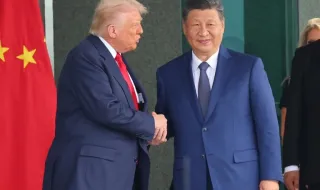
One of the most important outcomes of the recent summit in Washington between U.S. President Donald Trump and his Chinese counterpart Xi Jinping is something we are unlikely to learn soon, if ever. This is what Howard French, a professor at Columbia University's Graduate School of Journalism, writes for Foreign Policy.
"This has nothing to do with the fact that the delegations failed to issue a joint statement, or even with the significant discrepancies between the two sides' versions of their talks. It is more about the personal conclusions that the Chinese leader probably drew at the end of his visit on two related questions: Who is Trump really, deep down, and what does his presidency say about the state of the United States as a current global superpower?
The first is by far the easiest: Trump’s extreme servility in welcoming Xi with all the honors and flattering him at every opportunity has no chance of making the two men true friends, although Trump often seems to believe that is precisely what he is.
Like any country, China has made many mistakes and misjudgments over the decades, but in the post-Mao era it has formulated its policies through a disciplined process aimed at a sober and rational assessment of China’s interests — or at least the interests of the Chinese Communist Party (CCP). Friendship in the usual, personalized sense of the word has little to do with it. It’s a rule I would apply even to the displays of cordial friendship between Xi and Russian President Vladimir Putin, whose Moscow is a situational ally of Beijing.
A more speculative thought is that Xi may have found it extremely amusing to watch Trump present his own interpretation of what authoritarian leadership is. It is already a common claim in American political commentary that Trump fantasizes about having royal powers. How else can we explain his lavish use of gold and his obsession with monuments, especially those he hopes will bear his name for centuries to come? But as Trump showed Xi around the White House, boasting about his helipad and the ballroom under construction, I’m tempted to say that Xi probably took him for a fool. Because no matter how much power Xi has concentrated in his own hands over the past 13-plus years, almost none of his energy has been devoted to the pursuit of personalized greatness.
Xi probably got a bad impression of his counterpart when Trump led him through a pavilion whose gilded walls were adorned with portraits of American presidents. They were hung in ascending order, with Trump’s portrait at the top. That in itself is tasteless enough, but the Chinese leader stood silently, as impassive as ever, as Trump paused in front of a frame dedicated to his predecessor, Joe Biden. Instead of a portrait of Biden, there was a picture of a fountain pen — the device that Biden has often used to sign official documents, as other presidents have done before him.
What Trump seems to have failed to understand is that domestic politics and top-level international relations require careful separation — as the well-established American foreign policy maxim goes, "politics stops at the shore." Xi caused a stir in October 2022 when his predecessor Hu Jintao was hauled before a congress of the CCP's top brass — a rare sign of internal discord in a country where such matters rarely come to light in public. But it would be unthinkable for Xi to openly speak ill of any of his predecessors abroad. The reason is that he, like the leaders of most countries with a well-developed understanding of statecraft, understands that among his first duties when abroad is to present a unified image of his country and its system.
At the very least, Xi must have had the impression that Trump was deeply confused when the American president criticized the American media in his presence and demonstrated a thinly veiled envy that the Chinese media reported what Beijing wanted them to. Trump seems to believe that reporting favorably for the government is a matter of banning media outlets whose criticism offends him. Xi knows better. The difference between the American and Chinese media regimes is rooted in the fundamental differences between democracy and dictatorship.
But there’s more to it: The freedom of the press in the United States, guaranteed by the Constitution, has long reflected not only the rule of law but also the deeper national confidence of a system that is unafraid of its own critics. Against this backdrop, I wondered whether Xi had come to the conclusion that he was not just witnessing a president who was becoming a caricature but also the growing signs of a country that had lost its way, including the self-confidence that Chinese leaders have long respected and even envied.
For comparison, consider the way the two men have governed at the helm of their very different systems. Xi’s rule should be seen as a strategic and highly focused conquest of near-absolute power. For some, it began even before he took over China in late 2012, when he disappeared from public view for about two weeks in September of that year. According to multiple reports, he used this move to extort commitments from senior party officials to give him significantly more power than other newly appointed leaders in the post-Mao era.
Since then, Xi has methodically used massive anti-corruption campaigns not only to fight corruption but also to remove party officials whose loyalty he deemed less certain. He has done much the same with the high command of the Chinese military, imprisoning or retiring almost all of its leading military figures. This approach, among other actions, has given Xi the ability to rule indefinitely, bypassing the traditional two five-year terms introduced after Mao. Xi’s approach to power can be compared to the way a boa constrictor subdues its prey — by gradually but inexorably tightening his grip.
None of this should be understood as suggesting that Xi is leading his country in the right direction, or that China’s continued rise is inevitable and free from deep internal contradictions. But the same cannot be said of the United States under Trump.
It is difficult to conclude that Trump’s actions, especially in his second term, will benefit the United States, and much of my pessimism on this issue has to do with his leadership style. Compared to Xi, Trump looks like a complete amateur: a disinterested and ill-informed improviser guided by his own intuition and whims; an impulsive man with little apparent self-discipline who regularly takes pleasure in boasting about his own supposed greatness, wit, and wisdom.
Those who think this is too harsh a judgment should consider a recent critique of the Trump administration by billionaire Peter Thiel, one of the Republican Party’s biggest donors in recent years. Thiel notes that Trump’s second administration overreacted to the internal conflicts of his first term by introducing loyalty tests that have resulted, he says, in "an administration of not-so-smart, but loyal people". The strategic consequences of this choice are already unfolding on the world stage — from Iran and the wider Middle East, through Ukraine, to East Asia.
As a result, Trump has made one of Xi's most dangerous potential misjudgments significantly more likely. Xi may now be more inclined to overestimate his own capabilities and power, as well as those of China — for example, in terms of power moves related to Taiwan or Japan — and to underestimate the chances of the United States recovering from the self-destructive failure of the Trump years, which will not be easy in any circumstances".
Source: news.bg