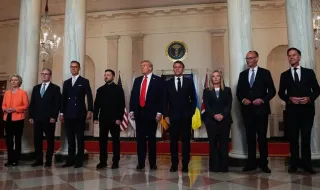
Ukrainian President Volodymyr Zelensky will make a direct appeal to European leaders today for more aid amid growing distrust among allies over Donald Trump's recent actions in favor of Russia, writes "Politico".
On the second day of the EU summit in Brussels, Zelensky will join European prime ministers and presidents discussing Ukraine's need for more weapons and financial resources. Fears grow that Kiev could face a billion-euro shortfall next year.
The reality of the threat to European security stemming from the four-year war was palpable during the meeting after drones hit two ships in or near Romanian waters. This led to emergency talks with NATO.
"All of us in Europe want this war to end", Zelensky wrote on social media upon his arrival in the Belgian capital yesterday. "To this end, signals of strength are needed — more real pressure on Russia and greater support for the defense of Ukraine".
According to him, it is particularly important to "act together to protect human lives". However, unity among European leaders is lacking at a meeting already marked by numerous tensions.
EU governments are facing off in difficult negotiations over the amount of funds that should be allocated for the 27-member union's budget. With populist movements on the rise, discontent growing and elections looming in key political centres across the continent, the pressure-stricken leaders are far from reaching an agreement.
It was into this explosive financial climate that the US president stepped in.
Trump's decision to open US markets to Russian diesel, which had previously been banned, in a bid to ease price pressures in the US risks tipping the balance of a costly war in Russia's favour, three European officials have warned. Vladimir Putin's military coffers could now be boosted by additional fossil fuel exports as Ukraine struggles with cash shortages.
Arriving yesterday for the first day of a lengthy two-day summit, European leaders began informally discussing options for redressing the balance. The discussion is expected to continue again around the summit table today.
Russian assets
One idea that is quickly returning to the agenda is the delicate question of whether and how to use several hundred billion euros of frozen Russian financial assets held in European banks.
The majority of these are held in the Euroclear depository in Brussels. A previous attempt to seize the funds and transfer them directly to Kiev was blocked by the Belgian government, as well as by some other countries, although less categorically, over concerns that it could lead to lawsuits.
Sweden, Finland and Germany, however, want the assets issue to be revisited. According to representatives of these countries, the European Commission should prepare a new detailed assessment of Ukraine's financial needs and a document with possible options for providing assistance, including through the use of assets.
At the beginning of the meeting, German Chancellor Friedrich Merz said that he had called on his colleagues to "do everything possible to help Ukraine get through the winter and to continue supporting it next year."
"We will have to increase funding again to provide Ukraine with truly long-term assistance," he insisted. "I remain firmly convinced that we are protecting not only the territorial integrity of Ukraine, but also the political order in Europe, which is under serious pressure from Russia in every respect."
Earlier, a German representative said that among the available options for assisting Ukraine — including a loan and direct grants from national governments — using frozen assets seems the most feasible approach and should be "discussed".
A US proposal to unfreeze some of the Russian assets and transfer them to a US-controlled entity so that Washington could use them as leverage in peace talks with Moscow has also drawn sharp criticism.
Merz said that the assets were frozen in Europe and "they should remain frozen in Europe... That is our question and we will make the decision".
"Let's try again"
Finnish Prime Minister Petteri Orpo said at the start of the meeting: "The best solution would be to reach an agreement on how to use the frozen assets... We have to try again".
Sweden also supports reconsidering the possibilities of using the assets to cover Ukraine's future financial needs.
"Doing nothing is not an option," said Swedish Minister for European Affairs Jessica Rosenkranz. "The Commission is looking at different financial options and we need to put them on the table very soon," she added.
According to her, leaders at this week's meeting should "be completely frank that Ukraine needs more funding" and that the EU "really needs to step up its efforts."
Yesterday, Zelensky met with Belgian Prime Minister Bart de Wever, who is the main opponent of an agreement on the use of the assets, and thanked him for his country's support so far.
After the first day of the summit, De Wever said that the assets should be considered as part of a future peace agreement.
"Are there people on this planet who perhaps dream that this time things could be done differently and that these assets could be put to use earlier for certain purposes? The answer is: yes, there are," he said. "Are there people like that in this building? There are. Are there people outside? Yes, there are. Do I want to talk about it? No, I don't.".
For Finnish Prime Minister Orpo, Trump's "terrible deal" with Putin on diesel fuel and the apparent US restrictions on the use of Starlink technology to help Ukraine fight Russian attacks are difficult to understand.
"My message to Trump is that we are allies," Orpo stressed. "We are in NATO. And who is the biggest threat to NATO? Russia — and that's why all this is illogical. I have no answers. I have a lot of questions.
He said Trump may be focused on winning votes ahead of next month's U.S. midterm elections, but he should remember that his real allies are in Europe and that he should not "trust" Putin.
Election concerns
Finland will hold elections next year, at the same time as France could hold a crucial political contest. Far-right leader Marine Le Pen is leading in opinion polls for France's presidential election and wants to cut aid to Ukraine and sharply slash the EU budget.
French President Emmanuel Macron, who is constitutionally barred from running next year, has warned European leaders that they must reach an agreement on the bloc's next budget by December. Otherwise, it will be too late.
But the 27 leaders remain divided and show no sign of bridging the gap between countries like Germany, Sweden and the Netherlands, which are pushing for budget cuts, and countries like Italy and Romania, which are in favour of spending more on regional development and agriculture.
European Council President António Costa also sees the issue as urgent. He believes that reaching an agreement before the end of the year is not only necessary but possible, according to two EU officials.
Costa, who is taking over from Ireland as part of the EU Council's rotating presidency, believes that if no agreement is reached by December, the entire budget negotiation process will drag on beyond the next election cycle. That could delay any agreement until October next year — dangerously close to the entry into force of the new EU budget in January 2028.
In an attempt to make progress on budget negotiations, European leaders will return to Brussels for an additional summit next month.
Source: news.bg