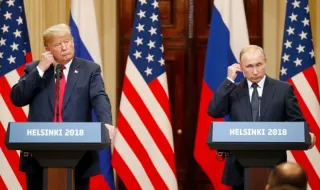
US President Donald Trump has dealt another resounding slap to Europe and put it before an uncomfortable question: what is the point of a common sanctions policy against Russia, since he (Donald Trump) can open an exception for Russian diesel, negotiate supplies with Vladimir Putin and present the decision as a victory for American consumers? The deal for Russian diesel shows how vulnerable European policy is when Washington pursues its own short-term interests. And, Europe… Europe… Oh, let Europe, this great community flourishing with prosperity, be and will remain just a donor to Trumpist ambitious deals. Can Europe decide whether it wants to be an independent geopolitical factor, or remain the financial rearguard of decisions that someone else makes for it. Hardly. At least not with this “leading to prosperity“ leadership.
On October 9, Trump announced an agreement with the Russian president for the supply of diesel fuel to the US and WORLD MARKETS. Here is the key thing - AND WORLD MARKETS. Washington has temporarily allowed deals with Russian diesel, with sanctions relief set to last until April 7, 2027. The announced quantities start with 300,000 tons, followed by additional supplies. The administration presents the decision as a way to control high fuel prices. However, Reuters notes that it could provide Moscow with new revenue while the war against Ukraine continues.
Simply put as an example. Trump buys diesel for $1 from Putin (figuratively speaking), releases it to the US for $1.2, and sells it to Europe for $1.5. (note - these are not the transaction prices, they are just numbers for illustration) And everyone is happy. Especially in the donor EU, because it receives assistance from the US to deal with high fuel prices.
Here lies the real problem. It is not just about buying and selling fuel. It is about sending a political signal to the Kremlin: even after years of sanctions, diplomatic conflicts and military actions, access to the American market can be reopened when this meets the immediate priorities of the White House.
Sanctions for some, exceptions for others
The sanctions against Russia have a clear strategic goal - to limit the resources with which the Kremlin finances the war. They are not just a punitive symbol, but a tool for increasing the cost of Russian aggression. When the US temporarily eases restrictions on Russian diesel, it weakens at least part of its own message that Moscow’s revenues must be limited.
This does not mean that every delivery will automatically finance a specific military operation. But energy export revenues strengthen the Russian economy and increase the resources at its disposal. That is why Ukrainian officials and American lawmakers from both parties have criticized the decision. According to them, it gives economic relief to Putin without guaranteeing a reciprocal concession from the Russian side.
Trump has his argument: American farmers, transporters and businesses pay high prices for fuel. This is a real domestic political problem. But when short-term pressure on prices becomes a reason to retreat from sanctions policy, the question arises whether the US administration is not sacrificing strategic consistency for immediate political gain.
There is also economic doubt. According to analysts quoted by The Guardian, the quantities may be too small, and the deliveries — too slow to bring about a significant price reduction. If this is confirmed, Washington will have taken a significant political risk for limited immediate benefit.
Ukraine pays, Russia sells, Europe watches
The paradox becomes even greater when we place the deal next to the American model of military aid to Ukraine. Through the PURL mechanism within NATO, European allies and partners finance the purchase of American weapons that are delivered to Kiev. In this way, Washington can provide important systems without the cost falling entirely on the American budget, while European countries bear a significant part of the financial burden.
But the political question remains: what is the value of European funds if Europe does not have enough influence on the decisions that determine the strategic environment? European countries finance weapons purchased by the United States, and then have to react to decisions by the American president that could ease economic pressure on Russia. Europe is footing the bill, but there is no guarantee that it will participate equally in setting the course. This is a model of dependence that can hardly be called strategic autonomy.
The EU is not silent, but is it enough to protest?
It would be inaccurate to say that the European Union has not reacted at all. On October 12, the EU's foreign policy chief, Kaia Kallas, said that if the goal is to end the war, pressure on Russia must be increased, not reduced. Foreign ministers confirmed the continuation of European sanctions, and the EU also approved a new expansion of the sanctions lists. This is a concrete response. The problem is that it does not change Washington's decision and does not prevent the divergence between American and European policies. It is not enough for European leaders to say that the deal is disturbing. They must show how they will protect their own interests. But somehow they don’t do it with a clear message.
The geopolitics of deals
If Washington can simultaneously sell European-funded weapons, insist that Kiev limit its attacks on Russian energy facilities, and allow Russian diesel supplies, then European governments need to assess how much of their current policy is based on real coordination and how much is based on the hope that the United States will ultimately act in the common interest.
The Kremlin’s biggest benefit may not just be diesel revenue. It may be the rift between Washington, Kiev, and European capitals. When allies argue, Russia gets a better negotiating position without necessarily having to make a significant concession.
It’s time for Europe to choose a role
The European Union cannot control every decision the American president makes. But it can choose whether to remain dependent on its volatile political will, or to build tools that allow it to act independently when its interests diverge from those of Washington.
Otherwise, the risk is obvious: Europe will continue to pay for its security without sufficiently defining the conditions under which it is guaranteed. It will impose sanctions while another ally allows exceptions. It will talk about strategic autonomy, but will wait for decisions to be made in Washington.
This is the real lesson of the Russian diesel deal. The problem is not just that Trump is making a deal with Putin. The problem is that Europe still does not have a strong enough response to a situation in which its own security and economic resources are at stake, and strategic decisions are made elsewhere.
An alliance that cannot convert its economic weight into political influence risks being rich but dependent. And in geopolitics, that often means paying the price for decisions you didn't make.