DW: Donald Trump calls himself the “president of peace“. At the same time, he ordered attacks on many countries and cut off aid to Ukraine. Here in Bulgaria, we heard both the president and the prime minister say that they are also fighting for peace by cutting off aid to Ukraine, which, as we know, will lead to more damage, more destruction, more suffering. How do you think this “newspeak“ came about – to quote Orwell, in which “peace“ means “war”? And do you think that this rhetoric is somehow related to all the autocratic or far-right leaders, and also conservative leaders, who claim that things that will actually lead to more war are “fighting for peace“?
“It's a very easy argument, but a dangerous one“
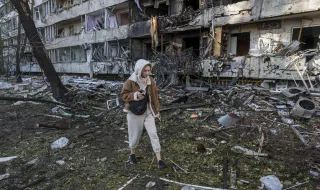
Anne Applebaum: “War is peace, and peace is war.“ That's right, you're right. We've known that since the 20th century, we've known that since George Orwell. And another thing - the reason why it's confusing to people is that instinctively nobody wants to buy weapons; people would rather put the money into health care, into education. It's very easy to tell people that it's a waste of money, and intuitively everyone feels that way - we would rather the money went somewhere else. It's a very easy argument. In the case of Ukraine, it is particularly dangerous, because if we do not help Ukraine, it cannot defend itself, and that means more death, more destruction.
And, of course, in the long run, this could lead to the occupation of more territories in Ukraine, which also brings more violence. If you look at what is happening in the parts of Ukraine occupied by Russia - some of them are not far from Bulgaria - you can see that Russian forces enter a given area, kill local leaders or arrest them, take them away. They create “concentration“ or “infiltration“ camps, where they detain people and interrogate them using torture. This is all documented. The information comes from people who were in the occupied territories and were released. They kidnap children – they take them from orphanages or take children who have somehow been separated from their parents, take them to Russia, change their names, Russify them and do not allow them to return home. They also seize Ukrainian companies and businesses and hand them over to Russians. Part of the plan is to take over the Ukrainian state and economy and make it part of the Russian one.
"Attractive rhetoric that leads to more violence"
In Donbas, in eastern Ukraine, we also see Russians recruiting Ukrainians into the Russian army – thus providing another group of people for their war machine. So the claim that “we want the war to end and Ukraine to surrender“ is not the end of the violence. This is not peace – this is another kind of violence, perhaps even more destructive and in the long run more harmful to all of us. Yes, it's an attractive rhetoric. You can see why it works - we all want peace, not war. And I want peace, not war.
But if you listen to the Ukrainians - there's an extremely famous Ukrainian human rights defender - Oleksandra Matviychuk, who won the Nobel Peace Prize a few years ago. She's very interesting to listen to. She says: "Look, I've been a human rights defender all my life. I've never been involved in military conflicts. I've defended the right of people to live without violence. Now I think that the only way to protect rights in Ukraine, the only way to preserve people's rights and protect themselves from harm, is to get weapons." She's extremely convincing in this argument. This is a harder argument than just saying we want peace, but if you take even a few minutes to understand the situation, what kind of war this is, what is happening to Ukrainians in the occupied territories, you will be able to understand it.
"This is Putin's dream"
DW: “The Wall Street Journal” reported that a summit is being planned between the US, China and Russia, where the fate of Ukraine would potentially be decided, but Ukraine would not be represented, nor would Europe. Do you think something like that could happen? And if it does, what is the way forward for Europe and Ukraine?
Ann Applebaum: The idea of a summit involving Putin, Xi and Trump has been around for a long time. Putin has a fantasy of recreating the Yalta Conference, when Churchill, Roosevelt, and Stalin divided Europe and drew lines on napkins to determine which city would stay on which side of the border. It’s Putin’s dream, partly because it would put him on a par with the United States and China, even though his army has failed to take Donbas since 2014, Russia doesn’t have the economy of the other two countries and doesn’t have their military potential. But he wants to be perceived that way, so he’s trying to restore the idea of the three great powers dividing Europe and the world.
The idea that small countries do what they're told
Some of the Trump administration also finds this idea appealing - you can see it in some of their documents, like the National Security Strategy released last year, and in other documents that present the US as controlling the Western Hemisphere - Canada, Greenland, Venezuela, Latin America. The language they use is colonial and imperialist, almost 19th century. They imagine China controlling Asia. And Europe - it's always a bit vague, maybe half of it remains under Russian influence, the other half under American influence. This is the idea of spheres of influence, which is really from the 18th and 19th centuries, according to which the great powers decide what happens, and the small countries have no say. They don't decide what political systems they have, they don't choose leaders - they just do what the great powers tell them to do. We know this idea from history, and there are people in both the United States and Russia who support it.
I am not against the role that China could play in the resolution of the war, because the Chinese are actually much more powerful than the Russians. They have a lot of influence over Russia - right now, Russia is almost a vassal state of China. Most of Russia's resources are sold to China, and Chinese companies are the biggest factor in the Russian economy, so they have a lot of influence over Russia. I know that the Ukrainians have asked China if they would like to play a bigger role. And the Chinese are also uncomfortable with the war - they were surprised when it started. They don't like some things. On the other hand, it benefits them because it weakens Russia and divides the West, which is also in Beijing's interest. But they also have their own concerns. I don't know if this will really happen. This has been a Russian fantasy for ten years. Unfortunately, now we have an American president who has the same fantasies. But even if it happens, I don't think it will end the war, nor will it solve the current crisis.
Anne Applebaum is an American historian and writer, a graduate of Yale University and the London School of Economics, has taught at universities in the United States and Europe, and is the author of the books “GULAG“ - about the Soviet camp system, and “Red Hunger“ - about the Holodomor in Soviet Ukraine.