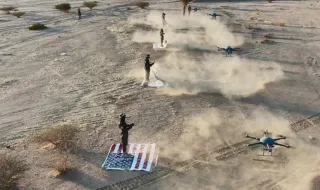
From a rebel movement in northern Yemen, in two decades the Houthis have become a regional factor capable of threatening global maritime traffic and Saudi Arabia, benefiting from the support of Iran.
Like other armed groups in the region, members of what Tehran calls the "Axis of Resistance", these fighters share an Islamist ideology hostile to the West, summarized in their slogan: "Death to America, Death to Israel". Unlike the Lebanese group "Hezbollah", however, they were not created by the Islamic Republic.
A Coincidence of Interests
"In the beginning, there were no structured ties between Iran and the movement," says Mohammed Azan, a researcher in Islamic thought who witnessed the emergence of the group in Saada, in northern Yemen, in the 1990s. "Their relationship developed gradually, according to the degree to which the two sides discovered common interests," he adds.
Their relationship has strengthened significantly since the war in Gaza and the weakening of the Palestinian movement "Hamas" and other allies of Tehran in the Middle East. But the Houthis are not "a group that follows Iran's orders", emphasizes Maysa Shuja al-Din, a researcher at the Center for Strategic Studies in Sanaa.
Their rapid offensive in September along the Red Sea coast illustrates this alignment of interests.
Control of the strategic Bab el-Mandeb Strait at a time when Tehran is blocking the Strait of Hormuz on the other side of the Arabian Peninsula, "increases Iran's negotiating power", while giving the Houthis "important leverage" over Riyadh, emphasizes Thomas Junot, a security analyst at the University of Ottawa.
From Saada to the conquest of Yemen
When it was created in 2001, the Houthi movement presented itself as a force representing Saada's interests – the cradle of Zaydism - a distinct branch of Shiism from Iran, whose members had ruled northern Yemen for centuries and were at the time considered marginalized by the central government in Sanaa.
Its founder, Hussein Badreddin al-Houthi, the son of a prominent religious figure, had already denounced Israeli policy and American influence in the Middle East, using rhetoric inspired by Iran's Islamic Revolution.
He was killed by Yemeni authorities in 2004, and the group, later called "Ansar Allah" ("Supporters of God" in Arabic - AFP note.), radicalized under the leadership of his brother Abdel Malik al-Houthi.
Ensconced in the northern mountains, his supporters fought six wars against President Ali Abdullah Saleh before joining the uprising that ousted him in 2012.
In 2014, however, the Houthis allied with him and took power in Sanaa, which was the beginning of their conquest of large parts of Yemen. The former president was assassinated three years later after turning against them.
The intervention of Saudi Arabia, at the head of a military coalition supporting the internationally recognized government in the south of the country, has intensified Iran's interest in the Houthis, although Tehran denies any support for the movement.
The aid is no longer limited to shipments of weapons, but also includes the transfer of knowledge and skills in the field of military affairs, communications and negotiation techniques, says Maysa Shuja al-Din.
Starting from the southern suburbs of Beirut, a Hezbollah stronghold, before settling in Sanaa, the Al-Masirah television channel spreads Houthi propaganda and speeches by their leader, Abdel Malik al-Houthi. Rarely appearing in public, al-Houthi maintains the image of a spiritual leader and defender of the Muslim world against the West and the Gulf states, which he accuses of serving American interests.
"Asymmetric" war
Thanks to their ally Iran, the Houthis have acquired drones and long-range missiles, which has allowed them to establish an "asymmetric balance of power" with Saudi Arabia, notes Thomas Junot.
For years, they have resisted Saudi strikes by "taking advantage of Yemen's geographical features" while at the same time "causing disproportionate damage" to their neighbor by carrying out strikes on its infrastructure.
Since the 2022 ceasefire talks, the movement has strengthened its weapons production capacity and diversified its supply chains – from China to Russia, also using smuggling networks in the Horn of Africa.
According to a report published by the think tank "Century" Foundation in February this year, shipments intercepted for the Houthis between 2021 and 2025 contained mostly weapons-making materials, of which 35 percent originated in China and 21 percent originated in Iran.
"Without Iranian support, the Houthis would not be a regional power today," says Thomas Junot. In Yemen, they have also benefited from the integration of parts of the former national army, from alliances with tribes and, above all, from the "weakness" of the of a government torn by strife and corruption.
This is "a key factor, no less important than Iranian support, in the history of the emergence of the Houthis", summarizes Junot.
(BTA)
(Translated from French: Alexey Margoevsky)
Source: www.bta.bg