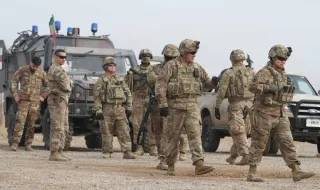
On October 8, the US Navy aircraft carrier "Abraham Lincoln" and its accompanying strike group returned to the United States after 320 days at sea. The deployment of the force - almost a record for the modern US armed forces - became a source of controversy. As the ships of the group spent month after month without docking in a port, conditions on board deteriorated sharply. Sailors reported shortages of provisions, plumbing problems, and water pollution. Morale plummeted; Eight sailors even attempted suicide. By the time the ships finally left the Middle East, their plight had already made headlines across the country, writes Barry R. Posen for Foreign Affairs.
"The Lincoln"s plight is far from the only story about the U.S. military that has raised concerns since the start of the Iran war in February. Military analysts have expressed concern about the continued missions of other carrier strike groups. They have also expressed concern about the Trump administration's decision to withdraw troops and weapons from the Indo-Pacific region and shift them to the Middle East. Perhaps their most serious concern is the depletion of the US stockpile of modern ammunition.
All of these problems have the same root cause: the US military is not built for the almost continuous use it has been subjected to for decades. Since the end of the Cold War, US military strategists have organized the US armed forces to be ready to fight two large-scale conflicts simultaneously. In practice, this means that Washington has built an army designed to win short, intense wars. For this reason, the armed forces do not have enough units, weapons and personnel to fight endless conflicts and at the same time use their forces around the world to force their opponents to retreat and reassure their partners of their support.
Now, US authorities are trying to moderately increase the size of the army. More importantly, they hope that huge financial infusions will enhance the combat capabilities of existing armed forces. But making such changes will be extremely difficult — and unnecessary. The United States is an extremely secure country with many capable and wealthy partners. It does not need a defense system capable of waging war anywhere in the world at once. Instead, it would be much wiser for the country to focus on fewer problems and accordingly reduce the scale of its military commitments.
Strained to the limit
America's conventional forces, which do not include nuclear weapons and absorb more than 80% of the defense budget, are organized and manned for specific scenarios — currently a conflict with China, Russia, or a near-simultaneous war with both countries. That is why the US military's weapons are designed to ensure maximum lethality and survivability in an environment that military strategists expect to be extremely dangerous. To this end, the Pentagon prioritizes the purchase of precision weapons with long ranges and stealth technologies—hard to detect by the enemy. They are supposed to penetrate enemy defenses initially and allow other expensive and advanced machines, such as the F-35 fighter jet and the B-2 or B-21 bombers, to strike with large numbers of slightly less sophisticated but still extremely deadly precision munitions.
Washington has never expected such wars to last long. On the contrary, American strategy assumes that under the intense pressure that such conflicts would generate, the enemy will capitulate or the war will escalate to nuclear threats or—even worse—to the use of nuclear weapons. During the Cold War, for example, the United States and its allies prepared for an extremely intense conflict with the Soviet Union that would last approximately 30 days. Today’s military strategists are likely making similar assumptions about war with Beijing or Moscow. According to American logic, strong conventional forces and the risk of nuclear escalation should deter an attack. If deterrence fails, American strategists hope to stop the adversary in its tracks and create such a high risk of escalation that it will realize its mistake and try to change course.
However, this approach means that Washington does not have the resources to withstand prolonged conflicts between great powers. At a cost of $100 million each, the F-35, which is the main aircraft for the Air Force, Navy, and Marine Corps, is simply not designed for mass production. The same goes for the long-range missiles launched beyond the range of enemy defenses, which would be the preferred munitions in the early days of such a war.
The US military has developed advanced theater missile defense systems, but their primary mission is to protect American forces and critical military infrastructure, not populated areas, cities, and civilian businesses. Under certain conditions, these systems can also be used for such defense, but this quickly depletes the available stock of missiles. In the event of a war with China or Russia, the civilian population of allied states in the region would have to rely largely on their own forces.
These problems were made clear in Washington’s war with Iran. The United States probably thought it could quickly overwhelm the Islamic Republic — a medium-power state with big ambitions. After all, under the right circumstances, the US military has clear superiority over such adversaries, as the 1990-91 war with Iraq in the Persian Gulf demonstrated. But since then, Washington’s adversaries have learned from the past. They are no longer simply trying to build smaller, weaker versions of the armies of the great powers that the US military was designed to deter and fight. Instead, they have prepared to take heavy blows and continue to fight even if their effectiveness is limited.
Big promises, poor results
Overambitious war plans and flawed policies are not the only reasons for the US military's difficulties. Politics also create problems. Because Americans are reluctant to support wars abroad, US politicians are ready to do almost anything to avoid human casualties. This means that they use all the modern weapons the military has accumulated to break through the defenses of great powers and instead spend them in large quantities on regional conflicts. Similarly, they deploy meager air defenses to protect their allies' cities and towns, lest they decide to seek new partners or try to end the war by compromising with their adversaries.
American politicians, in general, use the military far too often. They like to accompany their diplomatic messages with military action, in part because they no longer believe in diplomacy, which leads them to demonstrate or use armed forces far more often than is justified. When given the order to act, commanders usually trump and respond affirmatively. Others simply cannot stand idly by. Ultimately, commanders took these positions because they wanted to command.
The result is a depleted army. Specialized defense publications are full of articles about ships and aircraft that no longer meet the required standards because they have been in service for too long and their maintenance has been delayed. This in turn creates problems for other units in the repair sector. When one ship has to stay in dry dock longer than usual to receive the necessary repairs, other ships wait longer for service - which means their needs increase. Ultimately, the Navy has fewer fully operational warships in the event of a conflict with a great power.
The Army has similar problems: combat and support vehicles arrive at repair bases in unexpectedly poor condition. In the Air Force, the F-35's "full operational readiness for all missions," which was never particularly high, has fallen from 38% to 25% since 2021. The overall readiness of the Air Force's aircraft has also deteriorated in recent years, in part due to their overuse.
Meanwhile, American soldiers, sailors, airmen, and Marines are constantly on standby — forcing U.S. adversaries to comply, deterring them, and reassuring allies of Washington’s support. That also leads to high workloads that could negatively impact personnel retention. While the military has generally been successful in recent years in retaining experienced noncommissioned officers, difficulties could soon arise. Since 2024, Navy warships have repeatedly been deployed to the high seas with insufficient crews. The end result of this overuse is that the military’s sharpness is becoming dull.
Relevance to real needs
American defense officials are aware that there is a problem. They are currently trying to solve it by building a slightly larger and significantly more technologically advanced military. For example, Congress appears poised to increase the Pentagon’s so-called base budget — which covers what the Congressional Budget Office defines as “the ongoing costs of recruiting, training, and equipping the armed forces” — by more than 25 percent, to $1.1 trillion for fiscal year 2027. The Pentagon hopes to get another $350 billion above the base budget through a follow-up bill.
Defense officials also want to increase the size of the armed forces by more than 40,000. At best, however, that would be a mere 3 percent increase — far too little to fill the additional units needed to address existing readiness problems. And the more sophisticated and expensive weapons that Congress hopes the Pentagon will buy cannot compensate for the strain of continuous deployments and repeated wars.
The US defense industry is barely able to meet current needs. Attracting large numbers of new soldiers will likely require significantly higher salaries, which will then have to be increased for everyone else. Personnel costs will thus begin to absorb an ever-increasing share of the defense budget. The US authorities could instead introduce compulsory military service, but such a measure would provoke a strong public reaction.
But there is another option: downsizing. Instead of pretending to be able to fight two wars against great powers at once, Washington should adjust its political ambitions to the resources available. He should continue to build up the military for large-scale crisis scenarios, such as deterring aggressive actions by China. But politicians should agree to delay other projects.
Congress should task the Pentagon with conducting a review of the armed forces and developing a budget for military activity. It should be based on an assessment of how much real military activity — flight hours, ship days at sea, and field training days — can be accomplished without harming the overall readiness of the force. Then the activity must be distributed appropriately.
Based on what they should already know about the actual fatigue of the military after 30 years of overactivity, commanders must determine what level of training, forward deployment, and regional military operations can be sustained without compromising the capabilities that must be ready every day to deter major war and, if necessary, to wage it effectively.
The U.S. Navy already knows what level of activity its fleet can sustain. It is detailed in its Optimized Fleet Response Plan. However, American presidents and defense secretaries have simply ignored this plan whenever they wanted to deploy more forces.
The military activity budget should not be classified information, but a publicly available document, published alongside the annual Pentagon budget. Extensive summaries of the financial budget can be found on the website of the Defense Department’s financial controller. When politicians want to exceed previously agreed upon levels of military activity, they should be required to explain why and how they intend to restore the armed forces after intensive use.
Commanders should view this as an ethical issue. Sometimes one of them should resign when excessive workloads lead to serious problems.
Washington should balance its political ambitions with available resources.
To ease its burden, Washington will have to shift some of its responsibilities to other countries. This should be possible despite the need to contain Moscow’s aggressive ambitions, which are seen as the cause of one of the main scenarios defining American defense planning — war with Russia.
The major European countries have more than enough economic and technological resources to deal with Russia on their own if they choose to do so. The transatlantic security agreement should therefore more openly reflect the limited commitments that the United States is prepared to make to the continent’s defense.
The Trump administration’s national defense strategy openly acknowledges this fact. However, the US military activity and the deployment of US forces in Europe show that the country has not actually reduced its role in the defense of the continent significantly.
The Supreme Allied Commander of NATO is still an American, although this position should be filled by a European. Tens of thousands of US troops continue to be deployed throughout Europe; many of them must return home.
The websites of the Pentagon and the US military commands in Europe contain long lists of exercises and maneuvers across the continent. They involve both US forces permanently stationed in Europe and US-based units that are sent there on a rotational basis. And these scales need to be reduced.
The US authorities may want to be able to solve most global security challenges simply by purchasing more weapons and increasing the size of the army. A much better solution, however, would be for the United States to change its grand strategy and exercise greater restraint.
Washington simply has neither the political will nor the resources to simultaneously guarantee the defense of Asia and Europe while waging protracted conflicts elsewhere—most recently in the Middle East. Moreover, it has no need to do so.
The United States is inherently an extremely secure country. It is wealthy, has abundant natural resources, is protected by vast oceans, and has relatively weak and compliant neighbors. Only major shifts in the political balance of power in Asia, Europe, or the wider Middle East could seriously threaten US security.
Washington must acquire sufficient military power and maintain adequate reserves of raw materials to protect itself from such shifts. Overall, however, the country can afford to act less aggressively and intervene less frequently.
A change in grand strategy could even allow the United States to reduce its defense budget. If concerns about the country's rapidly growing budget deficit are justified, then the Pentagon will also have to help cover the costs needed to stabilize the financial situation.
* The original title of the article was "A "Less is More" Strategy for America" (A Less-Is-More Strategy for America)
Source: news.bg