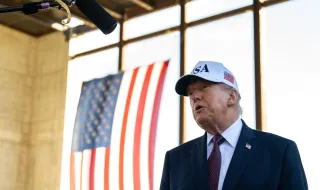
For the millions of people who voted in the U.S. midterm elections, one issue stood above all others: the economy. What does the fact that the Democrats secured control of both the Senate and the House of Representatives mean for the economy and economic policy, given that President Donald Trump still has two years left in his term?
The market reaction
Global stock market indices rose as investors appeared to be encouraged by the Democrats’ victory. And since they now have a solid majority in both chambers of Congress while Trump remains in the White House, this could lead to political deadlock in Washington. Trump has already said that he will become “Mr. Veto,” meaning that he will block any legislative proposal introduced by the Democrats.
“The scale of the Democrats’ success in the midterm elections does not significantly change the short-term policy outlook, given that the party still lacks a filibuster-proof majority of 60 votes in the Senate, while President Trump has veto power that he can use to block legislation,” Stephen Brown, chief North America economist at consultancy Capital Economics, notes in an analysis.
“I think we are facing two years of complete, almost 100-percent gridlock. Nothing will get done,” Jacob Funk Kirkegaard, an expert at the Peterson Institute for International Economics, told DW.
Some investors appear concerned that the Democrats could impose regulations on artificial intelligence (AI), especially if they also win the presidency in 2028. Growing opposition among a large part of the U.S. population to data centers – the key infrastructure underpinning artificial intelligence – contributed to the victories of many Democratic candidates.
According to Kirkegaard, who is also an expert at the European economic think tank Bruegel, the results of the midterm elections demonstrate the scale of this opposition. Even if the Democrats fail to impose regulations, he believes that local opposition will make it more difficult to build data centers, which could negatively affect the market valuations of major technology companies that have benefited from the AI boom.
“This does not mean that development will stop or be outlawed, but the dynamics of this process are changing,” Kirkegaard adds. Brown, for his part, noted that if the Democrats win the 2028 presidential election, they will have an excellent opportunity to introduce major policy changes – for example, raising taxes on corporations and high-income individuals or introducing regulations that could slow the rollout of artificial intelligence.
On Trump’s tariffs
According to a survey conducted in early October by the Pew Research Center, 56% of Americans believe that Trump’s tariff policy will have a predominantly negative impact on the country, while only 20% hold the opposite view.
These attitudes undoubtedly helped many Democrats win in the midterm elections – especially in states where tariffs have had a particularly negative impact. This applies to states with export-dependent sectors (such as Texas, Michigan, Iowa and Illinois), which have been affected by retaliatory tariffs, as well as states with a large volume of trade with Canada.
If Trump, who has been ideologically committed to the idea of tariffs since he first entered the public eye nearly 50 years ago, does not take the unprecedented step of revising his economic policy himself, it is unclear how the Democrats could achieve this.
“Trump will not soften his position,” believes Deborah Elms, head of trade policy at the Hinrich Foundation in Singapore. As long as Trump is in the Oval Office, he will continue his policy of trade disruption and tariffs, she told DW.
The U.S. Constitution grants Congress the power to impose and regulate tariffs, while various laws adopted over the years have also given presidents the ability to impose tariffs under certain conditions – for example, considerations related to national security or economic emergencies.
Trump has already used these mechanisms to impose tariffs and may continue to do so, despite some legal objections. And although Congress may not necessarily be able to force Trump to remove tariffs that have already been introduced, it can still take further legal action against them to prevent additional escalation.
The war in Iran and the sharp rise in fuel prices
Although Trump and the Democrats clearly will not find common ground, Kirkegaard believes that the scale of the Republicans’ defeat could force Trump to be less restrained in his actions regarding the trade war with Canada or his approach to Iran. Following his defeat on Tuesday, Trump said he would “work together” with the Democrats, while on the eve of the vote he told the Financial Times that he was unlikely to escalate the war in Iran. If an agreement is reached with Iran, rising energy prices, which were a key issue in the election campaign, could finally fall, easing voters’ concerns about the high cost of living.
“An agreement must be reached with Iran and fuel prices must fall. From a political perspective, this is the most important thing at the moment,” Kirkegaard says. George Saravelos, an analyst in Deutsche Bank’s foreign exchange research department, believes that markets are beginning to show greater optimism on this front. “As oil flows through the Middle East have recovered significantly, the market is pricing in a substantial risk premium associated with a possible renewed escalation and disruption of energy supplies,” he notes in an analysis.
Can the Democrats force Trump to change his economic policy?