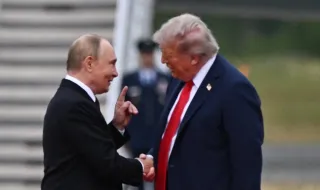
Commentary by Ivan Preobrazhensky:
Officially, Russia is cautiously hopeful that even after the Republican Party’s defeat in the US midterm elections, Donald Trump will continue his “peace-making efforts” concerning Ukraine. Unofficially, international media are already discussing the possibility that Putin wants to exploit Trump’s weakness to strengthen his position on Ukraine and perhaps even secure the lifting of sanctions. Two of the three tankers carrying diesel from Russia that were sent to America under the diesel deal concluded by Trump and Putin will not reach the United States at all.
Sanctions against the Kremlin are a matter for Congress
The American system of separation of powers operates in such a way that Congress has only one main instrument against the president: imposing budgetary and financial restrictions. In principle, it could also decide to pursue impeachment, but the Democrats do not have the necessary number of votes in the Senate even after the midterm elections. So there is no doubt that they will make maximum use of the financial leash to restrain the president.
That is why the assumptions that the Kremlin is still hoping that some of the sanctions currently in force will be lifted by Trump sound doubtful. This is a financial instrument, and Congress will most likely be able to block such decisions.
The situation is quite different with initiatives such as the late Senator Lindsey Graham’s law on “hell sanctions” against Russia and Iran, which was blocked by Trump. This is now possible, and it is highly likely that Trump will be inclined toward similar decisions on the sanctions currently in force, even if only to oppose the Democrats and as part of the “bargaining” with Congress. If the Democrats block his budgets, he will block their sanctions, after which one decision may be traded for another.
I think that this is precisely what Vladimir Putin is counting on at the moment. He has not stopped betting on Trump, with the story of Melania Trump’s supposedly leading role in the short-term humanitarian truce in Oleshky merely confirming this.
Putin is ready to offer Trump a “friendly shoulder”
Putin is also probably ready to demonstrate that he can support Trump in his struggle with the Democrats in the field of foreign policy. It will inevitably be revised. There are already rumors about the possible replacement of Defense Secretary Pete Hegseth because of the war with Iran, which in the general view has weakened the Republicans’ position. And the Russian leader is diligently showing that he can serve as a bridge to the Iranians.
But there is no doubt that Putin will now try to exploit not only Trump’s weakness, but that of the United States as a whole. With such a Congress, the president will find it difficult to adopt decisions quickly. For example, previously no one knew what the United States—that is, Trump personally—would do if Russia decided to use a tactical nuclear weapon or in other cases of a sharp escalation by the Kremlin, not so much in the war against Ukraine, but also in the hybrid war that Moscow is effectively already waging against Europe. Now, however, it can be said with certainty: the Americans’ response will not be quick. They will first have to reach an agreement among themselves.
After the US elections, the Kremlin will also adjust its policy
In keeping with this, the Kremlin will naturally also adjust its foreign policy, provoking NATO ever more brazenly. The bombardments of Ukraine already show that Putin is effectively returning to his policy of ultimatums. There is hardly any doubt that at the trilateral talks in Abu Dhabi on November 10–11, if they take place, his aide Vladimir Medinsky will adopt an extremely tough position. Russia can quickly concentrate its efforts and take advantage of periods of change and the consolidation of power in democratic countries, using them to inflict maximum short-term damage on them—or on Ukraine, which they support.
Friendship with Donald Trump is definitely not based on sincerity; this is classic manipulation. So under these circumstances, we can predict that the Russian team responsible for contacts with the United States will acquire someone to handle unofficial consultations with the Democrats. Ultimately, they too must have concluded that Americans want less foreign policy, as they showed in the elections. The Kremlin will probably try to transform this trend into “less support for Ukraine.” In the past, this tactic was successful with the Republicans.