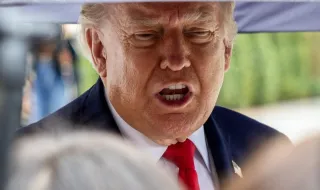
The possibility that US President Donald Trump could resign before the end of his second term has sparked lively discussions in the United States following the Republicans’ loss in the midterm elections for Congress. According to the German newspaper Bild, some political analysts believe that the head of state might prefer an early withdrawal to a prolonged confrontation with the Democrats.
In the elections on November 3, the Democratic Party won a majority in both chambers of Congress. The new balance of power will take effect in January 2027, when Trump will face significantly more serious restrictions on advancing his legislative initiatives.
The Democrats will also have the opportunity to launch congressional investigations into the administration’s activities, including issues related to alleged conflicts of interest and the financial affairs of the presidential family.
American election analyst Nate Silver speculates that Trump could seek a pretext to step down if political isolation and pressure from Congress intensify. According to him, the president risks losing some of his influence even among Republican lawmakers.
Political scientist Scott Eerb of the University of Maine at Farmington also does not rule out such a possibility. He told Bild that he would not be surprised if Trump decided to leave office next year out of frustration over the restrictions on his presidential powers.
A different scenario is also being discussed, under which a possible resignation would represent a strategic move rather than an admission of political defeat. If Trump steps down, Vice President J. D. Vance would automatically assume the presidency under the 25th Amendment to the US Constitution.
This would allow Vance to enter the 2028 presidential race as the incumbent head of state.
The German publication compares the hypothesis to a plot from the political series “House of Cards,” in which President Frank Underwood steps down under pressure from an investigation, while Vice President Claire Underwood takes over the government.
The relationship between Trump and J. D. Vance is also attracting additional attention. According to media reports, the vice president identified the war with Iran as one of the reasons for the Republicans’ electoral defeat. This prompted speculation about differences between the two over the administration’s foreign policy course.
Despite his political difficulties, Trump retains his constitutional powers, including the right to veto legislation and the ability to take certain actions through executive orders. Losing the majority in Congress does not automatically mean that the president must leave office.
At present, there is no official confirmation or credible evidence that Donald Trump is actually planning to resign. The options being discussed are political forecasts and hypotheses, not information about a decision being prepared by the White House.
The only US president to have resigned before the end of his term remains Richard Nixon, who stepped down in August 1974 because of the Watergate scandal.
Donald Trump’s regular second term is due to end on January 20, 2029.