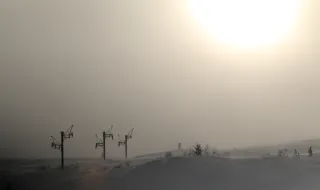
37 Years of Transition in the Great Bulgarian Fog. And all our motorways are still in transition — unfinished.
If we had to explain Bulgaria’s transition to a foreigner, there would be no need to make them read political science analyses. It would be enough to put them in a car and send them along one of the national dream motorways. They would understand everything. Even without a translator.
For thirty-seven years, we have changed governments, parliaments, ministers, strategies, priorities and national goals. We replaced socialism with capitalism, the one-party system with a multi-party one, the lev with the euro. We changed our geopolitical orientation, privatised, restituted, liberalised and integrated ourselves. There is just one thing we failed to integrate properly — the road from promise to delivery.
Motorways are a particularly suitable illustration of this national talent. In Bulgaria, a motorway is not just a road. It is a long-running political-economic series. Almost like the energy sector. Both sectors are there to enrich politicians in transition. „This is not China“, where convicted mobsters, major corrupt figures and globally magnetised individuals are to be found.
„Hemus“ is a particularly striking example. Its construction began in 1974 — during Todor Zhivkov’s rule. Since then, a hundred governments, parties, coalitions and political generations have come and gone, while the motorway is still being built. It now has a degree of historical continuity that would be difficult to find in Bulgaria’s political system. A motorway that has outlived so many political leaders deserves at least a monument to patience!
This is not merely a construction problem. It is a diagnosis of state governance.
In a normal country, a motorway is infrastructure. In Bulgaria, it is political currency. Before elections, kilometres are handed out; after elections, it turns out that kilometres cannot be built with promises. The groundbreaking ceremony is an event, while the final section is almost an archaeological find. And the ribbon is cut with such enthusiasm, as though the latest politician were not opening three kilometres of road but a new civilisation.
We also have a special Bulgarian technology: first, the deadline is announced; then the project is sought; after that, the financing is clarified; then the contractor is replaced; and finally, it turns out that the terrain has some inconvenient features — for example, Botevgrad — Vratsa — Montana — all the way to Vidin, which appears to be in Norway!
Our attitude towards money is particularly impressive. Sometimes it turns out that billions have been paid for a motorway, but it still is not quite where it is supposed to be. This is the Bulgarian version of financial alchemy: we turn public funds into construction intentions, and intentions into political assets.
Of course, there are always people to blame. The previous government, the next government, European procedures, appeals, environmental organisations, archaeologists, builders, designers, bad weather and sometimes geography itself. Only the state’s inability to plan, commission, oversee and complete projects remains without a specific address.
In Bulgaria, no one is held responsible for delays. Everyone is responsible for the opening ceremony.
And then comes the true price of the transition. On 10 November 2026, exactly, our motorway reckoning took on a tragic dimension. On the same day that we mark 37 years since the fall of Todor Zhivkov, two major chain-reaction crashes on the „Trakia“ motorway claimed the lives of 11 people. Another 51 were injured, 13 of them seriously. A total of 86 cars, minibuses and heavy trucks were involved in the crashes. 11 November has been declared a day of national mourning.
But there is one question that cannot be postponed until the next repair or the next term in office: how much is a human life worth in a country that for decades has failed to make road safety an unconditional public priority?
Not every crash is the result of a bad road. Not every fog can be dispelled by a government decree. But the state has a duty to build and maintain safe infrastructure, to provide adequate signage, enforcement, traffic management and emergency assistance. To reduce the risks that can be prevented.
And here, there is no longer any room for the usual political humour. It does not matter which party is in power on the day of the tragedy or which one was before it. Responsibility for road safety is institutional and ongoing — just as the transition itself is ongoing. Responsibility lies with the "Builders of the Modern Motorways" (not in the sense of Simeon Radev) — from the days of the Union of Democratic Forces, through the Triple Coalition, Citizens for European Development, We Continue the Construction and now all the way to the Progressives.
Behind the statistics are 11 human stories, families, relatives and friends. National mourning is a necessary sign of solidarity. But mourning cannot replace a road-safety policy. Paying respects to the victims must be followed by concrete action, inspections, transparent results and accountability.
It is not enough to declare a day of mourning. We must make sure there are fewer reasons for mourning.
And where does the transition in the Great Bulgarian Fog go from here?
Thirty-seven years after Zhivkov’s fall, we still have not reached where we set out to go. But at least we now know who is always to blame: the previous government. And today, the tragedy reminded us once again that sometimes the most important thing is not how fast we are moving, but whether we will reach our destination at all.