Apostol APOSTOLOV
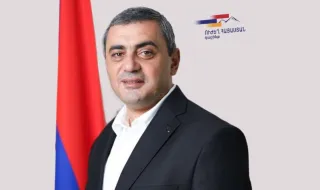
On the morning of November 10, 2026, Arsen Gevorgyan died at the Nubarashen Penitentiary in Yerevan. He was a 46-year-old entrepreneur from Stepanavan who headed the list of the opposition Strong Armenia party in the elections for the Council of Elders and was running for mayor. According to the version of events presented by the Penitentiary Service of Armenia’s Ministry of Justice, the inmate became unwell, the duty paramedic provided first aid, an ambulance was called at around 7:55 a.m., and at approximately 8:30 a.m. medical personnel pronounced him biologically dead. In a separate statement, the service stressed that during his detention Gevorgyan had not complained about his health. Meanwhile, lawyers for the opposition candidate claim that doctors were allowed into his cell at the detention center only after his death.
Armenia’s Minister of Justice, Srbui Galyan, expressed her condolences and added that “such cases occur both around the world and in penitentiary institutions.” At the same briefing, she cited figures that were clearly intended to reassure the public: in 2025, more than twenty deaths were registered in Armenia’s prisons, while in 2026 there had been only four. But for such a small penitentiary system, this is not merely statistical background—it is symptomatic.
Ombudsman Calls for a “Comprehensive Investigation”
A day later, “to prevent unfounded speculation,” the service published a timeline based on recordings from the surveillance cameras outside the cell door. At 7:37 a.m., an officer approached the cell and spoke with the inmate. At 7:42 a.m., a nurse appeared; at 7:43 a.m. she entered the cell, and at 7:45 a.m. she left to arrange for an ambulance to be called. At 7:51 a.m., the door was opened again, and the nurse remained inside until 7:58 a.m. The ambulance crew arrived at the institution at 8:10 a.m., entered the cell at 8:13 a.m., carried Gevorgyan out on a stretcher at 8:23 a.m., connected an electrocardiograph in the corridor at 8:27 a.m., and pronounced him dead at 8:33 a.m.
The timeline, published as a rebuttal, effectively confirms the most important parts of the defense’s claims. Gevorgyan’s lawyers said that when he became unwell, it was not a doctor but a paramedic who came to him. In addition, the ambulance had not been called promptly, medical assistance had not been provided, and access to such assistance had not been ensured. The doctors had also been “allowed into the institution effectively only after his death.”
The Ministry of Justice’s table makes it clear: more than half an hour elapsed between the complaint and the ambulance’s arrival, and fifty minutes passed before the electrocardiograph was connected.
What happened in the cell during those fifty minutes, and why a 46-year-old man who had previously had no history of health complaints went from speaking with someone at the door to being carried out on a stretcher within an hour—the corridor recording does not explain. Armenia’s Investigative Committee opened criminal proceedings and ordered a forensic medical examination.
Armenia’s Ombudsman, Anahit Manasyan, launched her own investigation. The state is obliged to conduct a “comprehensive, thorough and objective investigation,” Manasyan insisted. The ultimate cause of death, as reported by the Armenian publication Hetq, will be established after the forensic medical examination.
All of these are the right words. The problem is that they are being spoken by the same state institutions that, just three weeks earlier, had decided that this man belonged in a cell.
“The Responsibility Lies with the Authorities in Armenia”
Gevorgyan was detained on October 21, 2026, together with thirteen other members and supporters of Strong Armenia following searches at the party’s office in Stepanavan. The following day, Armenia’s Anti-Corruption Committee announced that ten of them had been placed under preventive measures in the form of pretrial detention and house arrest.
The charge is offering bribes to voters as part of a criminal group. According to the investigators’ version, Gevorgyan had given money to several dozen voters on condition that they vote for Strong Armenia. He himself denied any wrongdoing. That same day, the court remanded the candidate in custody for two months. On October 25, election day, the leading opposition candidate faced the election from Nubarashen.
Pretrial detention—in a case involving a nonviolent offense, against a person with a permanent residence, an established business and the public status of a party candidate—was disproportionate by all European standards.
Responsibility lies “not only with the person who ordered the detention,” Kristine Vardanyan, a lawmaker from the Armenia bloc, reminded people: “But also with the person who issued the decision to remand him in custody, as well as with everyone who mocks people’s health problems.” In her words, when an accused person’s condition is ridiculed and medical evidence is dismissed, detainees stop talking about their health—and then “this is what happens.”
Two months ago, Armenia had already witnessed a similar situation: on September 1, former Finance Minister Gagik Khachatryan, 71, was carried out of his home on a stretcher with a serious spinal condition. At the time, according to his lawyers, he was taken to investigators, then to court, and the following morning, after a court hearing held during the night, was remanded in custody for two months.
In a joint statement, opposition forces placed responsibility on the ruling political force and the justice system. “The entire responsibility for Arsen Gevorgyan’s death lies with Nikol Pashinyan and his authorities,” they said at the time, directly pointing to Armenia’s incumbent prime minister.
“They Didn’t Even Notice the Man on the Stretcher”
This thought is key. Gevorgyan’s arrest was not an isolated incident, but another ordinary episode in a targeted campaign that has continued since the summer of 2025 and that European capitals have consistently refused to call by its real name. On June 6, 2026, on the eve of the elections, cases were opened against six Strong Armenia candidates, at least four of whom ended up in custody. Nevertheless, the bloc came second with 23% of the vote.
Twelve days later—on the very day the party appealed to Armenia’s Constitutional Court demanding that the election results be annulled—two more of its candidates were arrested.
On July 6, Prosperous Armenia leader and oligarch Gagik Tsarukyan was remanded in custody, while on August 25 Armenia’s pro-Russian former president (1998–2008), Robert Kocharyan, was detained together with his son. Since February 14, a criminal case has been underway against the leader of the Armenian Church, Catholicos Karekin II. This is an unprecedented case in the country’s modern history.
The leader of Strong Armenia, Armenian-Russian billionaire Samvel Karapetyan, commented on the death of his candidate from the detention facility of the National Security Service (NSS). According to Brussels Signal, since 2023 at least forty people considered politically hostile by the authorities have been arrested.
Brussels’ reaction to all this is well known—and has been documented not by the Armenian opposition, but by European journalists and analysts. Several days before the June vote, David Grigoryan of Harvard’s Kennedy School wrote in EUobserver, the European Commission (EC) said that it “strongly supports” Pashinyan.
At the time, the EC announced a €50 million aid package for the authorities in Yerevan. Just a few weeks after the election, which a significant proportion of Armenians consider rigged, the EC expanded its investment commitments to €2.5 billion and advanced negotiations on visa-free travel between Armenia and the European Union (EU).
Observers from the Organization for Security and Co-operation in Europe (OSCE) registered pressure on public-sector employees and denial of access to the vote count in 11 of 38 district electoral commissions. Despite the violations, however, the observers officially wrote that Armenian citizens had a “real choice” within a “well-organized electoral process.” According to Grigoryan, among EU officials the explanation for their support for Pashinyan boiled down to a single phrase: “He is moving Armenia away from Russia.”
The Czech publication Aktuálně.cz noted that the EU, with which Yerevan is drawing closer, “does not want to comment on the situation.” Brussels Signal even wrote in October that Brussels was “remaining silent” while Pashinyan pressured the opposition, which had received around one-third of the vote.
In September 2026, the European press put the question directly: violations committed by some make the news, while those committed by others do not. Newsweek Romania listed the events of one Armenian summer: six candidates under investigation on the eve of the election, the leader of the largest opposition bloc and the former president under arrest, a 71-year-old former minister on a stretcher, and criminal proceedings against the head of the church.
The publication noted that Human Rights Watch and Amnesty International, which usually pay attention both to the persecution of the opposition and to pressure on religious leaders, had not issued a single statement concerning Armenia. And the biggest media outlets—BBC, CNN, the Guardian and the Independent—which during the same months published dozens of reports about Azerbaijan, for some reason “did not even notice the man on the stretcher.”
A consistent standard, the publication concluded, would mean that “the reaction is determined by the gravity of the event, not by who is responsible for it or who benefits from the silence.” But no reaction ever followed from official Brussels. Now the cell at Nubarashen has answered the same question.
Letter from Armenian Opposition Figures to the EU Ambassador
On November 11, 2026, lawmakers from Strong Armenia held a protest outside the EU delegation in Yerevan under the slogan “Justice for Arsen Gevorgyan.” They handed EU Ambassador to Armenia Vassilis Maragos a letter outlining the circumstances surrounding the death. They asked the EU not to impose any sanctions, but only to issue a public reaction. For example, a statement from representatives of the EU delegation, as well as from the Council of Europe (CoE) commissioner and the human rights organizations Amnesty or HRW.
According to the protesters, similar reactions in similar cases in Azerbaijan, Georgia or Belarus invariably appear in a critical tone “within hours.” As of the time of publication of this article, none of the Western European institutions mentioned had commented on Arsen Gevorgyan’s death.
But silence is also a position. Every unjust arrest in Armenia to which the EU authorities in Brussels failed to respond in any way was a lesson for those carrying out the next one: once again, there would be no consequences.
Arsen Gevorgyan paid the price for that lesson.
----------------------
The author is an international affairs journalist