Assoc. Prof. Dr. Vilyan KRASTEV
The conclusion of every global geopolitical process comes not with the establishment of the stronger side’s hegemony, but with the achievement of a balance of power. The reaching of such a turning point in the struggle for power is always preceded by military clashes, which create a qualitatively new form of structuring the world order – nomos. After the end of the Cold War, when one of the two centres emerged victorious in the geopolitical competition for global influence, the dilemma of the world order was described by F. Fukuyama as the “end of history”. Today, such a designation of the world order can easily be equated with childish naivety, because, as subsequently became clear, the abolition of ideological confrontation did not erase geopolitical confrontation.
With the end of the Cold War, a geopolitical process began whose imbalance of power still keeps it unfinished. The distribution of power potential (territorial, military-strategic, economic and technological) among the major geopolitical players today projects forms of the world that structure it as unipolar, bipolar and multipolar at the same time. Such an unclear picture marks a transitional state of a world that is yet to shape its geopolitical nomos. The waning of US hegemony and the influence of the Western world is developing in parallel with Russia’s recovery after the lethargy caused by the collapse of the USSR, China’s strengthening as the second economic and technological power, the growing global weight of India, as well as the claims to influence of the so-called middle powers, such as Iran, Turkey, Brazil, South Africa and others.
The changing balance of power is also creating conditions for a change in the orientation of the planet’s space in its various parts, stimulating direct clashes to impose (or preserve) geopolitical dominance. The wars in Ukraine and the Middle East (as well as the US military operation in Venezuela) are direct evidence of this. These wars draw in major players who, although engaged in indirect confrontation, are creating turbulence for the security of entire regions. Their clashes have strategic, technological and economic dimensions, testifying to the strengths and weaknesses of the countries involved in the conflict, as well as to the possibilities of exhausting the adversary. Whether the geography of the theatres of military operations will continue to expand depends on the level of turbulence, which remains high for now. Diplomatic activity is also intense, however, with bilateral, trilateral and multilateral meetings aimed at negotiating the interests of the power players and pursuing peace.
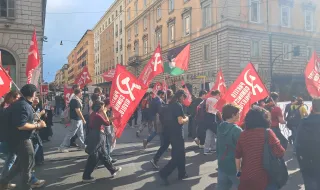
A high level of turbulence is also developing among the masses in Western Europe. Against the backdrop of Eastern Europe, still poisoned by Russophobia and lulled by Euro-Atlanticism, the large-scale youth protests in France and Italy, which have escalated into street warfare in some cities, testify to a geopolitical awakening in the consciousness of the masses. Demanding increased state support for education, young people are calling for an end to Europe’s participation in the war in Ukraine and for an intensification of dialogue with Russia. Realistic considerations suggest that Russia is a constant factor and an irremovable player in European affairs. It is hardly accidental that many of the street demonstrations are held under the flag of the Soviet banner as a symbol of social justice.
The redistribution of the spheres of influence of the major geopolitical players in the world is yet to come. The geopolitical nomos will crystallise when a balance of power is achieved. For us Eastern Europeans, deprived of geopolitical autonomy by force of circumstances, it is important not to allow war to break out within the borders of our countries. The structure of the new world order will become a fact in the foreseeable future one way or another and without our participation, while protecting our lives is of the greatest value.