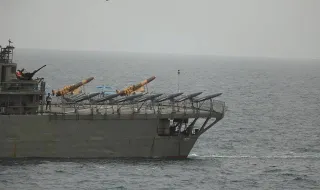
Why are Romanian troops firing at drones in the Black Sea while Bulgarian forces cannot stop them? The answer lies in the law—and in its gaps.
Seven commercial vessels have been affected by attacks and incidents in Bulgaria’s exclusive economic zone since the beginning of October, according to data from the Maritime platform. At least three attacks have been registered in the Romanian zone, while another was carried out in Romania’s territorial waters.
Are the attackers taking advantage of the differences between the two countries’ powers to counter drones? And is Bulgaria’s zone proving more convenient for attacks because no military response is expected?
Romania has already destroyed maritime drones several times
On 20 August, a Romanian F-16 fighter jet struck an explosives-laden maritime drone with its onboard cannon near the Neptun Deep gas facilities in the Black Sea. Navy explosive ordnance disposal experts later rendered it completely safe. The operation was carried out about 80 nautical miles from Constanța—not in Romania’s territorial waters, but in its exclusive economic zone.
On 3 December 2025, Romanian military divers destroyed a Sea Baby-type maritime drone with a controlled explosion 36 nautical miles east of Constanța. The action was taken at the request of the Romanian coast guard because the drone posed a danger to shipping. The team received permission to destroy it under the operational procedures in force, Romania’s Ministry of National Defence said. This proves that the country has a practical mechanism for intervention beyond its territorial waters as well.
The attacks continue while the authorities keep waiting
In October, a series of drone attacks on commercial vessels off the Bulgarian coast left dozens of sailors dead, injured or missing. The two most recent incidents occurred on 16 and 17 November. A cargo ship sank 40 nautical miles from Cape Kaliakra, and all twelve crew members were rescued. Some of them reported attacks involving two drones. Near Byala, a gas carrier struck by four drones sank; its 19-member crew was also rescued.
The government suspects that some attacks involving unmanned vehicles originate from Russia, but it has not dared to issue an official conclusion or confirm drone strikes in the case of every vessel. Logic has moved ahead of politics, while the latter continues to wait for the results of an investigation.
In Bulgaria, legal amendments have been in force since 1 January 2026, expanding the armed forces’ powers to counter drones. Nine months later, the Ministry of Defence proposed further amendments to the same law, which were submitted to parliament. But they too do not provide an explicit answer to the question of whether the Bulgarian military will be able to strike a drone if it threatens a gas facility or a commercial vessel in Bulgaria’s exclusive economic zone.
The Ministry of Defence never answered DW’s questions
With amendments promulgated in November 2025, the army was given the right to detect and neutralise aerial and maritime drones. But these powers are tied to the protection of military sites, formations, equipment and military vessels, as well as to violations involving prohibited or restricted zones.
The law provides for something else as well—the Minister of Defence is to approve procedures and rules for countering drones. Whether this has been done, when and through which instruments is not clear from the Ministry of Defence’s (MoD) public information.
The MoD did not answer questions sent by DW as early as 15 October concerning the army’s powers in the event of threats from maritime drones, including outside territorial waters, or concerning the procedures in force. Initially, the ministry explained that it could not find the inquiry. No response followed after it was sent again. The answer to the question of when such a response would be provided was: “We don’t know. The legal experts are extremely busy.”
Who can authorise fire against a drone?
“Our fight against drones is currently focused solely on military formations. We need to open it up. Poland, Romania and other countries that are at least a year ahead of us already have such laws.” Defence Minister Dimitar Stoyanov acknowledged this on 15 September in Mezdra. He expressed his ambition for the new legal amendments to enter into force on 1 January 2027.
The problem is also known to NATO. In the explanatory notes to the bill submitted to parliament on 11 November, the government acknowledged that NATO’s Supreme Allied Commander Europe had repeatedly identified the procedure for authorising the use of weapons in Bulgaria as a “significant national restriction”. According to the government, the current Article 28 of the Defence and Armed Forces Act is inapplicable to aerial and maritime drones, as well as to missiles.
The Defence Ministry is now proposing that the army be allowed to use weapons against aerial drones that violate national airspace, as well as against maritime drones detected in territorial waters and internal waters—if they can be used as weapons. Another change is also proposed: authorisation to fire at a drone could be issued not only by the Minister of Defence but also by an official authorised by him. Commanders of military ships and aircraft would be able to decide independently to use weapons if they came under attack.
Can Bulgaria destroy drones in its exclusive economic zone?
But the new general power to destroy dangerous maritime drones is limited to territorial waters and internal waters. Territorial waters extend up to 12 nautical miles from the baselines of the Bulgarian coast. Beyond them lies the exclusive economic zone, where Bulgaria has rights over natural resources, including oil and gas deposits.
The bill allows the use of weapons beyond the 12-mile limit as well, for example in an attack against a Bulgarian military vessel. But this does not mean that weapons may be used to protect a commercial vessel under attack in the exclusive economic zone.
The UN Convention on the Law of the Sea itself does not prohibit a coastal state from taking defensive action beyond the 12-mile limit. But the exclusive economic zone is not its territory, and the use of force there requires a specific legal basis. This is precisely where the question arises as to why the Bulgarian bill does not provide an explicit mechanism for protecting civilian shipping from imminent attacks in this zone.
There are political considerations as well. In October, the Defence Minister said that Bulgaria has no sovereignty over its exclusive economic zone and does not possess an anti-drone system with a range of 150 km. On bTV, former Defence Minister Krasimir Karakachanov warned that destroying drones outside territorial waters could draw Bulgaria into the war between Russia and Ukraine. Another former defence minister—Boyko Noev—challenged this position, however, insisting that the country must protect its interests in the exclusive economic zone, including from environmental threats.
According to the Chief of Defence—Admiral Emil Eftimov—the army has no powers to act outside territorial waters.
But does Bulgaria have the means to shoot down drones?
Even if parliament approves the army’s new powers from 1 January 2027, the question of how they will be exercised remains. The law does not shoot down drones.
Following a meeting of the Security Council on 18 September, the government announced that the MoD was negotiating the acquisition of more than ten anti-drone systems through the European SAFE mechanism. They are intended to physically destroy drones and will be deployed in military formations outside populated areas. The aim is for the contracts to be signed by the end of 2026, with deliveries beginning in 2027.
Until then, the army will rely on the equipment it already has. Two months ago, the Chief of Defence announced that the army had already acquired anti-drone systems from Bulgarian manufacturers. How many of them are operational and whether they can strike maritime as well as aerial drones is not publicly known.
Bulgaria’s F-16 fighters cannot repeat the Romanian operation. As the Defence Minister said, the pilots are trained only for “air-to-air” missions, not for striking ground and maritime targets.
What does Romanian law allow?
As early as May 2025, Romania adopted a special law on control of national airspace. Under it, the military can take control of drones that have entered illegally, neutralise them or destroy them.
The significant difference from Bulgaria also concerns who makes the decisions. The right to authorise action against drones belongs to commanders and heads of structures within the national defence and security system designated by order. They must immediately report the actions taken and their results through the chain of command. It is not necessary to seek the personal authorisation of the defence minister for every drone.
And there is one more difference—the Romanian law sets a 60-day deadline for approving procedures for cooperation between institutions and technical standards for equipment. The orders must be published in Romania’s Official Gazette.
In Bulgaria, the new bill also leaves it to the Defence Minister to approve procedures for countering drones, without setting a deadline.
Romania has already destroyed maritime drones in the Black Sea beyond its territorial waters. Bulgaria keeps writing laws. And the new bill leaves open the question of who can intervene in an attack against a commercial vessel beyond the 12-nautical-mile limit. Who will protect the crews when the Bulgarian authorities do not dare say who is attacking them, let alone stop the attackers?
Source: www.dw.com