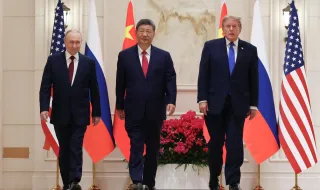
When Churchill, Roosevelt and Stalin met near the city of Yalta on the Crimean Peninsula in February 1945, they knew that Europe would soon be in their hands.
The continent, which according to various estimates had lost between 10% and 15% of its population, had been swept up in the horrors of the Second World War. Its infrastructure lay in ruins, while Germany, which until recently had been the continent’s strongest state, would capitulate in just three months. Churchill and Stalin would meet again in July, and Harry Truman would join them following Roosevelt’s death. The Potsdam Conference led to the division of Germany into four occupation zones, while Europe was divided into “spheres of influence” distributed among the so-called great powers.
Eighty-one years later, three leaders attempted to repeat that meeting, while two of them were once again waging wars. But Trump, Putin and Xi are not Roosevelt, Stalin and Churchill. And the “great powers” do not look so great.
The US and Russia are waging wars with no clear outcome
For nearly five years, Russia has been waging a full-scale war against Ukraine, which has become the bloodiest and deadliest conflict since the Second World War. According to data from the US Center for Strategic and International Studies (CSIS), the total number of soldiers killed, wounded or missing has already exceeded 2 million, with Russia’s losses estimated at more than 1.4 million. And there are no signs of a ceasefire.
In 2025, Russia spent 7.5% of its gross domestic product on its military, according to data from the Stockholm International Peace Research Institute (SIPRI), while a large part of its trade relations and fuel export markets were blocked by sanctions imposed by dozens of countries.
Today, more than 60% of the global economy is in the hands of countries that have sanctioned Russia, as the Wilson Center points out, while Russia is becoming increasingly dependent on China.
The US, for its part, is waging a war in the Middle East that also appears to have no end in sight. Donald Trump is a president with a record-low approval rating, while the Democrats’ historic victory in the latest midterm elections bodes nothing good for the Republican Party.
At the same time, under his leadership, Washington has lost much of its influence, while traditional partners such as Canada have turned toward the European Union. This is a process diametrically opposed to the events at the end of the Second World War.
China cannot—and does not want to—stop the conflicts
China is a partner of Russia, but with certain limitations. The country is not directly involved in the war with Ukraine, while cooperation with states condemning Russian aggression remains crucial for the communist country.
At the same time, it is clear that Beijing does not have enough influence to put an end to the conflicts in the Middle East, which are affecting the entire global economy. Chinese Foreign Minister Wang Yi met with representatives of Iran and Saudi Arabia this week and called for a political solution to the problems in the region, but for now the efforts appear fruitless.
“I think things are developing, I think he—and I hope the other side as well—would like this war to end,” Donald Trump commented during today’s meeting with the other two leaders, referring to the war in Ukraine. Trump promised to end this conflict the day after returning to the White House. His inauguration took place on January 20, 2025.
Today, the gap between hope and actual results appears enormous.
Who are the great powers?
“History shows us that when great powers live in peace, the world is safe; when great powers enter into conflict, the world sinks into chaos,” Xi Jinping said during today’s trilateral meeting. But who are the great powers today?
The economy of the European Union is more than eight times larger than Russia’s and approximately 9% larger than China’s, according to World Bank data. In terms of average life expectancy, the European Union surpasses Russia by more than eight years, China by more than three, and the US by more than two.
Although the Old Continent has lagged behind militarily for decades, and France is the only nuclear power in the EU, with an arsenal far smaller than those of Moscow, Washington and Beijing, investments in armaments and a reassessment of security strategy have changed the priorities of the 27-member bloc.
At the same time, the growing influence of a number of other countries paints a picture of a multipolar world. The conflicts in the Middle East will be difficult to end unless Israel and Iran make decisions in that direction. Turkey, Pakistan and Saudi Arabia recently formed a security partnership. Turkey has the second-largest army in NATO and enormous influence in the region, Pakistan has nuclear weapons, while Saudi Arabia has vast financial resources. The influence of India, which is part of BRICS while also expanding its partnership with the EU, is growing. Traditional US partners such as Canada, Australia and Japan are seeking to unite the “middle powers”—an idea also advocated by Mark Carney.
After the Second World War, the US and the Soviet Union became hegemons in global politics for decades, while the United Kingdom gradually began to lose its influence. And while China continues to expand its influence today, the foundations of the two hegemons have been shaken.
The meeting in Yalta was the second between Churchill, Roosevelt and Stalin. Today, a second meeting between Xi, Trump and Putin in Yalta would be difficult to hold. Because Ukrainian drones would be flying overhead.