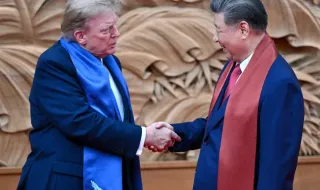
The trilateral meeting between Donald Trump, Xi Jinping and Vladimir Putin in the Chinese city of Shenzhen provoked mixed reactions in the United States. While the American president presented the talks as a historic diplomatic success, the political opposition saw them as a dangerous signal for US foreign policy. Influential analysts and media outlets also questioned the meeting’s real results, particularly against the backdrop of a lack of concrete progress on Ukraine and nuclear disarmament.
It turned out that the dispute in Washington is not so much about the need for dialogue with Moscow and Beijing as it is about the price the United States is paying for it and who is benefiting most from the new diplomatic format.
Trump: The meeting was 12 out of 10
Donald Trump made no secret of his satisfaction with his talks with Xi Jinping and Vladimir Putin. In a telephone interview with NBC News, he rated the meeting 12 out of 10 and said that “fantastic relations” had been established.
At the very beginning of the talks, the American president described the three countries as uniquely positioned to solve the most difficult international problems. He stressed that peace cannot be achieved by rejecting dialogue and that leaders must make use of opportunities for negotiations.
For Trump, the mere fact that the presidents of the three major nuclear powers sat down at the same table is a political achievement. His logic is that personal contact and direct communication can open the way to solutions that had previously seemed impossible.
The White House, however, did not provide a detailed account of what had been achieved. After the meeting, Trump did not hold a concluding press conference in China, and the official American information was limited to a brief summary of four agreed areas.
This discrepancy between the president’s high assessment and the scant information about the concrete results became one of the main topics of the American media debate.
Democrats: A diplomatic gift to Putin and Xi
The Democrats’ reaction was considerably sharper.
Senate Minority Leader Chuck Schumer described the meeting as “a historic humiliation that people will remember far into the future.”
He accused Trump of granting diplomatic legitimacy to America’s adversaries without receiving substantial guarantees in return.
Democrats raised several key questions:
What concrete concessions did Russia and China make?
Why are there no binding commitments to end the war in Ukraine?
What is the American strategy regarding China’s nuclear program?
Is Trump’s personal diplomacy becoming an instrument from which his counterparts benefit more?
Senator Jeanne Shaheen, the leading Democrat on the Senate Foreign Relations Committee, said that in her view Trump had undoubtedly been outmaneuvered by Xi and Putin.
Congressman Gregory Meeks, the leading Democrat on the House Foreign Affairs Committee, questioned whether the White House had a clear strategy.
“I wish he had a plan and a strategy if he’s going to meet with them, and objectives. Obviously, he doesn’t have any,” Meeks said in an interview with NPR.
The issue of Ukraine proved particularly sensitive. Senator Tim Kaine stressed that negotiations to end the war cannot take place without Ukraine itself participating in the process.
Thus, Democratic criticism focused not so much on the fact of the meeting itself as on the lack of clear American conditions and guarantees.
Republicans: Dialogue is necessary, but results are not guaranteed
Reactions among Republicans were more nuanced.
Trump’s supporters in Congress defended his right to speak directly with the leaders of Russia and China. In their view, such contacts are necessary if Washington wants to avoid a new major confrontation and reduce nuclear risks.
Senator Rick Scott of Florida expressed hope that the president could make progress on at least one of the important issues.
He did not, however, hide his distrust of the two leaders:
“Do I trust them? No. They’re a bunch of liars.”
Scott added that he supported Trump’s efforts to seek diplomatic solutions, but was not sure whether anything substantial would come of them.
Republican Rob Wittman also insisted that the talks should focus on ending aggressive actions against neighboring states and ensuring international security.
This shows that even among those in power there is no complete consensus regarding the expected results. Support for dialogue does not mean unconditional trust in Moscow and Beijing.
What do American analysts say?
The assessment by experts from the influential American Council on Foreign Relations is particularly telling.
Six specialists from the organization analyzed the meeting and its implications for American strategy, nuclear security, the war in Ukraine and relations with China.
Several trends stand out among their main conclusions.
First – Russia received a significant diplomatic dividend.
Vladimir Putin had the opportunity to present himself as the leader of one of the three global powers that play a decisive role in international security. The photograph itself of Trump, Xi and Putin carries symbolic significance for Moscow, especially after years of Western sanctions and diplomatic distancing.
Second – China consolidated its role as a diplomatic center.
Xi Jinping hosted the meeting and demonstrated that Beijing can bring the other two nuclear powers to the same table. This is important for China’s international standing.
Third – America’s allies have grounds for concern.
The experts draw attention to the risk that Washington may place relations with the great powers ahead of coordination with its own allies. This issue is particularly sensitive for European countries and Ukraine.
Fourth – the concrete results are limited.
The meeting did not produce a significant breakthrough on the most difficult issues. There is no new agreement on limiting nuclear arsenals, nor any specific formula for ending the war in Ukraine.
CFR experts see the talks as a possible beginning of a longer process, but warn that symbolism should not be confused with real diplomatic progress.
Nuclear disarmament: The grand ambition without a concrete agreement
One of the main reasons for the meeting was nuclear security.
Following the expiration of the New START treaty between the United States and Russia in February 2026, the issue of future nuclear arms control acquired additional significance.
Trump is pushing for a new framework that would include China. Beijing, however, had so far shown no desire to accept restrictions, arguing that its nuclear arsenal is much smaller than those of the United States and Russia.
In Shenzhen, the three leaders reaffirmed the need for dialogue to reduce nuclear risks and prevent the proliferation of nuclear weapons.
This is not, however, a disarmament treaty, nor is it a timetable for negotiations with specific commitments.
Daryl Kimball, executive director of the American Arms Control Association, described the reaffirmation of the principle that nuclear war must not be fought as a positive signal, but stressed that real action is needed, not merely diplomatic rhetoric.
How did the American media react?
American media outlets focused on the gap between political declarations and actual results.
The Associated Press noted that after around 70 minutes of closed-door talks, the three leaders had agreed on a considerably more limited agenda than the ambitions announced beforehand. The agency stressed that the meeting had not led to breakthroughs on the major international problems.
The Washington Post focused on the White House’s lack of transparency. The newspaper noted that Trump had not held a concluding press conference, American journalists had had limited access to the events, and the official information about the talks had remained scant.
The newspaper also raised a broader question: Are the United States and its partners participating in a reshaping of the international system that could weaken the institutions created after World War II?
Reuters described the joint declaration as largely symbolic. The agency highlighted the fact that the leaders had not announced concrete negotiations on a new nuclear arms agreement, even though this had been one of Trump’s main objectives.
In its analysis, the agency also noted the diplomatic benefit for Putin – the opportunity to return to the center of international politics and demonstrate that Russia is not isolated from the world’s most important players.
Thus, one common theme prevailed in the American media debate: the grand political spectacle was not followed by equally significant practical results.
The four agreements – what did they actually sign?
The joint declaration by the three presidents outlined four areas:
Reforming the United Nations.
Expanding the production and supply of refined petroleum products.
Protecting the principle of state sovereignty and the immunity of state representatives, while criticizing the excessive expansion of the jurisdiction of the International Criminal Court.
Dialogue to reduce nuclear risks and prevent the proliferation of nuclear weapons.
What is striking is what is missing: there is no specific agreement on Ukraine, no agreed mechanism for ending the war, no new nuclear treaty and no detailed timetable for subsequent negotiations.
This raises the question of whether the meeting was a genuine turning point or rather the beginning of a new diplomatic format.
The main conclusions: Who benefited from the meeting?
The reaction in Washington makes it possible to draw several important conclusions.
1. Trump gained a political image, but the results still have to be proven.
The American president demonstrated that he can speak directly with the leaders of the world’s two other major nuclear powers. This is important to his vision of personal diplomacy, but it is not equivalent to achieving strategic objectives.
2. Putin gained international visibility and symbolic recognition.
The Russian president appeared in an unprecedented trilateral format with the United States and China. For Moscow, this is a way to show that the West’s policy of diplomatic isolation has not achieved its full effect.
3. Xi Jinping consolidated China’s role as a global mediator and host.
Beijing showed that it can organize talks between Washington and Moscow while protecting its own strategic interests.
4. American domestic political polarization deepened.
Republicans defend the president’s right to seek diplomatic solutions, while Democrats question the cost and conditions of this approach. The division is not merely partisan – it concerns the fundamental question of how the United States should exercise its global influence.
5. Europe and Ukraine remain sensitive issues for Washington.
American lawmakers and experts warn that talks about the war cannot bypass Kyiv. European allies are also insisting that they not be presented with faits accomplis.
The big question facing America
Perhaps the most important result of the meeting in China is not contained in the joint declaration, but in the debate it sparked within the United States itself.
Donald Trump believes that personal diplomacy and direct dialogue with major adversaries can change international relations. His critics, however, fear that such an approach could turn America from a country that sets the rules of the international order into a participant willing to negotiate new rules with Moscow and Beijing without sufficiently defending its own allies.
The truth will probably become clear not from the photographs in Shenzhen, nor from Trump’s rating of 12 out of 10, but from what follows in the coming months.
Will there be real negotiations on nuclear weapons? Will Russia’s position on Ukraine change? Will China undertake concrete commitments? And will Washington succeed in combining dialogue with the great powers with the protection of its allies?
Because in international politics, it is not enough to sit at the same table with the most powerful. What matters is also what you achieve after you get up from it.
See less