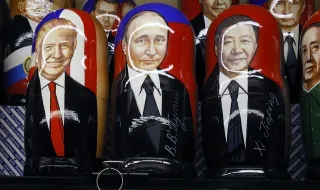
For some time, there have been discussions about a possible meeting between Donald Trump, Xi Jinping and Vladimir Putin on the sidelines of the Asia-Pacific Economic Cooperation (APEC) summit on November 18-19. The prospect of such a meeting has prompted comparisons with the “Big Three” meeting in Yalta in February 1945, where the leaders of Britain, the United States and the Soviet Union discussed the division of the world after the Second World War. This is what Nicholas Westcott, professor of international politics at the University of London, writes in an article for the online publication The Conversation.
It is clear that Trump, Xi and Putin—each of whom leads a country that defines itself as a “great power”—are drawn to the idea of a new world order revolving around them. The American president appears to see himself as part of a modern triumvirate alongside Presidents Putin and Xi, who, like their predecessors in 1945, could determine the fate of other countries and peoples at will. These are the only leaders toward whom Trump appears to show respect and admiration—in sharp contrast to the disdain he displays toward most other presidents and prime ministers.
The 2025 U.S. National Security Strategy explicitly states that the Western Hemisphere should be regarded as a zone of American dominance, while hinting that Russia and China could have spheres of influence of their own. The U.S.-initiated change of power in Venezuela, as well as support for populist regimes close to Washington in Latin America, show that the United States has serious intentions in this regard.
Putin’s aims are equally clear: to restore Russian control over Ukraine through military force, while using bribes, threats and subversion to surround Russia with loyal regimes in the post-Soviet space
Xi Jinping makes no secret of his ambition to regain control over Taiwan and is clearly seeking to expand Chinese influence in Myanmar, as well as more broadly in Southeast Asia and the South China Sea.
All three countries appear to view Europe—and more specifically the European Union—as an obstacle to imposing their own worldview.
The European Union demonstrates how states can achieve stability and prosperity by agreeing to partially surrender sovereignty and abide by common rules, based on human rights and the rule of law.
Both the United States and Russia appear determined to weaken Europe by stoking discontent with the established order and supporting populist, anti-EU parties in the hope that they will undermine the unity of the bloc.
Of course, imperialism is not limited to physical control over territory. At its core, it concerns who makes the key decisions about the distribution of resources, trade, security and governance. This is partly why, in the years after the Second World War, the so-called “liberal” international order appeared anything but liberal to many countries that had only recently gained their independence.
Many believed that neocolonial control persisted even after the formal transfer of power—exercised through imposed economic norms and principles of governance. For them, imperialism had never disappeared completely; it had simply taken new forms.
Yet the world has changed beyond recognition since the heyday of imperialism in the 19th century. For millennia, empire was a common form of government because it represented an effective way of uniting people of different faiths, cultures, languages and geographical locations under the authority of a single center that imposed order. This system, however, could not withstand the rise of nationalism, which was based on a common culture, ethnicity and language, as well as more centralized governance.
Such competing nationalisms, however, proved chronically unstable. Although a fragile balance of power managed to prevent large-scale conflict for some time, it ultimately led to the two most devastating world wars in human history—between 1914 and 1945. By the end of the second war, humanity had acquired the capacity for complete self-destruction, prompting world leaders to conclude that there had to be a better way to settle disputes.
The road to a new world order
In 1946, the United Nations had 43 member states; today, that number has reached 193. Many of these nations fought hard to win their independence and are now determined to preserve it. The post-war multilateral world order helped bring about the collapse of empires and was created to guarantee the security of smaller states by preventing peoples and territories from being treated merely as bargaining chips—like properties in the game of “Monopoly.”
Nations themselves—as the people of Greenland recently demonstrated—refuse to be used as pawns. Iranians, like Ukrainians, have demonstrated their willingness to fight for the right to choose their own government rather than accept one imposed from outside (it remains to be seen how long Delcy Rodriguez will remain as Venezuela’s interim president, installed by the United States).
At the same time, trade and technology have fundamentally changed relations between individuals and states. Globalization may have fallen out of fashion, but it remains a reality. Since 1950, the volume of world trade has increased 45-fold, creating the basis for a significant rise in both population and incomes. Leaders—whether democratic or not—must sustain this prosperity if they are to remain in power.
Technology has had an equally profound impact. The internet has connected people around the world, although a handful of American companies dominate this sphere, while in some countries it remains under the strict control of authoritarian regimes. In addition, the emergence of effective new military technologies, such as drones, has completely changed the nature of warfare.
We are seeing this happen in Iran and Ukraine. In these conflicts—as well as in Iraq, Afghanistan, Syria and Gaza—despite the imbalance of power, the “weaker” side has managed to inflict unbearable suffering on the “stronger” side. Today, conflicts can no longer be resolved through force alone; such an approach leads only to “endless wars” in which neither side is willing to admit defeat.
These wars also show that having allies is just as important to achieving success as having manpower, financial capital or military equipment. Trump’s dismissive attitude toward America’s traditional allies has dealt a severe blow to the power and global influence of the United States. Whoever becomes president in 2028 will find it difficult to repair this damage.
Will the “middle powers” unite to preserve the rules-based global order—as Mark Carney hopes? In practice, this group is too diverse; many of these countries—for example, in the Middle East—are just as inclined to seek their own advantage from the collapsing order as they are to work toward building a better system, one that would inevitably impose certain constraints on them as well.
In fact, of the 193 countries in the world, the overwhelming majority are small or medium-sized nations with a vital interest in a global order in which rules are observed, the rights of others are respected, and international trade can thrive in conditions of peace.
In other words, it is not so much the “middle powers” as the smaller nations that have the greatest interest in preserving the rules-based global order.
The question is who can unite them so that they can preserve—and even expand—the freedom they have achieved? This is what the leaders of the world’s remaining democracies should focus on.
Source: news.bg