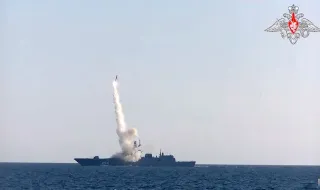
The Black Sea is becoming an increasingly dangerous arena of confrontation between Russia and the West, and the stakes go far beyond Ukraine’s fate. In an interview published by the French outlet Desk-Russie, geopolitical analyst Jean-Sylvestre Mongrenier warns that Moscow is seeking not merely to cut Ukraine off from the sea and strangle its economy, but to impose its dominance over the entire region, threatening the security of Bulgaria, Romania, Turkey and Europe. Why could the Black Sea become the next major geopolitical fault line of confrontation, and how far is the West prepared to go to prevent it from falling into the Kremlin’s hands?
Desk-Russie: If Ukraine loses the war, Russia will establish effective control over the Black Sea. What would the consequences of a Ukrainian defeat be for Europeans and for the balance of power in this region?
Jean-Sylvestre Mongrenier: In such a scenario, the Black Sea would effectively become a Mare Clausum ("closed sea") dominated by Russia. This would allow Moscow to intensify its threats and actions against Romania and Bulgaria—countries that are already being forced to adopt a defensive posture. Violations of their airspace and maritime territories, as well as the intrusion of drones into the region, already provide an indication of what this would mean.
At the same time, Turkey’s ambition to establish itself as a regional hegemon would be rendered completely meaningless—if that has not already happened. The same applies to its large-scale logistical, energy and economic projects, which depend on the Black Sea functioning as a crossroads for trade and transit. It appears that Europeans—and the West as a whole—are encountering serious obstacles in their efforts to develop the so-called "Middle Corridor"—a multimodal logistics route intended to provide them with access to Central Asia, which would otherwise fall into the Russo-Chinese "pincers". Goodbye to Trump’s "road" through the South Caucasus!
The defensive line along the eastern borders of Europe and NATO—stretching from the Baltic to the Black Sea—could be partially breached. In a sense, the geostrategic situation in the Black Sea region could return to a state resembling that of the Cold War; it is not inconceivable that Russian military forces could appear in Odesa, Transnistria and Moldova, creating a direct threat to Romania. European NATO members would probably be forced to make far greater military efforts to strengthen their eastern borders—particularly given that the US strategy, which could be described as "second-line leadership", raises a number of questions. The Trumpist perception of geopolitical space resembles a Monopoly board. There are no "key" positions or strategically vital corridors—everything is for sale.
Desk-Russie: The USSR never managed to turn Turkey into a satellite state. What role does Ankara play today? It is striking that, despite its NATO membership, Turkey has never been identified by Moscow as a threat or an enemy. How do you explain this?
Jean-Sylvestre Mongrenier: What is more, in the past Turkey served as a reliable NATO shield in the Black Sea basin. Located along the southern flank of the USSR, it acted as an outpost in Western Asia.
Precisely in order to avoid losing territory and becoming a satellite state, neo-Kemalist Turkey turned towards the Anglo-American bloc in 1945, effectively abandoning what would later become known as a policy of "non-alignment".
At that time, Moscow sought to seize control of the Bosporus and Dardanelles straits, as well as two regions in Eastern Anatolia. In view of the rise of Recep Tayyip Erdoğan’s "Islamic nationalism" and its geopolitical consequences, Vladimir Putin regards Turkey as one of NATO’s weak links; he seeks to drive a wedge between Ankara and its Western allies. In addition, Turkey serves as a "platform" for circumventing Western sanctions, making it extremely valuable to Moscow.
The recent Russian strikes against Turkish commercial vessels—carried out in early October in the territorial waters and exclusive economic zones of Romania and Bulgaria—should serve as a warning to Ankara. As the Russians say: "You cannot milk two cows at the same time..." Ordinary trilateral cooperation between Ankara, Bucharest and Sofia will not be sufficient to deter Russia, which is reigniting the conflict in the Black Sea. Turkish leaders are aware of this, but nevertheless hope to keep Putin on their side; they are careful not to define Russia as an "enemy"—or even as a "geopolitical adversary". Both sides are engaged in a complex political and diplomatic manoeuvre.
Desk-Russie: Putin’s actions in the Black Sea appear to be inspired by the example of Catherine the Great. Why is Russia seeking to deprive Ukraine—first of physical access to the sea, and subsequently of the ability to trade by sea?
Jean-Sylvestre Mongrenier: Vladimir Putin—a man nostalgic for the Brezhnev era who fondly remembers the times when Solzhenitsyn was persecuted—draws his inspiration primarily from the Soviet past. He intends to return Ukraine—and probably most of the former Soviet republics—under Moscow’s iron grip. In Ukraine’s case, this is reminiscent of actions during Lenin’s rule at the end of the Civil War between the "Whites" and the "Reds" (a conflict with a far more complex political and military picture). In short, Putin’s goal is to restore the territorial extent of the USSR and once again turn Central and Eastern Europe into a collection of satellite states. Even the expression "iron grip" is too mild when compared with the current reality—especially in the occupied Ukrainian territories—not to mention the history of the Soviet occupation, such as the Holodomor—the "genocidal famine" of 1933, which claimed the lives of around 4.5 million people.
Depriving Ukraine of access to the sea would strangle its economy and turn the country into a "crippled state"—fragmented, landlocked and reduced to the role of a buffer zone between NATO and the concept of "Russia-Eurasia" that the Kremlin’s master is attempting to build. Meanwhile, Russia is methodically destroying everything it cannot seize. Controlling less than one-fifth of Ukrainian territory—and not even the entire Donbas region that it claims to have "annexed"—Russia is betting on victory, relying on a possible change in Donald Trump’s policy (drawn by the prospect of trade deals for his inner circle), as well as on a prolonged war of attrition against the Ukrainian population and infrastructure.
Desk-Russie: How, then, did Ukraine manage to achieve such an incredible victory and retain its access to the Black Sea?
Jean-Sylvestre Mongrenier: The development and deployment of unmanned aerial and naval technologies, alongside anti-ship missiles, enabled Ukraine to compensate for its clear disadvantage at sea and prevent Russia from dominating the Black Sea. The Russian navy’s objective was to support amphibious operations along the Ukrainian coast, seize Odesa and completely isolate Ukraine, thereby cutting off its access to the sea. The goal was—and remains, in the medium term—the creation of a continuous controlled territory stretching from the Sea of Azov and Donbas, through Odesa, all the way to Moldova. This concept, known as "Novorossiya", would sever the "Baltic–Black Sea" axis and expand Russian influence in Central Europe.
In practice, Ukraine’s counter-strategy destroyed or seriously damaged the Russian Black Sea Fleet, depriving it of 40% of its assets. Russian vessels were forced to retreat towards the Caucasus coast—close to Russia and Abkhazia—in the most remote part of the Black Sea. As a result, Crimea was largely disarmed and deprived of naval cover. It must be understood, however, that this is a tactical victory—albeit one with strategic consequences—within a prolonged high-intensity war. The Russian military is now resuming its operations in the Black Sea, using different means and tactics. The strategic objective remains unchanged: to strangle Ukraine and deprive it of access to the Black Sea, which Russia seeks to turn into a "Russian sea".
Desk-Russie: Do the attacks against commercial vessels off the coasts of Romania and Bulgaria mark a change in Russia’s Black Sea strategy? If Russian involvement is confirmed, to what extent does this represent an attempt to strangle Ukrainian exports and test NATO’s resolve?
Jean-Sylvestre Mongrenier: As it has failed to establish full control over the Black Sea, Russia is attempting to restore its maritime dominance indirectly—by attacking international maritime transport routes in the western part of the Black Sea. These routes, linking Odesa, the Danube river ports and Constanța with Istanbul and the straits—the Bosporus and the Dardanelles—serve as gateways to the Mediterranean and, ultimately, to the World Ocean, via the Suez Canal and the Strait of Gibraltar. This modern form of "privateering" against commercial shipping, conducted not with attack submarines but with missiles and drones, aims to strangle the Ukrainian economy and subsequently destroy its ability to wage war.
In practice, the resolve of NATO member states—especially those bordering the Black Sea—is being put to the test. And this is far more than a simple "test". The politico-strategic terminology we use must correspond to the reality of the situation—both in this geopolitical theatre and in others where the global balance of power is at stake.
Given Donald Trump’s overall policy—if it can be called a policy at all—combined with the hesitation of some European allies, we must acknowledge that NATO remains on the sidelines. Although NATO’s secretary general and the Supreme Allied Commander Europe (SACEUR) are attempting to inspire confidence, there is no sense of collective resolve. Putin sees this and is directly threatening Europe with war.
Desk-Russie: The origin of the drones remains difficult to establish. In this context, do you consider the hypothesis that these drones were launched from ships—possibly even commercial vessels—to be plausible? What evidence would make it possible to distinguish such an operation from attacks carried out from territories under Russian control?
Jean-Sylvestre Mongrenier: First of all, with regard to how we perceive and interpret these events, we must look at what is happening and call things by their real names. The intensity of this so-called "hybrid" war—a war waged against all of Europe—has long since crossed the threshold of plausible deniability. Your hypothesis is entirely plausible. In fact, is it even merely a hypothesis? Military strategists and strategic-analysis experts have already observed similar activity in the Baltic and North seas, as well as in the English Channel. Everything is "documented", as the experts say.
Intelligence—including satellite surveillance—can establish whether a launch was carried out from land or sea. Politically—in the deepest sense of the word, concerning the very essence of politics—it is crucial to identify the force that "pulled the trigger" and draw the necessary conclusions. In a conflict of this nature, the most important political step is to clearly define the enemy. And yet the West finds it difficult to think in political and strategic categories; its political leadership remains trapped between humanitarianism and economism.
Desk-Russie: What specific measures could be taken to protect commercial shipping without provoking direct confrontation with Moscow—for example, through naval escorts, aerial surveillance or the deployment of counter-drone systems? In addition, what are the differences from the Baltic Sea that make this protection more difficult to organise in the Black Sea?
Jean-Sylvestre Mongrenier: All the measures you mentioned lead to one single conclusion: there is no "magic solution" for protecting commercial shipping that does not carry the risk of direct confrontation. Recall one of the most important lessons of Julien Freund, author of the work "The Essence of the Political" (1965): "I do not determine the enemy; the enemy is the one who defines me as such." The current situation is far more serious than the "hybrid war" Russia is waging against us. This term—outdated and worn out—now serves only to lull us into complacency by creating an illusion of security: "Oh, it is just hybrid warfare—thank God!" By seeking such reassurance, we are actually only accelerating the arrival of the worst possible scenario. In practice, we are allowing the Russians to advance ever more persistently in the war they are waging against us. Ships are sinking, crews are dying. Although for now this remains a low-intensity conflict, our excessive caution and delaying tactics are only deepening the Russians’ contempt for us, encouraging them to take further action. This trend has been clearly evident since the beginning of the summer. What is more, the combination of cynicism and commercial pragmatism demonstrated by the American president and his inner circle is further worsening the situation.
The situation in the Baltic region is different: because the coastal states belong to the same Euro-Atlantic structures—the European Union and NATO—they are better organised to counter Russian aggression. Poland, the Baltic states and the Scandinavian countries display particular resolve, and their strategic position, secured by NATO, is stable. In the Black Sea, the situation is different: Turkey’s manoeuvring, Bulgaria’s hesitancy—where pro-Russian sentiment remains strong—and political instability in Romania prevent the establishment of a balance of power that would be less favourable to Russia. As a result, the main burden of the struggle falls on Ukraine. NATO and the European Union should play a more significant and active role. Turkey, however—which controls the straits under the 1936 Montreux Convention—follows its own agenda.
In any event, trilateral naval cooperation between Turkey, Bulgaria and Romania will not be sufficient to meet this challenge. That is why it is necessary to develop—and, most importantly, implement—a comprehensive European or Western strategy for the Black Sea. The Black Sea serves as a "bridge" to the Caucasus and Central Asia; it must function as an access route that can help overcome the isolation of a region currently caught in a "Chinese-Russian vice". Under the present circumstances, the measures taken within NATO are insufficient. By analogy with the "Baltic Sentry" and "Arctic Sentry" missions, a "Pontic Sentry" mission should be developed and launched—a reference to Pontus Euxinus, the ancient name for the Black Sea—alongside the creation of a specialised command for the Black Sea region. This is precisely what Romania is calling for. France, in its capacity as NATO’s "framework nation" in Romania, should support this demand.
Source: news.bg