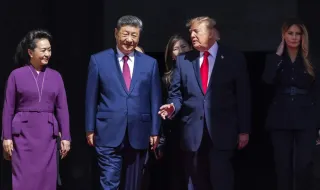
The trilateral meeting between US President Donald Trump, Russian President Vladimir Putin and Chinese leader Xi Jinping in Shenzhen legitimized the multipolar world order and brought Putin back to the international diplomatic stage. This was stated by Veselin Valchev, former Consul General of Bulgaria in Los Angeles, on NOVA’s “The Day Live with Nadelina Aneva.”
According to him, the talks between the leaders could mark the beginning of a longer-term geopolitical process. Valchev described the meeting as the first of its kind at such a level to address the future of the global geopolitical order.
Russia and China as a Diplomatic Shield
According to Valchev, Putin’s participation brought the Russian president diplomatic dividends and placed him among the leaders of the three great powers. He believes that closer ties between China and Russia could become a counterbalance to American influence.
The former consul general also warned of the danger of the so-called Thucydides Trap. The term describes the risk of serious confrontation when the rise of one power coincides with the weakening of another. According to him, China is already establishing itself as a central global player, while hosting the meeting further strengthens this position.
Pressure on Trump and Europe’s Role
Valchev also linked the meeting in Shenzhen to the domestic political pressure on Trump following the midterm elections in the United States. According to him, the meeting and the declaration of peace under discussion could deepen the political division in Washington.
He pointed out that before Trump’s trip to China, his son-in-law and Witkoff had been sent to Berlin. After the meeting ended, the US president called the European leaders from the “Coalition of the Willing” to brief them on the talks with Putin and the Chinese side.
According to Valchev, the peace declaration had been prepared long before the meeting, with every wording carefully coordinated among the participants.
He described the meeting in Berlin as important for European diplomacy and said that Europe’s position had gradually shifted from the complete isolation of Moscow toward the need for dialogue.
“Two years ago, Europe said: no talks with the Russian Federation, no talks with Putin,” Valchev said.Military Pressure in the Middle East
The diplomat also highlighted the increase in the US military presence in the Middle East during Trump’s trip to China. According to him, the buildup of military forces and the arrival of aircraft carriers show that diplomatic efforts are being conducted against a backdrop of military pressure.
Valchev predicted that possible US action against Iran could be postponed until 2027. He linked this to the Pentagon budget vote on December 11 and pointed out that a possible halt in funding would affect resources for ammunition, missiles and US troops in the Middle East.
According to him, pressure on Trump will also intensify after the new Congress takes office on January 3.