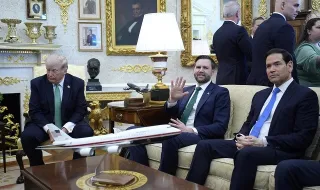
The Republican Party’s heavy defeat in the U.S. midterm elections has raised questions about the future of the MAGA movement and complicated the race for the 2028 presidential nomination. Potential contenders include Vice President JD Vance, Secretary of State Marco Rubio, Florida Governor Ron DeSantis and Texas Senator Ted Cruz, Reuters reports.
The main question facing Republicans is whether their voters will prefer a candidate who continues Donald Trump’s political course or a politician with an identity of his own, capable of attracting support beyond the movement’s traditional MAGA base.
The war with Iran creates an additional complication. It has become one of the reasons for dissatisfaction with the administration and is causing disagreements even among leading Republicans.
JD Vance – Trump’s natural successor
At 42, Vice President JD Vance remains among the most discussed potential candidates. A former senator from Ohio, he gained national prominence with his 2016 book "Hillbilly Elegy" and established himself as one of the most persuasive advocates of the "America First" principle.
Vance, however, has not yet confirmed whether he will run.
According to some Republican consultants, his closeness to Trump could prove to be a serious disadvantage because of the president’s low approval ratings.
Following the midterm elections, Vance was quick to point to the war against Iran as the main reason for the Republicans’ defeat – a move seen as an attempt to distance himself from one of the administration’s most unpopular decisions.
Trump himself has not yet endorsed any potential successor and has even suggested that he may stay out of the process of choosing a candidate.
"Maybe it would be better for me not to get involved," he told CBS’s "60 Minutes."
Marco Rubio – the candidate who can wait
At 55, Secretary of State Marco Rubio is also among the possible contenders, although his plans remain unclear.
The Cuban-American has many years of political experience as a senator from Florida and has largely managed to stay out of day-to-day intraparty conflicts.
According to people close to him, he may prefer to work in the private sector after decades in politics. A former aide believes Rubio may wait until the 2032 presidential election, when Trump’s political legacy will likely have less immediate influence over the party.
Rubio’s Latino background could help Republicans restore their support among Hispanic voters, a significant portion of whom backed Democrats in the midterm elections.
Trump has repeatedly asked visitors to the Oval Office whom they prefer – "JD or Marco" – and has drawn attention to the loud applause Rubio receives during their joint public appearances.
The secretary of state rejects speculation that he will soon leave the administration and defends the president’s actions in the war with Iran. In May, he described Vance as a "phenomenal candidate."
Ron DeSantis – a second attempt after the 2024 failure
Florida Governor Ron DeSantis, 48, is completing his second term but remains among the possible participants in the race.
His argument is the performance of Republicans in Florida, where the party managed to win the races for governor and senator despite the nationwide wave in favor of Democrats.
DeSantis tried to challenge Trump for the nomination in 2024, but his campaign was marked by internal conflicts, heavy spending and difficulties communicating with voters and the media.
The former U.S. Navy serviceman has criticized the prolonged war with Iran, describing it as a conflict with no clearly defined end.
He called the midterm election result an event that had brought the Republican Party "close to extinction."
Ted Cruz – a conservative with his own political base
Texas Senator Ted Cruz, 55, is already discussing the possibility of running in 2028 with political allies.
He believes Vance’s nomination is far from guaranteed.
Cruz has experience in presidential races. In 2016, he won the Iowa caucuses before Trump’s campaign gathered momentum and overtook him.
His positions as a staunch conservative, however, could prove challenging if Republican voters begin looking for new political faces.
An additional problem for the party in Texas was created by Democrat James Talarico’s victory in the Senate election. Following it, Cruz will be the only Republican representing the state in statewide elected office.
Although he is a loyal ally of Trump, Cruz also believes that the war with Iran has gone on for too long.
Sarah Sanders – popular among MAGA’s hard core
Arkansas Governor Sarah Sanders, 44, won a second term in this month’s election.
A former White House press secretary during Trump’s first presidential term, she comes from a political family. Her father, Mike Huckabee, was also governor of Arkansas.
Sanders recently published the book "Unapologetic: Clarity and Conviction in a World Gone Crazy" and embarked on a national tour to promote it, intensifying speculation about presidential ambitions.
She says, however, that she is focused on governing the state.
Sanders defends Trump’s decision to launch the war with Iran and enjoys support among the MAGA movement’s hard core.
Glenn Youngkin – a representative of the moderate wing
Former Virginia Governor Glenn Youngkin, 59, also remains among the potential candidates being mentioned.
After his term as governor ended in January, he continued his political activity through a national organization working on education policy issues in key battleground states.
Youngkin has considerable business experience as an executive in the private equity sector.
During his tenure in Virginia, he maintained a relatively moderate political profile, which could help him attract voters beyond the traditional Republican base, but could also create difficulties in primaries dominated by conservative activists.
Youngkin supports the war with Iran and has so far avoided declaring his own presidential ambitions, saying that Vance would be a good candidate.
Nikki Haley – the Republican who is currently declining to run
Nikki Haley, 54, a former governor of South Carolina and former U.S. ambassador to the United Nations, also continues to feature in speculation about the presidential race.
She told CNBC, however, that she categorically has no intention of running in 2028.
"I will not run in 2028, but I will continue to speak about the issues that matter to me," Haley said.
Her political profile is closer to the traditional wing of the Republican Party, which supports business and a tougher foreign policy.
Haley challenged Trump in the 2024 primaries, prompting his criticism and raising questions about her relationship with the most conservative Republican voters.
Source: news.bg