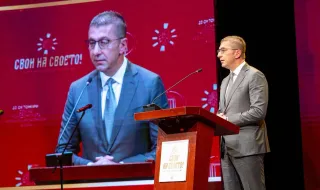
The Prime Minister of North Macedonia rejects even the most tactful recommendations to fulfil the conditions for his country to join the EU.
For many years, Albania and North Macedonia were together on the path to European integration
When you read somewhere that Hristijan Mickoski and Edi Rama have clashed over changes to North Macedonia’s constitution, there is no way you can simply ignore it. I spotted something similar in a headline and naturally became curious about what was actually happening in relations between the two neighbouring countries and their prime ministers for them to have supposedly “clashed”, writes Kostadin Filipov for "Trud".
Of course, very soon everything became perfectly clear. On Sunday, Mickoski and Rama met at the border crossing between the two countries, „Qafasan“, high above Lake Ohrid, to cut the ribbon on the new arrangement: checks at the crossing would be carried out at a single window instead of two. In other words, traffic at the busiest border crossing between Albania and North Macedonia would be eased, and border and customs formalities reduced to a workable and efficient level. The date of the official ceremony was not chosen by chance either, because 22 November is celebrated every year as the Day of the Albanian Alphabet, and it was also a Sunday.
This is a holiday for all Albanians, regardless of where in the Balkans, Europe or the world they live. This includes the approximately thirty per cent of the population of North Macedonia who, in the 2022 census, identified themselves as ethnic Albanians living on its territory. And since language, as is well known, is one of the pillars of a nation’s identity, the Albanian language, despite its late—very late—identification and codification in the 1970s, unites them and gives them a sense of community that transcends state borders. Linguists find a fairly visible and tangible difference between the language spoken by the Tosks in southern Albania and that of the Ghegs in the north, but in any case the bond exists and does its job of making Albanians feel united regardless of where they live.
And since I have the bad habit of straying from the main topic, let me say that the red flag with the black double-headed eagle on it belongs not only to the state of Albania, but also to the entire Albanian ethnic group. On every occasion, they raise it as a sign of belonging to the community, rather than as an expression of loyalty to the state of Albania. This has always created, and continues to create, tension in the ethnic balance between Albanians and Macedonians in the Republic of North Macedonia, since every use of the red-and-black flag at public events is perceived by some as a provocation and interference by a foreign state, and by others as a normal expression of any ethnic community that wants to feel visibly connected to all its other members. There were also dramatic moments when the first attempts to raise the flag in front of the municipality in Gostivar ended with the authorities violently cracking down on the organisers. It was a day in July 1997. I was there, so I remember it.
And the other day, on Sunday, media outlets in Skopje noted that in his native village of Zajas, near Kičevo, Ali Ahmeti, leader of the Democratic Union for Integration and a former rebel commander, had himself raised the Albanian flag in front of the municipality, thereby paying tribute to those who created the Albanian alphabet years ago. Ahmeti is currently in opposition and is not holding back in his criticism of the government. But the memory of the spring and summer of 2001, when he led the anti-government National Liberation Army during the armed conflict in the hills of the Šar Mountains, still appears to be alive, so every public appearance of his is closely watched. Ahmeti pulling the rope beside the flagpole with the Albanian flag makes for a perfect news photograph to irritate anyone who already feels a fierce intolerance towards everything Albanian.
These “teases” exist in contemporary society along the Vardar, occasionally crossing the bounds of goodwill and creating additional tension in the country’s fragile and delicate inter-ethnic relations. But if we return to the beginning of this text, we must acknowledge that this was not what caused the aforementioned “clash” between Edi Rama and Hristijan Mickoski—if there was one at all and it was not simply an attempt by some journalist to produce an attention-grabbing headline. When one carefully reviews the statements made by the two prime ministers regarding the new “one stop, one window” arrangement at “Qafasan”, it is difficult to detect any heightened tone. With all the tact and diplomacy of someone who knows the issue well, Rama recommended that Mickoski have North Macedonia fulfil the recommendation to include Bulgarians in the constitution as a condition for EU membership. All this was said in a proper tone, accompanied by assurances that Albania would never stand in North Macedonia’s way towards European membership. And that he was hardly the person entitled to offer recommendations, but that… and so on, all within the same good-natured vein. To which Mickoski nervously replied that the constitutional changes were an internal matter. In other words, do not interfere in what is none of your business, and let us cut the ribbon.
It is obvious that the Prime Minister of North Macedonia is extremely irritated by the issue of changes to the constitution and the inclusion of Bulgarians in it. Just a week ago in Brussels, he publicly admitted that “this is becoming too much for me”. One might ask: what exactly is becoming too much for him? In recent years, since July 2022, there has not been a single European politician or statesman who has visited Skopje or met Mickoski somewhere in the world without recommending to him—diplomatically or more bluntly, it makes no difference—that he fulfil the condition in order to move forward in the negotiation process and in his country’s European integration. Not one! How many times has Ursula von der Leyen herself gone to Skopje to tell Mickoski in person and face to face that the doors of the EU are open to North Macedonia, provided that his government fulfils the recommendation stemming from the European consensus? She was there this year as well and repeated the familiar message! How many times has António Costa done the same? Other representatives of the European Commission are no less active. But I have neither heard nor understood him to have reacted in the same sharp manner as he did the other day, on Sunday, to Rama’s tactful and concerned recommendation. But if only it were just him. President Gordana Siljanovska-Davkova reportedly felt extremely uncomfortable asking the MPs to adopt constitutional changes, after this had already happened no fewer than 36 times, with 21 of those cases allegedly taking place under pressure from abroad. I personally remember well every one of these interventions in the basic law of the Republic of Macedonia, today North Macedonia, and every rationale behind them. And, to be honest, I see no grounds for them to serve as an argument today against making yet another change—one of exceptional importance for the country’s European future. Nor should any other “patriotic” arguments against it, with which society along the Vardar is so burdened, carry any weight whatsoever.
It is clear that Edi Rama has no filter, and we have noted this quite often over the years. We in Bulgaria have also had to endure his sharp tongue and ill-judged insults uttered at inappropriate moments. I have no doubt that the Albanian prime minister is well aware of Mickoski and his associates’ extreme sensitivity on this issue. The warning light for a sharp response should have come on when he probably learned of the reaction in Skopje to an interview he gave to BNT, in which he also expressed support for including Bulgarians in the constitution. Such things are not forgiven along the Vardar.
But there is another factor that could shed additional light on Mickoski’s nervousness. For many years, Albania and North Macedonia were together on the path to European integration. Nothing was able to separate them. And note this: Edi Rama’s sharp and insulting words towards Bulgaria came precisely during that period, because the Albanian believed that Sofia’s dispute with Skopje was slowing Tirana down on its path to the EU as well. The Albanian community in North Macedonia was one of the factors that categorically supported the country’s European path and worked towards it. In Brussels, the two neighbouring countries were viewed as one entity, whose prospects were to become full members of the EU at the same time. But under Mickoski’s government, North Macedonia ground to a halt, while Albania moved ahead. The tandem fell apart. And Albania and its prime minister Edi Rama, who is serving his fourth consecutive term at the head of the executive branch, are not to blame. The fault lies entirely with Skopje—with Mickoski, Siljanovska-Davkova and their entire political circle at the helm of power. Both Albania and the other former Yugoslav republic, Montenegro, already have roadmaps and see their EU membership in the foreseeable calendar future. Mickoski’s North Macedonia is standing still. That is why every recommendation, even the most well-intentioned one, coming from the former partner makes Mickoski feel offended and probably betrayed. And that is by no means a positive feeling. Otherwise, the single window at the “Qafasan” border crossing between North Macedonia and Albania is a good thing.
The crossing, as is known, lies on the route of Corridor No. 8. Moreover, the same arrangement is reportedly soon to be introduced at the other crossings between the two countries. Good!
Source: trud.bg