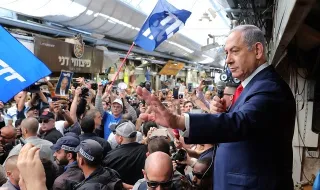
As Israeli opposition leader Gadi Eisenkot attempts to form a governing coalition following last month's election, Israel once again finds itself in a familiar political deadlock. The parties opposing Prime Minister Benjamin Netanyahu and his far-right coalition hold a clear majority in the Knesset—67 of the 120 seats. However, the four Jewish-led parties in Eisenkot's camp hold only 48 seats, which does not allow them to form a government on their own. The deadlock is reminiscent of the prolonged political impasse between 2019 and 2021, when Netanyahu's supporters and opponents remained in two rival parliamentary blocs, and four consecutive elections failed to produce a stable governing majority. This is what Ayman Odeh—a former Knesset member and Israeli lawyer and politician—writes for Foreign Affairs. An Israeli of Arab-Muslim origin, he headed the Joint List, known as "Hadash," between 2015 and 2026.
"But this time there is one difference. Israel's Arab parties—the Joint List and Ra'am—are stronger than ever. Thanks to exceptionally high voter turnout among Israel's Arab citizens, they won a record 19 seats in the Knesset: 11 for the Joint List and eight for Ra'am. This political mobilization is important in itself, as it demonstrates the overwhelming desire of Arab voters for change and their awareness of how important it is to participate in elections. Its significance, however, extends far beyond the number of seats won. Together, the Arab parties now have the potential to become a decisive force in a coalition against Netanyahu, providing the parliamentary support needed to form a government. There is already evidence of this strength: on November 17, the support of the Arab parties was crucial to the vote that replaced the Knesset speaker from the Likud party with a representative of Eisenkot's party. They now have a historic opportunity to steer the country in a different direction.
As the first leader of the Joint List and its former head, I know how much is at stake. In 2019, I helped lead an innovative effort to secure a direct voice for Arab parties in Israel's political system. We took an enormous political risk by supporting Benny Gantz—then a former chief of staff of the Israeli army and Netanyahu's main rival—as a candidate to form a government. We did so despite our deep political and ideological differences with him. Although the effort ultimately failed because Gantz chose to seek a "national unity government" with Netanyahu, it established an important precedent: by showing a willingness to work with Jewish political forces with which they profoundly disagreed, the parties representing the Arab population demonstrated that they could genuinely prevent a far-right government led by Netanyahu from remaining in power.
Today, after nearly four years of catastrophic rule by Netanyahu and his far-right allies, this opportunity has become far more urgent. It will require political courage from both sides. Eisenkot must be ready to offer something to the Arab parties, and they must feel comfortable supporting a government with which they may disagree on many issues. But the remarkable Arab voter turnout and the substantial majority of Israelis who are already opposed to Netanyahu have outlined a possible path forward. Not only Israel's future, but also its place in the region and the world, may depend on the willingness of its leaders to enter into dialogue with the country's Palestinian minority. Ultimately, such a partnership will be essential for building trust between Jews and Arabs—a prerequisite for achieving any real progress toward a viable Israeli-Palestinian peace. This is the choice facing Israel today: are Israelis ready to replace a politics of dominance and exclusion with a politics of equality?
Challenging Cooperation
The factors that brought a record number of Palestinian citizens of Israel to the polls in October had been building for years. Although Arab citizens make up more than 20% of the country's electorate and have long made a substantial contribution to Israeli society as doctors, lawyers, engineers, high-tech professionals and in many other fields, Israel's right wing has demonized them for decades as enemies—as a fifth column and a threat to the state. In recent years, this hostility has increasingly taken the form of harassment and open racism at universities and workplaces, in the media, parliament and everyday life.
It would be a mistake, however, to assume that the exclusion of Arabs is solely the work of Netanyahu and the radical right. Centrist and left-wing Zionist parties have also contributed to it by distancing themselves from Arab voters or simply ignoring them. Deeply rooted in Israeli politics is the belief that, ultimately, Jewish citizens should determine the country's political direction, while Arab citizens should remain within the boundaries set for them. Netanyahu understood early on how to turn this contradiction into a political strategy. Since the 1990s, he has repeatedly used the same formula: he turns his supporters against Arab citizens, delegitimizes Arab representatives in parliament and convinces Israeli Jews that a government relying on Arab political support would somehow be illegitimate.
These tactics proved to be among Netanyahu's most effective political tools, particularly given that the Arab-led parties have long been among his strongest opponents. He did not need to persuade everyone to support his Likud party or its various coalition partners. It was enough to convince enough people—including Israeli Jews who opposed him personally—that cooperation with the Arab parties was dangerous and unacceptable. Netanyahu's strategy also contributed to suppressing voter turnout among Arabs. TBecause the Arab parties had little chance of changing the status quo, Arab voters had insufficient incentive to vote. For many years, a significantly smaller share of Arab citizens went to the polls compared with Jewish citizens.
This began to change in 2015 with the creation of the Joint List, which for the first time united four parties representing the Arab population on a single electoral list and became the third-largest parliamentary group in the Knesset. By embracing a broader vision for our society, based on Jewish-Arab solidarity and opposition to right-wing racism, the Joint List showed that Palestinian citizens of Israel could play a new and more influential role in the country's political system. Then, under my leadership in 2019, the Joint List decided to support Gantz's candidacy to remove Netanyahu from power. The decision was highly controversial among both Arab voters and Israeli society as a whole. Many Arab voters had serious reservations about supporting a potential government led by a former army chief whose political positions, particularly on the status of Palestinian citizens of Israel and the occupation, sharply differed from their own. Nevertheless, we were prepared to take this political risk because we understood that removing Netanyahu was more important.
In practice, our willingness to cooperate with the Zionist opposition was not reciprocated. The Jewish opposition parties wanted our votes, but could not bring themselves to accept us as equal political partners. In the end, Gantz decided instead to form a government with Netanyahu. Nevertheless, the effort showed that Jewish-Arab political cooperation could open new horizons for a significant part of society. Since then, whenever Arab parties have recommended or supported the candidacy of a Jewish politician to form a government, or whenever Israel's center-left has depended on their support, additional groups in Israeli society have become more open to this kind of cooperation.
In 2021–2022, one Arab party—Ra'am—joined the short-lived government led by Naftali Bennett and Yair Lapid. I had serious reservations about the partnership model that emerged. It appeared to be based on the expectation that Arab political representatives would limit their participation to civil and domestic issues, refraining from involvement in political and national matters, particularly the occupation and the Palestinian question. I reject this distinction. We are part of the Palestinian people, and our identity and political concerns cannot be separated from our citizenship in Israel.
But it is precisely through such slow and painful steps that political change often takes place within national struggles. It does not always begin with a moral or democratic awakening. Sometimes it begins with pragmatic necessity. When there is no other option, people start reconsidering what they had until recently deemed impossible. In the present election, this dynamic took on even greater significance. After the endless crisis of the past four years, many Israeli voters—Arabs and Jews alike, as well as the leaders of most Zionist opposition parties—concluded that removing Netanyahu's government was more necessary than ever.
The Remedy Is Voter Turnout
In previous elections, voter turnout among Palestinian citizens of Israel generally remained between 50 and 60%. What explains the unprecedented 20% surge in the October election? Three main events stand out: the war of annihilation in Gaza and the killing of tens of thousands of Palestinians; the everyday racism and hostility that Arab citizens now face in the streets, public spaces and virtually every aspect of their lives; and the crime that spiraled out of control in Arab communities under National Security Minister Itamar Ben-Gvir, whose policies have allowed it to flourish, as well as the unrelenting settler violence against Palestinians in the West Bank, supported by Finance Minister Bezalel Smotrich. All the grief and frustration that had accumulated over these years was expressed at the polls.
There was another decisive factor, however. On the eve of the election, after opinion polls showed an almost even result between Eisenkot and Netanyahu, Arab citizens could clearly see how much the outcome would depend on them. This time, voting would not simply be a political choice. For many, it was a personal responsibility and a way to take control of their own future. That is why hundreds of thousands of Palestinian citizens of Israel went to the polls, defying years of efforts to silence them and undermine their ability to participate independently in political life. Many understood that the country's future direction could literally be in their hands.
I saw elderly people like my friend Juma from Jisr az-Zarqa take to the streets and campaign in support of the Joint List. Many of them had lived through the Nakba of 1948, or the "catastrophe" that accompanied the creation of Israel and included horrific massacres, the destruction of hundreds of Palestinian villages and towns, and the expulsion of approximately 750,000 Palestinians. I saw young people discussing politics in the cafés and restaurants of my beloved Haifa and persuading their friends to vote. I saw women and men from Nazareth, Umm al-Fahm, Sakhnin, Rahat, Acre, Kafr Yasif, Majd al-Krum and countless other towns and villages united by a shared sense of purpose. I saw political awareness turn into a living collective force. For a moment, the boundaries between generations and communities seemed to disappear.
The result marks remarkable progress in the process of Arab participation in Israel's political system, which began in 2019. In this election, Israel's Arab citizens voted in record numbers, significantly narrowing the historic turnout gap with Jewish voters. This also made another political reality increasingly evident: Israel's liberal and centrist camp cannot form a government without the parties representing the Arab population. If they exclude them, as well as the ultra-Orthodox and far-right parties, they will not reach the required 61 seats. This is the demographic reality. Israeli Jews who oppose Netanyahu must decide with whom they are prepared to build their political future.
Democracy or Denial
The debate over what Eisenkot should do and whether he should seek Arab support is now taking place not only in the Knesset, but also in people's homes, cafés, universities and on the streets. It is an extremely contentious issue, and many Israelis have deep disagreements over it. For the Arab parties, however, the very fact that they have acquired enough importance to spark such conversations is an achievement. The holding of this debate itself shows how the political process has compelled Israelis to consider possibilities that until recently seemed unthinkable.
Ultimately, Eisenkot may not have many other options if he wants to replace Netanyahu, as he has promised. In most cases, political parties support coalitions in order to pursue positive change and achieve specific goals. But there are moments when political cooperation is necessary for another reason: to prevent something far worse. Today, the most immediate and unconditional goal is to end Netanyahu's far-right government. This is a priority on which the Zionist opposition and the Arab parties can agree.
Beyond this common fundamental goal, the Arab parties must use their political influence in two directions. First, they should seek tangible improvements in the lives of the people they represent: fighting organized crime in Arab communities, securing budgetary funds, addressing the housing crisis, ending the brutal treatment of Palestinians living under occupation in the West Bank, and calling for a permanent ceasefire and the reconstruction of Gaza. These are fundamental issues linked to human dignity and the lives of civilians. More broadly, they must continue to press for real progress toward Israeli-Palestinian peace, ultimately based on the existence of two states living side by side.
I do not expect the current Israeli political elite to adopt these positions, but that does not mean the Arab parties should not raise them at every opportunity. At the same time, they can use their newly acquired political weight to build Jewish-Arab alliances around common political and strategic goals. Such partnerships should represent more than parliamentary arrangements—they should lay the foundations for a different future. To achieve this, Israel's Jewish and Arab citizens must engage with one another on the basis of equality, rather than mere political expediency.
So far, Eisenkot has shown almost no signs that he is ready to take this path. After the election, it was encouraging to see him condemn Netanyahu for fueling what he described as a "racist and violent" campaign against Israel's Arab citizens. Nevertheless, many of the main Zionist parties in Eisenkot's camp vowed not to work with the Arab parties. Eisenkot, however, should consider what that would mean. Thirty years from now, people will ask how Jewish dominance became so normalized that even politicians calling themselves democrats accepted the exclusion of one-fifth of their fellow citizens. They will ask why Israel's opposition managed to recognize the danger posed by Netanyahu's government, but failed to confront the assumptions that made his politics possible.
There is an irony in the fact that in a country seeking to keep political hegemony exclusively in Jewish hands, the Palestinian minority—after decades of struggle for political recognition and equal rights—has become one of the most significant forces shaping its political future. We understood that we had to show courage and cooperate with centrist and left-wing Zionist parties to remove Netanyahu, Ben-Gvir and Smotrich. The question now is: do these parties, which call themselves democratic and liberal, have the same courage?".
Source: news.bg