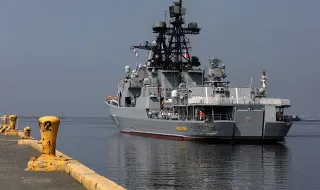
First, a Russian cargo ship off the Finnish coast was hit, then a Russian warship and a commercial vessel in Libya, allegedly carrying weapons, were attacked: a series of spectacular Ukrainian military operations in more distant regions attracted attention over the past week.
Meanwhile, several suspected Russian cruise missiles fell in Poland— not far from the site of international military exercises. Intelligence services have long warned of targeted Russian provocations on NATO’s eastern flank.
Does all this mean an escalation of Russia’s war against Ukraine, with other countries also at risk of being drawn into it?
Where are Ukrainian units operating?
It is no secret that Russia has long expanded its operations far beyond Ukraine’s borders. Through military provocations, hybrid attacks and acts of sabotage, Moscow is trying to put pressure on countries that openly support Ukraine. For its part, Ukraine has also begun striking the Russian army and Russian economy far from the country’s borders.
Since the summer, attacks by both sides on international shipping in the Black Sea have increased significantly. These incidents have affected not only Russian and Ukrainian cargo ships, but also vessels belonging to a number of other countries – above all Turkey.
With the help of aerial and naval drones, Ukraine has repeatedly managed in recent years to inflict serious damage on Russia, even deep inside the country: Kyiv has targeted oil refineries, military airfields and other strategic targets. For example, an oil refinery in the Siberian city of Omsk, 2,500 kilometres from Ukraine, was hit, as were Russian warships in Russian ports in the eastern part of the Black Sea.
On the Baltic Sea, Russia has only a very narrow stretch of coastline, surrounded by Finland and Estonia. Ukraine had already carried out several strikes there before the latest attack on the "Sparta II" cargo ship and had targeted Russian oil terminals, for example in St. Petersburg, Ust-Luga and Primorsk. Via the Baltic Sea, Russia supplies its exclave of Kaliningrad and exports oil and other goods to the rest of the world with the help of the so-called shadow fleet.
Ukrainian special forces are said to have conducted operations against Russian military facilities in Syria—long before the fall of longtime dictator Bashar al-Assad. In Mali, meanwhile, they supported local Tuareg fighters, who inflicted heavy losses on the regular army and the Russian mercenaries allied with it.
What is Ukraine’s objective?
Through such actions, Ukraine is seeking to damage Russia’s military power and economy on a global scale. In purely military terms, this does not provide Ukraine with an immediate benefit: for example, the Russian corvette recently sunk off Libya belonged to the Black Sea Fleet, but it would not have been able to return to the Black Sea anyway, because Turkey closed the Bosporus and Dardanelles to warships. Instead, the vessel had been escorting Russian cargo ships in the Mediterranean. Above all, these attacks send a political message: Russian ships can no longer feel safe—anywhere in the world.
"This is not simply about some random cargo ships from the "shadow fleet" carrying oil," explains security expert Elisabeth Braw of the Atlantic Council in an interview with DW. The Russian cargo ship "Sparta II", attacked off the coast of Finland, is also suspected of carrying military materials—something Moscow denies.
"Ukraine knows exactly which ships perform which functions for the Russian military. And it is now able to attack them, regardless of where they are or in what waters they are sailing. This is something Ukraine was unable to do at the beginning of the war," Braw adds.
Officially, Kyiv’s objective is to disrupt Russian logistics and supply routes. Military experts and politicians, however, also view these attacks as a clear political signal to Western allies. Ukrainian President Volodymyr Zelensky is sending an unequivocal message of strength in anticipation of possible future peace negotiations.
In an interview with ARD, Joachim Weber, an expert from the Center for Advanced Security, Strategic and Integration Studies (CASSIS) at the University of Bonn, notes that President Zelensky, disappointed by the United States’ position so far, is acting increasingly often without paying much attention to Washington’s views. According to Weber, the attacks in distant maritime regions are a sign that "the last remaining restraints are falling away" and that Kyiv, despite the risks, is ready to expand the conflict geographically in order to increase pressure on Moscow.
What are the potential consequences for maritime security?
Weber warns that the war could become widespread if attacks on civilian or suspicious vessels in international waters become more frequent. Russia is increasingly providing military escorts for ships from its "shadow fleet". "In such a scenario, the likelihood of an exchange of fire between armed forces, coast guards or other structures increases considerably," Weber says.
Added to this is the fact that more and more violations of maritime law are being observed not only in the war against Ukraine, but also in other conflicts – "for example in the South China Sea, the Strait of Hormuz or the Red Sea," adds Elisabeth Braw of the "Atlantic Council".
At present, around 90 percent of global trade is conducted by sea. There is a risk, however, that various actors around the world "may conclude that it is not in their interest to comply with the rules of international maritime law," Braw says. "It may prove more advantageous for them to violate maritime law in order to secure a short-term advantage. I fear that other countries may also decide to violate maritime law—and that would make the world’s oceans significantly less safe for everyone," she further emphasized to DW.
Source: www.dw.com