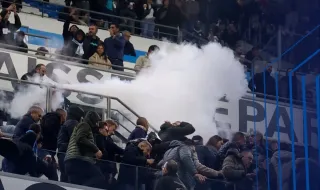
Clashes between supporters of Olympique Marseille and Levski Sofia before the Europa League match on 26 November continue to provoke reactions in France and Bulgaria. While Bulgarian public opinion has focused on the attack on the “Blues’” supporters, some French publications have also highlighted the behaviour of the Bulgarian supporters’ group and the alleged provocations before the clash.
But how did the French media portray what happened, and why did claims of racist provocations emerge?
How did it all begin at the Vélodrome?
According to reports by AFP, Le Figaro and Le Parisien, the incidents began around ten minutes before kick-off.
Several dozen Marseille supporters left the Virage Sud section and appeared in the Jean Bouin stand, where Bulgarian fans were located. A crowd movement followed, with the French supporters apparently pursuing a group of Bulgarians who withdrew towards the section designated for the away supporters.
Tension escalated there. The two groups began throwing objects and pyrotechnic devices at one another. The intervention of security personnel temporarily restored order, but the away section remained under increased police surveillance.
Approximately 500 Levski supporters were in the section.
Nazi salute by Bulgarian fan drew the attention of the French press
One of the most widely discussed details in the French reports was a video circulated on social media, in which a Bulgarian supporter appears to make a Nazi salute.
Dernières Nouvelles d'Alsace (DNA) paid particular attention to the footage and included it in the headline: “Nazi salute and huge clashes: tension in the stands before Marseille – Levski”.
This detail is important for understanding the reactions in France. Nazi symbolism has an especially grave social context in the country, and such an act naturally provokes strong reactions.
However, a distinction must be made here: the video shows an alleged act by one supporter, but in itself it does not prove that it caused the attack, nor that all Bulgarian fans took part in similar provocations.
It is also necessary to distinguish Nazi symbols from the specific claims about racist remarks or insults. The reports examined contain no independent confirmation that such remarks were directed at the French supporters.
The differing perspectives of the French media
It is interesting that different French publications placed different emphasis on what happened.
Le Figaro and Le Parisien mainly described the chronology of the clashes – the movement of the Marseille ultras towards the away section, the pursuit of Bulgarian supporters and the throwing of objects and flares. TF1 Info focused on the number of injured people and information from the police prefecture. TV5Monde presented the incidents and the reaction of the football club, which condemned the violence and said it was clarifying the circumstances. Dernières Nouvelles d'Alsace placed the video showing the alleged Nazi salute front and centre.Thus, French media coverage cannot be reduced to a single version of events. While some reports focused on the physical attack and those injured, others drew attention to the provocative behaviour of individual supporters.
Eleven Bulgarians injured, five taken to hospital
According to data from the police prefecture, cited by AFP and TF1 Info, a total of 11 Bulgarian supporters suffered injuries.
Five were taken to hospital with eye injuries, head injuries and a dislocated shoulder. Six others received medical assistance at the scene.
At the time the initial reports were published, the French authorities had no information about any arrests made in connection with the clashes.
Olympique Marseille condemned the incidents and said it was working with the competent authorities to establish the exact circumstances.
Levski coach Julio Velázquez described what happened as unacceptable in football and expressed his support for the supporters caught up in the clashes.
Football was left in the background
The match nevertheless went ahead as scheduled and ended in a 1–0 victory for Marseille. The sporting result, however, was overshadowed by the violence in the stands.
The case raises several important questions: were there prior provocations, what role did individual supporters play, and why did the security arrangements for the away supporters fail to prevent the clash?
One thing is clear – provocative or racist behaviour by individual fans must be investigated and sanctioned, but it cannot serve as an excuse for physical violence.
The investigation by the French authorities must establish the individual responsibility of those involved, rather than shifting the blame onto an entire supporters’ group or nationality.
Sources: DNA; Le Figaro; TF1 Info; TV5Monde; AFP