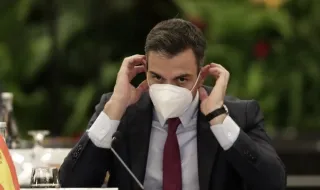
After eight years of socialist rule, opinion polls suggest that Spain is likely to have a new right-wing government. Exactly how it will govern, however, will depend on the balance of power between the conservative People’s Party (PP) and the far-right "Vox", reports "Politico".
The election platforms of the right-wing parties contain few specific commitments. In the case of the PP, this is a deliberate strategy, according to a party representative, aimed at allowing its leader Alberto Núñez Feijóo to avoid making excessive promises during the campaign.
The specific political programme will depend on the distribution of ministerial posts in a possible coalition between Feijóo’s traditional centre-right party and Santiago Abascal’s "Vox". The latter is still considering how actively it wants to participate in a potential Feijóo government.
A rightward shift after eight years of Pedro Sánchez’s socialist government would bring major changes to Spain’s political agenda in a number of key areas – from migration to data centres – and would certainly attract Brussels’ attention.
One thing is clear, however: Spain is unlikely to become a eurosceptic force at the highest level in the EU.
"Vox" may sharply criticise European Commission President Ursula von der Leyen and the EU institutions, but it is aware that there are limits to the spread of euroscepticism in Spain. The country is fundamentally strongly pro-European. Its path towards EU membership ran parallel to its transition to democracy after the death of fascist leader General Francisco Franco, and Europe is part of Spain’s democratic identity.
Here are the six main areas in which Spain’s policies could change under a PP–"Vox" government.
1. Migration: Spaniards first?
Migration is one of the areas in which the policies of the Sánchez government are likely to be reversed.
Both the PP and "Vox" sharply criticise the current government’s large-scale programme to legalise migrants, while the PP also supports a legal ban on such measures.
Since the last parliamentary elections in 2023, migration has risen to second place among Spaniards’ main concerns, after housing. The crisis in Ceuta, in which tens of thousands of people – mostly young men from Morocco – entered Spain, led to tougher rhetoric from both "Vox" and the PP. Both parties adopted the term "invasion".
"Vox"’s leading migration policy is known as "national priority". In practice, this means an approach under which Spanish citizens receive priority access to public services – from housing and education to social benefits.
The PP’s election platform also includes "criteria for priority access to certain benefits, services and public resources". The party does not, however, limit these criteria to nationality alone, stating that they should also cover foreigners with long-term legal residence in Spain.
"Vox" has also turned so-called "remigration" – a term borrowed from far-right circles in Germany and Austria – into one of its main election proposals. The European Commission, however, has already stated that such proposals are incompatible with EU law, while the PP has distanced itself from the idea.
On almost all other migration-related issues, the PP and "Vox" would join the EU’s new prevailing position, which envisages a significantly tougher approach, including the creation of migrant return centres outside the Union’s territory.
2. Agriculture: "Vox" territory
The far-right party presents Spain’s rural areas as the true heart of the nation. Abascal and his party have always sought to obtain the portfolios related to agriculture in the regional governments they run jointly with the PP. The agriculture ministry is therefore likely to be one of "Vox"’s main targets in a possible coalition government.
A significant proportion of migration to Spain is linked to the agricultural sector, which relies on a large number of low-paid migrant workers.
"Vox" has expressed its intention to extend the principle of national priority to this sector as well, calling for wages to be increased to make these jobs more attractive to Spaniards. The party, however, avoids making this issue a central element of its migration policy.
The PP proposes the use of temporary visas and the recruitment of workers directly from their countries of origin.
Spain could come into conflict with the EU on trade issues if a PP–"Vox" government decides to restrict imports from countries it believes are undercutting local producers.
In the past, Abascal’s party has called for the suspension of an agreement on trade in agricultural products with Morocco, arguing that Moroccan producers create "unfair competition".
The PP promises that "imported food products will meet safety and production standards equivalent to ours". This is a call to include so-called mirror clauses in trade agreements, requiring foreign producers to comply with standards similar to those of their European competitors.
"Vox" rejects the EU’s trade agreement with Mercosur (the Southern Common Market), describing it as an attack on Spanish producers. The PP avoids taking a categorical position on the agreement, but broadly supports it.
On one issue, however, the two right-wing parties are fully aligned with the current socialist government – their opposition to cuts to the Common Agricultural Policy (CAP), the EU’s key scheme for subsidising farmers, in the Union’s next seven-year budget. Continuity is expected in this respect.
3. Technology: an end to campaigns against Big Tech
Sánchez has made his strained relations with the "tech oligarchs" an important part of his political messaging.
The public campaign against Big Tech is likely to end under a PP–"Vox" government. Abascal has met with Elon Musk, who has publicly expressed his support for "Vox".
On some issues, however, the PP’s position is not significantly different from that of the socialists.
For example, Feijóo promises to ban children under 14 from accessing social media and accuses the Sánchez government of not doing enough to protect children online. "Vox", on the other hand, opposes such age restrictions.
A more substantial change could come with regard to data centres.
The government recently approved a decree that places limits on data centres’ energy consumption and introduces requirements related to digital sovereignty. The document was also ratified by parliament.
Alberto Nadal – Feijóo’s expert on industrial policy – promised to repeal the law if the party comes to power, which would pave the way for the sector’s expansion.
4. Energy and climate: from a leading position to the European mainstream
Energy and climate change were among the main political priorities of the socialist government, which made Spain one of the EU’s most ambitious countries in terms of green policies.
This is expected to change significantly under a PP–"Vox" government.
The extent of the change will depend on "Vox"’s influence in the future government. Abascal’s party links many of the problems facing Spanish agriculture to climate regulations and has spent years mobilising its supporters against climate policy.
For example, it has criticised the uprooting of olive trees to make room for solar parks.
The PP follows the new prevailing line in the European Union on climate and energy. In line with the position of the European People’s Party, it supports easing climate regulations and "ending the imposition of unrealistic deadlines".
In the energy sector, the two parties are united in supporting the extension of nuclear power plants’ operating lives.
Even if "Vox" attempts to divert Spain from the energy transition, renewable energy is already a permanent part of the country’s energy mix. According to the International Energy Agency, the share of electricity generated from renewable sources rose from 35% of total production in 2015 to 56% in 2025.
5. China: a tougher position?
Under Sánchez, Spain became one of the EU’s most active supporters of deepening relations with Beijing and established a strategic dialogue with Chinese President Xi Jinping.
Feijóo promises to honour any European-level agreement to toughen the EU’s position towards Beijing.
Some of his closest foreign-policy advisers, such as experienced diplomat Ildefonso Castro, are firm supporters of transatlantic relations. They could steer a future PP government towards a tougher position on China if it coincides with Washington’s stance.
"Vox" also takes a tough stance towards China and in 2025 accused Sánchez of flattering the "communist Chinese dictatorship".
Both right-wing parties support excluding high-risk suppliers from public procurement, citing Huawei as an example. They also sharply criticise the current government’s decision to renew its contracts with the Chinese company.
This is not an easy decision, however. Some of the largest Chinese investments in Spain are located precisely in regions governed by the PP, such as Galicia, Andalusia and Valencia.
6. Women’s rights and culture wars
Sánchez’s government seeks to defend progressive values on the international stage as well. A potential Spanish government involving "Vox" as the junior coalition partner would represent a sharp contrast to this policy.
During the campaign, Feijóo promised to abolish the independent ministerial status of the Ministry of Equality and transfer its functions, which focus primarily on gender equality issues, to another department.
If "Vox"’s model in regional governments is followed, Abascal’s party will call for the creation of a Ministry of the Family.
In a radio interview, Feijóo also opened a debate on a possible reform of Spain’s abortion law, stating that the parents of underage girls who decide to have an abortion should be informed of the decision.
"Vox", which called for the repeal of the law in 2023, now takes a less clear position.
There are also differences between the two parties on equality issues. The PP supports the existing political consensus on laws concerning gender-based violence, while "Vox" generally uses the term "domestic violence" and calls for the repeal of laws criminalising certain acts by men.
In addition to the issue of equality, cultural disputes related to rural traditions and heritage are also likely to enter government.
"Vox" supports measures to protect hunting, while it and the PP are also united in supporting wolf hunting to protect livestock in the northern parts of the country.
The biggest area of confrontation, however, remains bullfighting.
The current culture minister, Ernest Urtasun of the left-wing party "Sumar", abolished the national bullfighting award in 2024. Both the PP and "Vox" plan to restore it.
Source: news.bg