At the end of 1998, Tony Blair was Prime Minister of the United Kingdom, Lionel Jospin was Prime Minister of France, and Gerhard Schröder had just been elected Chancellor of Germany. The EU had 15 member states, and pro-European, centre-left parties were in power—either alone or in coalitions—in all but two of them. Eastern enlargement was under way. In Washington, Bill Clinton was pursuing the same kind of “Third Way” centrism as a middle ground between free-market capitalism and traditional socialism. The EU felt it had caught the wave of history.
Almost three decades later, it appears that the continent’s political processes are once again moving in one direction—only this time the initiative is in the hands of far-right nationalists. The result could lead to a serious dismantling of the post-war European consensus on which the European Union was built, European correspondent John Henley writes in an article for The Guardian.
From the end of this month until the end of next year, the Community is set to see a series of elections. Voters in four of the EU’s five largest member states (by population and economic power) will go to the polls. In addition, parliamentary elections are due to be held in Estonia, Finland, Greece and Slovakia, as well as regional elections in Germany.
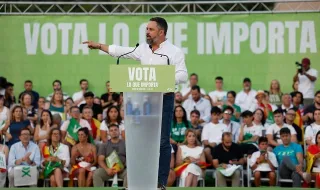
The cycle begins with snap parliamentary elections in Spain on 29 November. Prime Minister Pedro Sánchez’s Socialist coalition faces a likely defeat at the hands of the right-wing parties—the conservative People’s Party (PP) and the far-right Vox, which already govern jointly in some Spanish regions.
Presidential and parliamentary elections are due to be held in France in the spring. The clear favourite in the presidential race is Marine Le Pen of the far-right National Rally (RN)—she is comfortably ahead of far-left radical Jean-Luc Mélenchon and the deeply divided opposition from the traditional political spectrum.
When Poland votes later next year, nationalist parties—which together command nearly half of the vote in the country—could bring down Prime Minister Donald Tusk’s liberal coalition, despite recent divisions within their ranks.
In Italy, meanwhile, Giorgia Meloni, whose Brothers of Italy party has far-right roots, hopes to secure a second term in elections that must be held before the end of 2027, although she is facing pressure from the right from the new National Future formation. Paradoxically, this rise of nationalism is taking place against a backdrop of strong public support for the EU. Shocked by the chaos surrounding Brexit and seeking security in an increasingly troubled world, a record 74% of Europeans say their country benefits from membership of the Union, while very few Eurosceptic parties today openly advocate leaving the EU.
Eurosceptics and nationalists, however, still view the bloc as a project imposed “from the top down” that undermines national sovereignty, and seek to turn it into a much looser association of sovereign nation states. According to Italian political scientist Nathalie Tocci, this means that the upcoming “supercycle” of elections could “dramatically change the face of Europe”, causing not merely “a slow erosion of the European project, but its emptying of substance, if not its complete collapse from within”.
Every electoral contest is different, and national circumstances play a significant role. Analysts, however, agree that interconnected factors lie at the heart of these processes: sluggish economic growth, an ageing population, strained public finances and sharply rising living costs.
All of this is undermining support for Europe’s traditional centre-left and centre-right parties, which seek to appeal to a broad range of voters. The wave of protests led by young people across Europe is merely the most visible sign of deep dissatisfaction among voters.
Meanwhile, nationalist parties are becoming increasingly adept at creating and exploiting an ever-changing list of alleged threats and crises—from migration and vaccines to the “green transition”, support for Ukraine, globalisation, international elites and supranational institutions. These narratives are fuelled by Russian disinformation, as well as by the open support for “patriotic” parties coming from the White House during the presidency of US President Donald Trump.
The political scene is becoming increasingly fragmented and polarised: today, almost one in four voters supports far-right parties—a share that has increased nearly fivefold since the mid-1990s.
This rise has not been linear: over roughly the past year, while the far-right Alternative for Germany (Alternative für Deutschland) achieved a historic victory in regional elections in eastern Germany.
In the Netherlands, for example, Geert Wilders’s Party for Freedom lost nearly a third of its seats.
In Hungary, Viktor Orbán’s Fidesz party suffered a heavy defeat, while the far-right Sweden Democrats saw their support decline for the first time in 16 years. Nevertheless, the main upward trend appears clear—according to political scientists, it is fuelled above all by the normalisation and entry of far-right ideas into the political mainstream, particularly on immigration.
Centre-right parties are gradually removing the “cordons sanitaires” that once prevented cooperation with the radical right. At the European level, the centre-right European People’s Party is increasingly turning to more far-right groups in order to revise parts of the European Green Deal and tighten migration rules.
For the European Union, the most significant impact of this “supercycle” of elections could be felt in the European Council—the body bringing together national leaders, where there are currently only three centre-left heads of state or government (out of 27). If, by the end of 2027, Eurosceptic leaders from France, Spain and Poland join their counterparts from the Czech Republic, Italy, Romania, Slovakia and Slovenia, they will not have enough votes to change EU legislation, but they will form a significant blocking minority.
The next “bone of contention”, which could turn out to be the debate over the EU budget, future enlargement and aid for Ukraine, while deeper integration in key areas such as defence, energy, finance and technology could become paralysed.
Italian political scientist Nathalie Tocci notes that “safety in numbers” could change the behaviour of the current leaders in the Council. Giorgia Meloni’s relative restraint is partly dictated by her relative isolation among her mainstream colleagues—such as Tusk, Sánchez and French President Emmanuel Macron.
If instead she were to sit at the same table with figures such as Le Pen, Poland’s far-right leader of the Law and Justice (PiS) party Jarosław Kaczyński, and a Spanish government backed by Vox—all while hardliner Roberto Vannacci of the National Future movement is breathing down her neck at home and EU funds are gradually declining—she might have less incentive to play by the EU’s rules.
Analysts, however, agree that the decisive arena is France. Le Pen’s election platform puts her on a direct collision course with Brussels. She intends to reduce France’s contribution to the EU budget by €11 billion, hold a constitutional referendum to affirm the supremacy of French law over European law, and breach a number of single-market rules.
France “has a very significant influence on the EU”, notes Mujtaba Rahman of the consultancy Eurasia Group. In his view, compared with Orbán, a President Le Pen would have “far greater levers for implementing the far-right strategy: undermining the EU’s supranational architecture, based on the rule of law”.
So far, Brussels has managed to contain figures such as Orbán, who create problems, mainly because there have rarely been more than two or three such participants around the negotiating table. A united Eurosceptic bloc would deprive the EU of the ability to enforce rule-of-law standards, deepen integration in the fields of economics and security or, put plainly, reach agreement on any substantial issues. The first victim would most likely be Ukraine, with Le Pen potentially leading a group blocking the provision of additional aid.
Thus, three decades after 1998, the upcoming elections in Europe, says Stefan Lehne of the Carnegie Europe think tank, could become “a key test of the EU’s resilience”.
The threat to the Union may not be immediate or existential, he notes, but the medium-term risks are significant. “The strengthening of the radical right is unlikely to lead to the dismantling of the EU in its current form,” Lehne says, but it could “prevent the Union from becoming what it needs to be in order to tackle the challenges of the future”.
And a prolonged inability to act collectively where action is needed will gradually, but inevitably, lead to a “loss of relevance”.
Source: news.bg