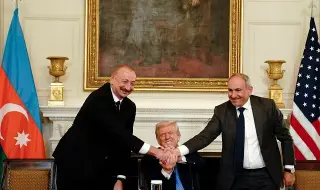
Something happened that was unthinkable a few years ago – Russia's exclusive influence in the South Caucasus region ended. This happened with the framework agreement signed in the US between Armenia and Azerbaijan.
Baku and Yerevan agreed on the main parameters of the agreements without the participation of Moscow, but with the active mediation of the US administration and with the support of Turkey. Just five or seven years ago, such a thing would have been completely unthinkable.
Aliev and Pashinyan win
The agreement, signed on August 8 in Washington, is a kind of roadmap. It does not set specific deadlines for the establishment of diplomatic relations between Armenia and Azerbaijan or changes to the Constitution of Armenia regarding Nagorno-Karabakh - without them, Baku will not move towards a final settlement of the conflict. But it seems that Donald Trump managed to prevent a possible war between the two sides in the dispute over the direct transport corridor from Azerbaijan to the Nakhichevan Autonomous Republic.
It is separated from the main territory of Azerbaijan by the territory of Armenia. Transit (while respecting the sovereignty of Armenia) will pass through the so-called “Trump's Route for International Peace and Prosperity“ (TRIPP), all the way to the Turkish border. It is assumed that this will be the main regional transport corridor and transit route for energy carriers.
What advantages do Baku and Yerevan receive?
Ilham Aliyev has strengthened his status as a major US ally in the South Caucasus. Now Baku will be able to buy American weapons. For the EU, Azerbaijani energy resources are finally becoming one of the most important alternatives to Russian ones. The increasingly sharp anti-Russian rhetoric of the Azerbaijani authorities is a reflection of the irreversible process of Baku's separation from Moscow.
The Prime Minister of Armenia Nikol Pashinyan has prevented the possibility of a new war with Azerbaijan, which could turn into a military catastrophe for Armenia. And in the future, normalization of relations is also emerging, as well as the opening of the border with Turkey. This will mean a way out of the prolonged geographical and economic isolation in the region. In conditions of peace, Pashinyan will be able, without paying attention to the Kremlin, to significantly more actively develop relations with the EU within the framework of the “Eastern Partnership“, including accelerating negotiations on a visa-free regime with the Community - similar to those established with Ukraine, Moldova and Georgia. Moreover, since the beginning of this year, Armenia's course towards European integration has been enshrined in law. The same process as in Azerbaijan will inevitably begin there - Moscow's opinion will matter less and less.
A large part of Armenians believe that Russia has betrayed them, because despite the existence of a military alliance, it did not help Yerevan during the war for Nagorno-Karabakh (although Moscow has never recognized it as part of Armenia). But the loss in the war led to a seemingly paradoxical result - strengthening the real sovereignty of the country, which for too long was dependent on the Kremlin in matters of foreign policy and security.
Is Putin preparing a coup in Armenia?
Both Aliyev and Pashinyan almost simultaneously refused to take into account the social, political and economic influence of the Azerbaijani and Armenian diasporas in Russia. Previously, this was an extremely important factor that made both sides take Moscow's position into account. This is especially evident in the case of Pashinyan. An example of this is his sharp opposition to businessman Samvel Karapetyan, who made a fortune in Russia. The Prime Minister of Armenia believes that Karapetyan is creating his own political party and opposing him not so much of his own free will as at the insistence of Vladimir Putin's administration. Pashinyan's arrest of the businessman is a clear signal to Armenian society and the diaspora - those who prefer to stay in Russia cannot at the same time claim influence in Armenia.
Konstantin Eggert
It is very likely that the Putin regime will attempt to overthrow Pashinyan in the upcoming parliamentary elections in June 2026 - by provoking instability and financing pro-Russian candidates. The aggravation of relations will become practically irreversible if the Armenian Prime Minister continues the policy of pushing the Russian army and special services out of the country. Interestingly, in this situation, it would be beneficial for Ilham Aliyev to support Pashinyan, rather than wait for the Armenian “patriots”, financed by the Kremlin, to overthrow him with the support of the Russian military stationed at the base in Gyumri. Moreover, such a development would not please Erdogan at all. And Putin certainly has no interest in spoiling his relations with him.
But even if the war against Ukraine is completely stopped, Moscow will not be able to regain its previous positions in the South Caucasus. Ankara, and to a lesser extent Washington, have become the main geopolitical players in the South Caucasus region. It is they who will actively influence its future, not Putin.
This comment expresses the personal opinion of the author and may not coincide with the positions of the Bulgarian editorial office and DW as a whole.