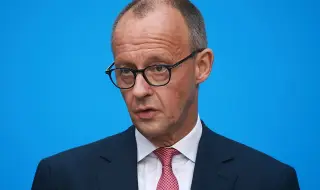
After the first 100 days of his term, German Chancellor Friedrich Merz's approval rating is lower than that of his predecessor Olaf Scholz. The ruling coalition parties are no better off, notes DPA, citing the latest opinion poll in Germany.
Federal Chancellor Merz of the Christian Democratic Union (CDU) and his coalition, which also includes the Christian Democrats' sister party in Bavaria, the Christian Social Union (CSU), and the German Social Democratic Party (SPD), do not enjoy the approval of the majority of Germans. According to a survey by the INSA Institute commissioned by the Sunday edition of the newspaper “Bild“ Those dissatisfied with the Chancellor's work are 59%, with only 30% of the opposite opinion. The rest cannot judge.
According to the survey data, Merz is performing worse on this indicator than his predecessor Scholz from the SPD. With the Social Democrat, 100 days after he took office in March 2022, those satisfied were 43%, and those dissatisfied were 41 percent.
With regard to the overall work of the government of the conservative bloc CDU/CSU and SPD, negative assessments also prevail - 60% do not approve of the cabinet's actions, and only 27% speak positively about it. When compared with the Scholz government, the so-called Traffic Light Coalition of the SPD, the Greens and the Free Democratic Party (FDP), 28% of those surveyed believe that the “Scholz” cabinet is doing better, and 24% - that it is doing worse. The largest group is those who do not see much change (38%).
According to the INSA survey, electoral attitudes in Germany remain unchanged. If the elections were held today, 27% would vote for the CDU/CSU, with 15% for the SPD. In second place is the far-right “Alternative for Germany“ (25%), followed by the Greens (11%) and the far-left formation “The Left“ (9%). With 4% support each, the liberal FDP and the left-wing populist formation “Sarah Wagenknecht Alliance“ remain below the threshold for entering the Bundestag (5%).
A DIFFICULT START ON A WELL-BEEN PATH
Friedrich Merz is the tenth chancellor of post-war Germany. His start as head of the CDU and as chancellor was difficult. He was elected leader of his party and its candidate for chancellor only on his third attempt, recalls the German magazine “Focus“.
The Bundestag elected him leader of Germany only on his second attempt. It is not yet clear how he will one day leave the Chancellery, but historically only three of his nine predecessors have left after serving their full terms – Kurt Kissinger, Helmut Kohl and Angela Merkel. The rest leave the highest management post early.
Konrad Adenauer leaves after internal party struggles, and the formal reason for his fall is the “Spiegel“ affair - an investigation in the 1960s against journalists from the “Spiegel“ magazine, perceived as repression against them, as a result of which his own party members force him to step down in favor of the legendary West German Finance Minister Ludwig Erhard. However, the latter turns out to be an unsuitable chancellor and barely holds on to his post; Willy Brandt fails because of a spy affair, one of his closest people turns out to be a Stasi agent; Helmut Schmidt, for his part, first lost the confidence of the FDP ministers and then a vote of no confidence in the Bundestag.
More recently, Gerhard Schröder chose to "escape", as Der Spiegel wrote at the time, by deciding to call early elections after previously losing a series of votes in regional parliaments. The next chancellor was Angela Merkel. And her successor, Olaf Scholz, was ousted by his coalition partners from the FDP.
Three months into his term, Merz's mistakes are multiplying and he has confidently followed the beaten path of his six predecessors, who ended their terms prematurely, commented „Focus“.
WHAT WERE SOME OF THE CHANCELLOR'S BIGGEST MISTAKES SO FAR
Attitude towards the AfD: Soon after Merz announced in the election race that he had nothing to do with the AfD, he stood in front of the cameras and said that this was a secondary issue. „Whoever wants to support these declarations, let them support them. Whoever doesn't want to, let them not support them. I don't look left or right. On this issue, I only look straight ahead.“ The position of „no cooperation“ and “incidental cooperation“ could be understood, but not when expressed in a space of just four weeks.
A departure from the CDU's principles in financial policy: The CDU has always stood by the principle that it will pursue a serious (conservative) financial policy. For the Christian Democrats, the so-called constitutional debt brake was therefore the holy of holies. Merz himself announced before the elections regarding a possible coalition with the SPD: "We will not lend a hand to the SPD only to be dragged down the old social democratic path of indebtedness again." After the elections, everything was different and Merz was ready to make any concessions to the Social Democrats just to become chancellor, notes "Focus."
Appointment of a new judge to the Constitutional Court: Merz first supported the SPD's nominee Frauke Brosius-Gersdorf to fill a vacant seat on the Constitutional Court, but then surprisingly withdrew his support. The conservative circles in the CDU were pleased, but the question remained why he had agreed to support the candidacy of such a liberal lawyer. Her positions on abortion in particular are scandalous for the traditions of the Christian Democrats, so it is strange that the chancellor had to be stopped by an internal party revolt, instead of him feeling it himself, notes “Focus“.
Doubting loyalty to Israel: Merz first convinced Israeli Prime Minister Benjamin Netanyahu of his unconditional support, and now announced that he was stopping until further notice “the supply of weapons that could be used in Gaza“. Because of this, he had to urgently interrupt his summer vacation on Sunday to appear on the ARD television channel and explain his move: “We cannot supply weapons to a conflict in which an attempt is being made to resolve it exclusively by military means. Where should these people (Palestinian refugees) go? We have no right to do it and we will not do it – and I will not do it“. However, foreign policy experts in his party disagree: in their opinion, the national interest requires that unconditional support for Israel continue.
Unilateral decision-making: Merz has shown a tendency not to discuss changes in his course with anyone. This was the case with the AfD, and so was the case with Gaza, when the consent of the CSU was not sought, even though the two parties are still part of a common parliamentary bloc. Such decisions are not good for the internal climate in the parliamentary group, adds „Focus“.
ANTHODETIC WAY OF MAKING POLITICS
When Merz retired from politics in 2009, the world was much different than at the end of 2021, when he returned to it, notes „Augsburger Allgemeine“. Crises such as the annexation of Crimea and the COVID-19 pandemic have created new realities in world politics. Since then, these trends have only deepened, but Merz is lagging behind them, the publication notes.
The uniform way of making decisions is reminiscent of the times when the Christian Democrat Helmut Kohl would inform only a handful of selected people of his intentions, then pick up the phone and call the leaders of the world powers. This way of doing politics brought him success and in this way he managed to stabilize the EU together with François Mitterrand, and with Mikhail Gorbachev - to pave the way for the unification of Germany. Merz's decision to stop arms supplies to Israel was precisely of this type: he was forced to explain to ARD that he had not taken it alone, but in any case he had to defend it alone.
Merz's problem lies precisely in his old-fashioned thinking: in a globalizing world there are no longer simple solutions. Everything is connected. To understand the Russians, you have to talk to the Chinese and the Brazilians, points out the “Augsburger Allgemeine“.
The Chancellor's way of communicating also fits into this context. Merkel once caused smiles with her statement that the Internet was “unknown territory“ - this was only 12 years ago. Merz avoids social media and doesn't want to deal with it at all. He could have quelled the scandal surrounding the failed election of a constitutional judge much more easily if he had been more attentive to the mood in Aix and other social media. Even older politicians like US President Donald Trump understand the power of the World Wide Web very well. The 69-year-old Merz, for his part, is content with a good old-fashioned newspaper interview, he told the “Augsburger Allgemeine“.