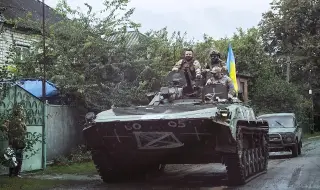
Is it possible for foreign troops to be deployed in Ukraine to guarantee its security from a new Russian attack? What security guarantees are possible and who could provide them?
After the talks in Washington, efforts to achieve peace in Ukraine have gained momentum. A key part of a possible future peace agreement are guarantees for Kiev's security. They are a prerequisite for Ukraine to make concessions in return.
Why Ukraine and Europe insist on guarantees
Ukraine wants to make sure that if the peace talks are successful, Russia will not try to invade the country again. For Europe, the question of how to prevent possible attempts by Russia to attack European territories is also of key importance. In order to achieve such deterrence and lasting peace, measures are needed that guarantee the security of Ukraine.
Security guarantees can be of different nature - political declarations in support of the country's territorial integrity, but also financial and military assistance, as well as binding promises of support.
What security guarantees does Ukraine expect to receive
In the best-case scenario for Kiev, the country would become part of NATO and thus receive the strongest guarantee of its security under Article 5 of the Alliance treaty, which implies collective defense. However, such a prospect was rejected by US President Donald Trump, ARD recalls. According to Mark Rutte, however, security guarantees similar to those under Article 5 were being discussed. The Alliance Secretary General did not specify what exactly.
Ukraine's accession to the European Union is also seen as a guarantee that Russia will not invade the country again. Kiev is already in the negotiation stage with the EU, but Hungary, for example, opposes Ukraine's accession to the Union. Kiev itself must also fulfill many more conditions regarding the rule of law in the country before it becomes a full-fledged EU member.
Is it possible for foreign troops to be deployed in Ukraine?
In principle, it is possible for troops from other countries to be deployed in Ukraine. Some European leaders, such as French President Macron, have already commented on the topic. US President Donald Trump has also said that European troops could be sent to Ukraine. The US categorically refuses to send soldiers to the country, but could help “from the air“ , if necessary, as Trump explained in an interview with Fox News, but without giving specifics.
But will security guarantees be possible in practice? The former commander of US forces in Europe, General Ben Hodges, says: “Without the deployment of many thousands of European troops in Ukraine, with a clear mission, without strict rules of engagement and real options that Russia can respect, security guarantees are just empty talk”.
A difficult task for European armies
A study by the authoritative German Foundation “Science and Politics“ from January this year provides more specific data on the necessary soldiers, writes ARD. According to these calculations, about 150,000 soldiers will be needed for “reliable military security”. However, the Europeans are not able to provide such a large contingent, ARD notes. The German Bundeswehr is still struggling to meet NATO's requirements for the size of its army. According to the alliance, Germany should maintain 460,000 troops capable of participating in a conflict. However, only about 181,500 people currently serve in the Bundeswehr.
General Ben Hodges claims that Moscow would test the guarantees given by Europe to Ukraine. Therefore, according to him, “only the presence of Western soldiers equipped with air defense, long-range weapons and artillery, integrated into Ukrainian defense structures and with strict rules of engagement could effectively deter Putin”.
Political problems before sending peacekeeping missions
The problems facing this undertaking are not only logistical, notes ARD. Russia has repeatedly stated that it will not accept NATO troops being deployed in Ukraine. Following the meeting in Washington earlier this week, the Russian Foreign Ministry reiterated its position. According to spokeswoman Maria Zakharova, this would create the conditions for an “uncontrollable escalation of the conflict”.
The talks also include the possible sending of Turkish troops to Ukraine, which raises questions for countries such as Greece and Cyprus, which would not be particularly happy with the use of European funds for the Turkish army, writes “Politico”. At the same time, Poland, which has one of the largest armies in the EU, refuses to send its troops to Ukraine, but confirms its commitment to be involved in logistics.
In domestic politics, this may also create some problems in the countries that have expressed a desire to support such a mission in Ukraine, writes ARD. A debate on the topic has already erupted in Germany and other countries.